Overview
Ulmus Leaf Beetles are destructive defoliating insects that feed on elm trees (Ulmus species) throughout North America and many other parts of the world. The most notable species is the Elm Leaf Beetle (Xanthogaleruca luteola), a well-known pest capable of causing extensive damage to ornamental, urban, and forest elm populations.
Both adult beetles and larvae consume leaf tissue, reducing the tree’s ability to photosynthesize and store energy. Heavy infestations can cause complete defoliation, forcing trees to produce replacement foliage and weakening them over time. Repeated attacks may leave elm trees vulnerable to drought stress, disease, and other insect pests.
Elm Leaf Beetles are particularly problematic in urban environments where elm trees are planted as shade trees. Their feeding damage not only affects tree health but also reduces landscape value and creates nuisance problems when adults seek shelter in homes and buildings during autumn.
Taxonomy and Classification
- Kingdom: Animalia
- Phylum: Arthropoda
- Class: Insecta
- Order: Coleoptera
- Family: Chrysomelidae
- Genus: Xanthogaleruca
- Species: Xanthogaleruca luteola
Elm Leaf Beetles belong to the leaf beetle family, one of the largest beetle groups in the world. Most members of this family feed on plants, and many are important agricultural, forestry, and ornamental pests.
Physical Description
Adult Beetles
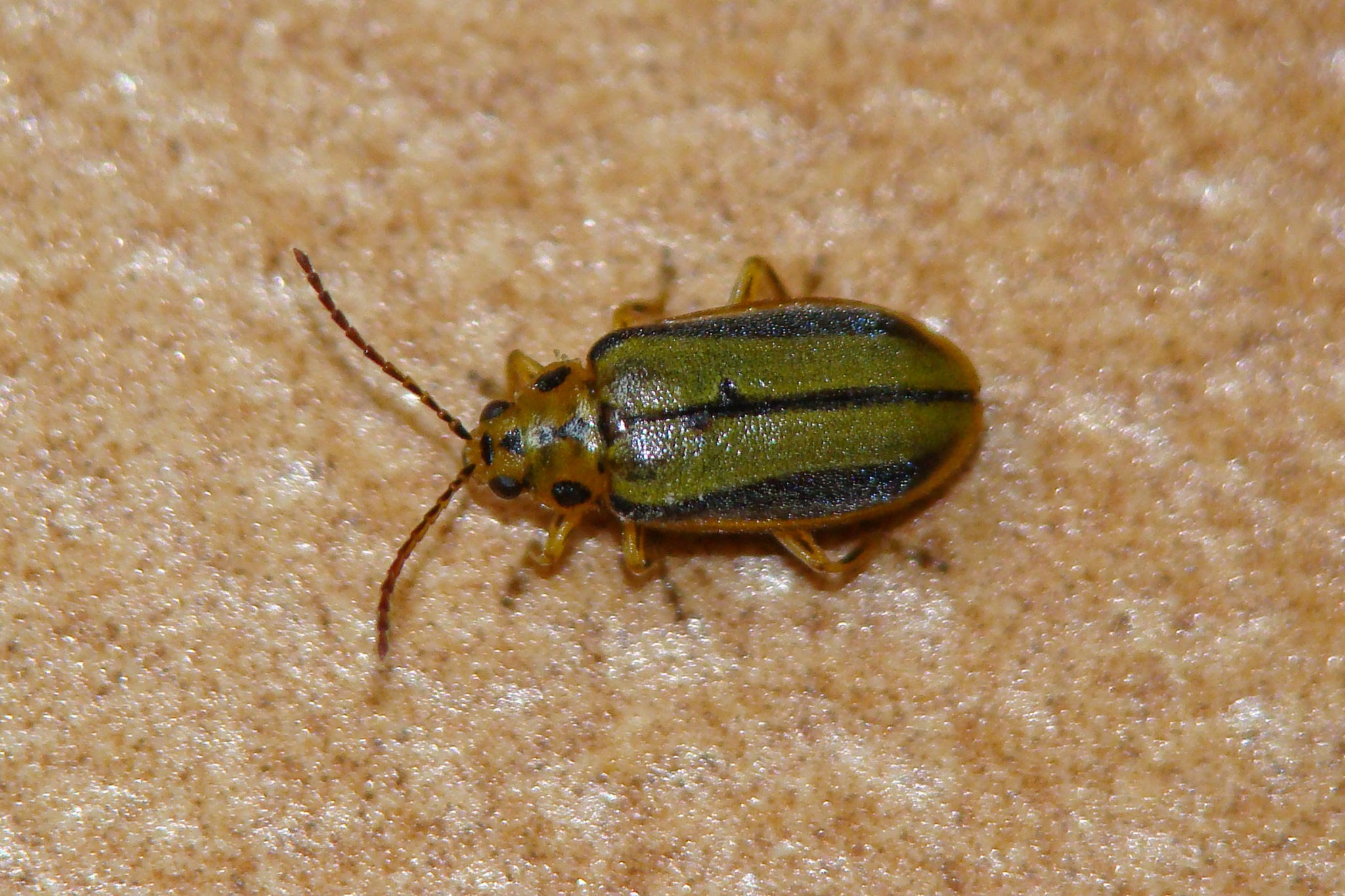
Adult Elm Leaf Beetles are small but easily recognizable insects.
- Approximately 6 to 8 millimeters long.
- Yellowish-green to olive-green coloration.
- Elongated oval body.
- Two distinct dark stripes running along the wing covers.
- Dark head and antennae.
Their coloration allows them to blend in with elm foliage, making infestations difficult to detect during early stages.
Eggs
- Bright yellow coloration.
- Spindle or cigar-shaped appearance.
- Laid in clusters on leaf undersides.
- Typically arranged in double rows.
Females may lay hundreds of eggs during their lifetime.
Larvae
- Up to 12 millimeters long.
- Yellow, orange, or dull green coloration.
- Two dark stripes running along the body.
- Black head capsule.
- Slug-like appearance.
Larvae are responsible for the majority of feeding damage observed during infestations.
Distribution and Habitat
Ulmus Leaf Beetles are found throughout much of North America, Europe, Asia, and other regions where elm trees are present.
Common habitats include:
- Urban landscapes.
- Residential neighborhoods.
- Street tree plantings.
- Parks.
- Campuses.
- Natural forests.
- Riparian woodlands.
- Commercial properties.
The beetles are closely associated with elm species and are rarely found far from suitable host trees.
Life Cycle
Elm Leaf Beetles undergo complete metamorphosis consisting of four stages:
- Egg.
- Larva.
- Pupa.
- Adult.
Adult beetles emerge in spring and begin feeding on newly expanded elm leaves.
Females deposit egg clusters on the undersides of leaves.
After hatching, larvae feed intensively for several weeks before descending the tree trunk to pupate.
Pupation typically occurs:
- In bark crevices.
- Under loose debris.
- In soil around the tree base.
Adults emerge shortly afterward and begin feeding again.
Depending on climate, multiple generations may occur annually, resulting in escalating damage throughout the growing season.
Feeding Behavior
Both larvae and adults feed on elm leaves, but they do so differently.
Larval Feeding
Larvae feed on the underside of leaves and consume the soft green tissue between leaf veins.
This feeding pattern creates the characteristic skeletonized appearance.
Leaves eventually turn brown and become brittle.
Adult Feeding
Adults chew irregular holes completely through the leaves.
The combination of adult and larval feeding can rapidly destroy large portions of the canopy.
Signs of Infestation
Several symptoms indicate the presence of Ulmus Leaf Beetles.
Skeletonized Leaves
One of the most recognizable symptoms is leaf skeletonization.
Only veins remain while the surrounding tissue is consumed.
Leaf Browning
Damaged leaves often appear:
- Brown.
- Scorched.
- Crispy.
- Parchment-like.
Premature Defoliation
Heavily damaged leaves may drop early, resulting in significant canopy thinning.
Visible Larvae and Adults
Large infestations often result in hundreds or thousands of beetles and larvae being visible on foliage.
Impact on Elm Trees
The primary effect of Elm Leaf Beetles is the destruction of photosynthetic tissue.
Repeated infestations can have serious consequences.
Reduced Photosynthesis
Defoliation limits the tree’s ability to produce energy.
Growth Reduction
Affected trees may exhibit:
- Smaller leaves.
- Reduced annual growth.
- Thinner canopies.
- Lower vigor.
Stress and Decline
Trees forced to repeatedly replace lost foliage become increasingly stressed.
This may increase susceptibility to:
- Drought.
- Dutch Elm Disease.
- Bark beetles.
- Secondary pests.
Urban Nuisance Problems
Adult beetles frequently seek overwintering sites inside structures.
Common locations include:
- Attics.
- Wall voids.
- Garages.
- Sheds.
- Storage buildings.
Large numbers of beetles entering buildings can become a significant nuisance.
Natural Enemies
Numerous beneficial organisms help suppress Elm Leaf Beetle populations.
- Predatory stink bugs.
- Parasitic wasps.
- Lady beetles.
- Ground beetles.
- Birds.
- Predatory spiders.
Conserving these natural enemies is an important component of long-term management.
Management and Control
Integrated Pest Management (IPM) offers the most effective approach for controlling Ulmus Leaf Beetles.
Monitoring
Inspect elm trees regularly for:
- Egg masses.
- Larvae.
- Adult beetles.
- Early feeding damage.
Manual Removal
Small infestations can sometimes be reduced by removing egg clusters before hatching.
Water Sprays
Strong streams of water can dislodge larvae from foliage.
Many displaced larvae fail to return to the canopy and become prey for natural enemies.
Trunk Barriers
Sticky bands or insecticide-treated trunk bands can intercept larvae as they crawl downward to pupate.
This method is particularly effective because the larvae must travel along the trunk to complete development.
Biological Control
Protecting natural predator populations helps suppress outbreaks.
Avoiding unnecessary broad-spectrum insecticide applications improves biological control success.
Systemic Insecticides
For valuable shade trees, systemic treatments may be applied through:
- Soil drenches.
- Soil injections.
- Trunk injections.
These treatments provide long-lasting protection by targeting both adults and larvae as they feed.
Organic Options
Products containing Spinosad can provide effective control while minimizing impacts on beneficial insects when used properly.
Research and Future Management
Researchers continue studying improved methods for managing Elm Leaf Beetles while reducing environmental impacts.
Current research areas include:
- Biological control programs.
- Host plant resistance.
- Improved monitoring systems.
- Reduced-risk insecticides.
- Urban forestry management.
- Integrated pest management strategies.
These efforts aim to provide sustainable solutions for protecting elm populations in urban and natural settings.
Conclusion
Ulmus Leaf Beetles are among the most important defoliating pests of elm trees. Through the combined feeding activities of adults and larvae, these insects can significantly reduce photosynthesis, weaken trees, and contribute to long-term decline.
Early detection, biological control, trunk barriers, and properly timed treatments remain the most effective methods for managing infestations. Maintaining healthy elm trees and encouraging natural predators can greatly reduce the impact of these persistent and destructive leaf-feeding pests.