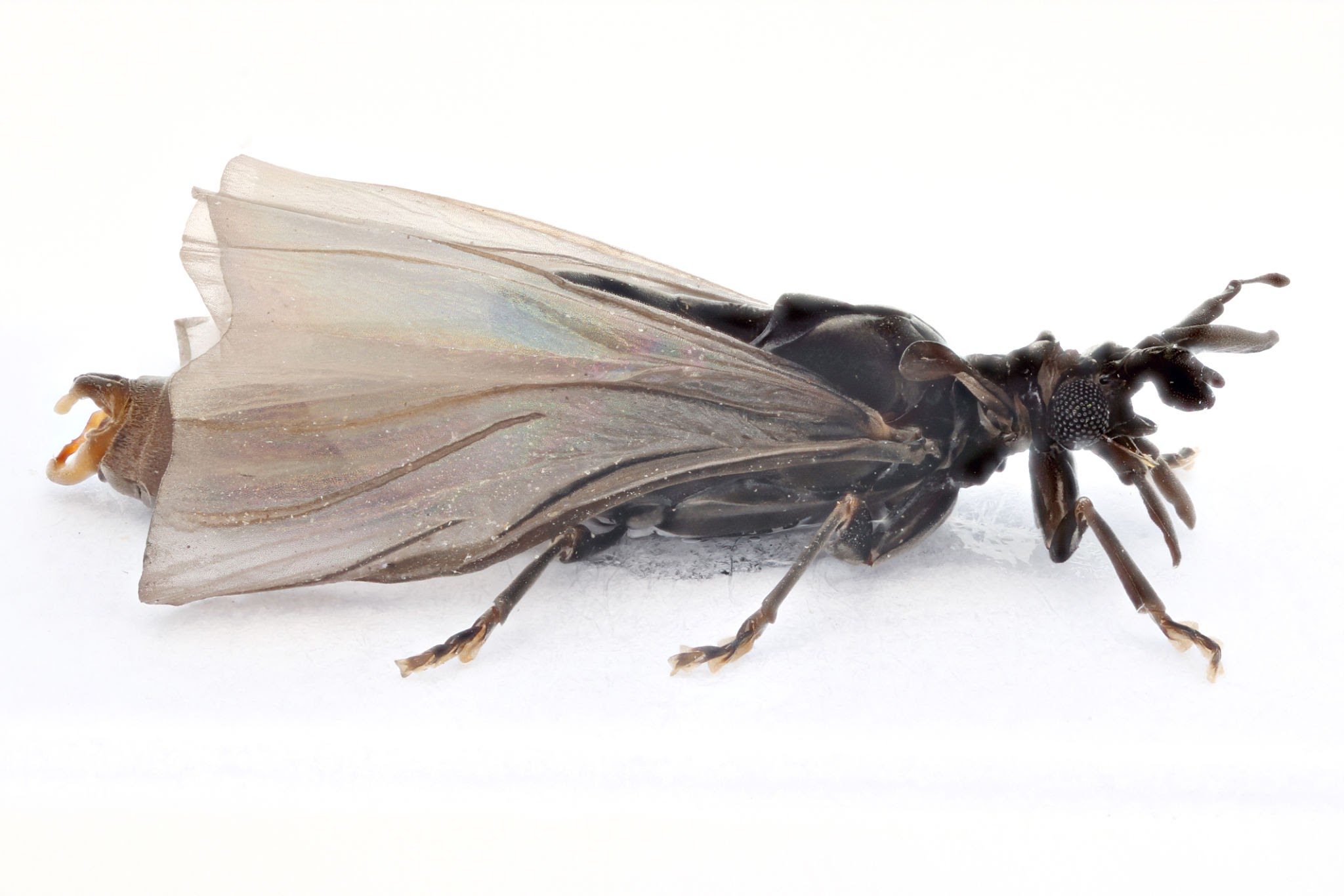
Twisted-wing Parasites are among the most unusual insects on Earth. Belonging to the order Strepsiptera, these highly specialized parasites spend most of their lives developing inside the bodies of other insects. Unlike common pests that damage crops or infest homes, Twisted-wing Parasites are primarily known for their remarkable biological relationship with their hosts. They parasitize a wide range of insects, including bees, wasps, leafhoppers, planthoppers, grasshoppers, and ants. In many cases, the parasite sterilizes its host, redirecting the host’s energy toward supporting the parasite’s development. This phenomenon, known as parasitic castration, makes Strepsiptera one of the most fascinating groups of insects studied by entomologists.
Taxonomy and Classification
Twisted-wing Parasites belong to the order Strepsiptera, a small but globally distributed group of insects. The order contains several hundred described species, although many more likely remain undiscovered.
For decades, scientists debated where Strepsiptera fit within insect evolution. Their unusual anatomy and life cycle made classification difficult. Modern genetic research suggests they are closely related to beetles, although their exact evolutionary relationships continue to be studied.
Twisted-wing Parasites undergo a unique form of complete metamorphosis known as hypermetamorphosis, in which different larval stages possess dramatically different appearances and behaviors.
The life stages include:
- Egg
- Mobile first-stage larva (triungulin)
- Internal parasitic larval stages
- Pupa
- Adult
Only the first-stage larva and adult male are free-living. The remainder of the life cycle occurs inside the host insect.
Identification
Twisted-wing Parasites display extreme sexual dimorphism, meaning males and females look entirely different from one another.
Adult Male
- Size: Approximately 1–4 millimeters long.
- Appearance: Slender-bodied with large, bulging eyes.
- Wings: Possess distinctive fan-shaped hind wings that appear twisted when extended.
- Forewings: Reduced to tiny club-like balancing organs called halteres.
- Lifespan: Usually survives only a few hours to several days.
- Function: Exists primarily to locate females and mate.
Adult Female
- Wingless: Lacks functional wings.
- Legless: In many species, legs are absent or highly reduced.
- Internal Parasite: Remains embedded within the host’s body.
- Visible Portion: Only the head and thorax protrude slightly from the host’s abdomen.
Stylopized Hosts
An insect parasitized by Strepsiptera is said to be stylopized. The most obvious sign is a small hardened protrusion emerging from the host’s abdomen or between abdominal segments.
Distribution and Habitat
Twisted-wing Parasites occur on every continent except Antarctica. Their distribution depends entirely on the availability of suitable host species.
They can be found in:
- Agricultural fields
- Grasslands
- Forests
- Wetlands
- Urban landscapes
- Gardens
- Meadows
Because most of their lives are spent inside host insects, their true habitat is often considered the body cavity of their host.
Life Cycle
The life cycle of Twisted-wing Parasites is one of the most unusual in the insect world.
- Birth of Triungulins: Females release thousands of tiny active larvae called triungulins.
- Host Location: Triungulins seek suitable hosts or attach themselves to flowers where visiting insects unknowingly transport them.
- Host Entry: The larva penetrates the host’s body and begins feeding internally.
- Parasitic Development: Several larval stages occur entirely inside the host.
- Pupation: Male parasites eventually pupate within the host.
- Adult Emergence: Males emerge from the host and seek females for mating.
- Mating: Females remain embedded within the host throughout their lives.
This highly specialized life cycle maximizes survival while minimizing exposure to predators and environmental hazards.
Behavior and Ecological Role
Twisted-wing Parasites are best known for their ability to manipulate host biology.
- Parasitic Castration: Many hosts become sterile after infestation.
- Behavioral Modification: Some hosts exhibit altered behavior that benefits the parasite.
- Extended Lifespan: Certain hosts may survive longer than normal while carrying parasites.
- Resource Diversion: Energy normally used for reproduction is redirected toward parasite development.
These adaptations ensure the parasite receives a steady supply of nutrients while reducing competition from host offspring.
Host Species
Twisted-wing Parasites attack a diverse range of insects.
Common hosts include:
- Leafhoppers
- Planthoppers
- Bees
- Paper Wasps
- Mud Daubers
- Grasshoppers
- Crickets
- Ants
Many Strepsiptera species are highly host-specific and can only develop within a limited number of insect species.
Agricultural Importance
Twisted-wing Parasites are generally considered beneficial rather than harmful.
When they parasitize agricultural pests such as leafhoppers and planthoppers, they can help suppress populations that would otherwise damage crops.
Potential benefits include:
- Reduced reproduction among pest populations.
- Lower pest densities.
- Natural biological control.
- Reduced need for chemical insecticides.
Because of these benefits, researchers have explored their potential role in integrated pest management programs.
Conflict Status
Twisted-wing Parasites are not considered pests.
They:
- Do not bite humans.
- Do not damage structures.
- Do not infest stored products.
- Do not harm pets.
- Rarely cause economic losses.
Their impact is almost entirely limited to the insects they parasitize.
Conservation and Management
Management of Twisted-wing Parasites generally focuses on conservation rather than control.
Recommended practices include:
- Avoiding unnecessary insecticide applications.
- Maintaining insect biodiversity.
- Protecting habitats that support beneficial insects.
- Encouraging natural biological control systems.
Since the parasites are protected within their hosts, direct control is rarely necessary or practical.
Scientific Research
Twisted-wing Parasites continue to fascinate researchers because of their unique anatomy, reproductive biology, and evolutionary history.
Current research focuses on:
- Evolutionary relationships with beetles and flies.
- Mechanisms of host manipulation.
- Parasitic castration.
- Behavioral modification of hosts.
- Potential biological control applications.
- Genetic adaptations to parasitism.
Their extraordinary life cycle has made Strepsiptera one of the most intensively studied examples of insect parasitism and evolutionary specialization.