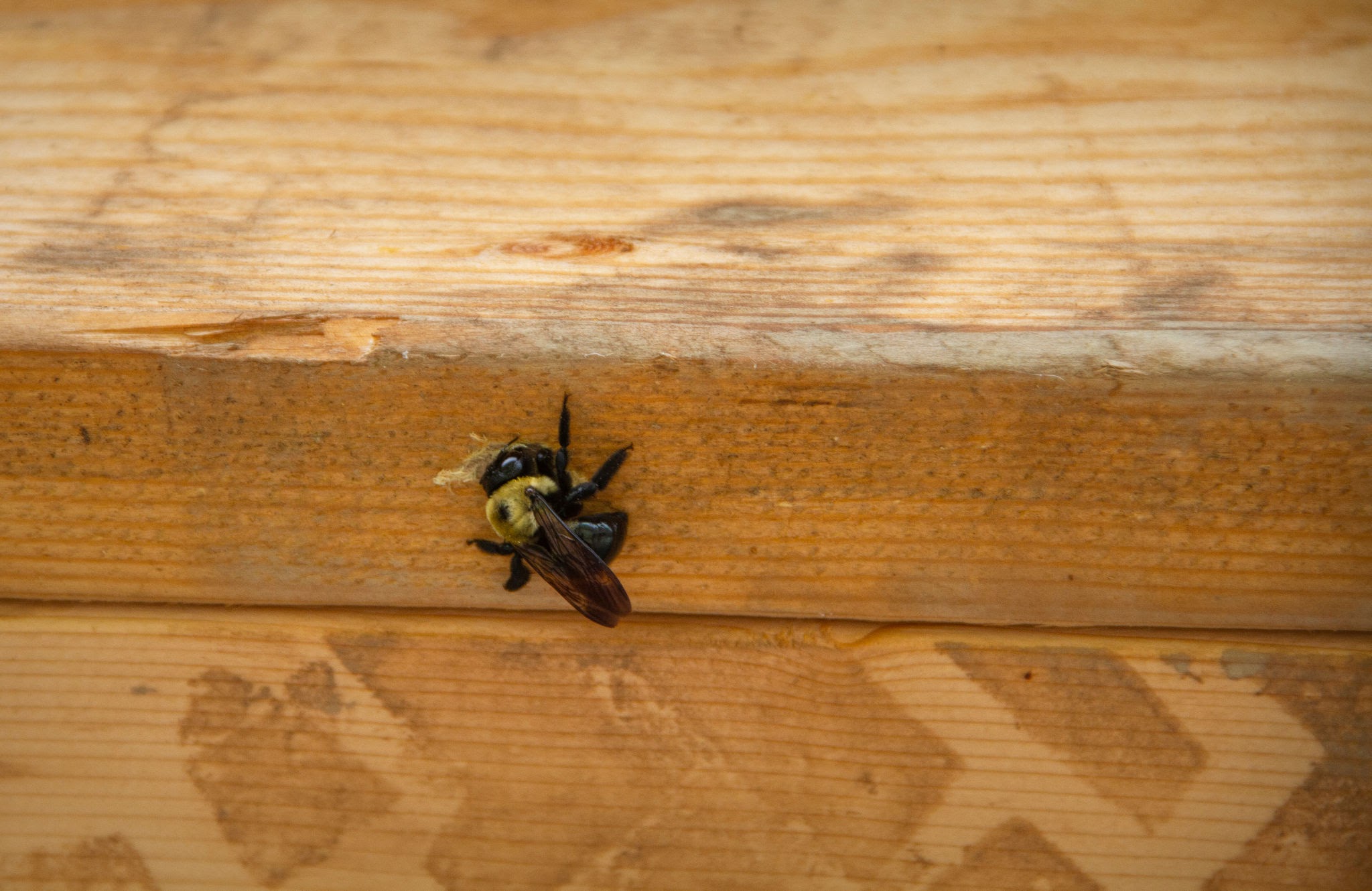
Tunnel Carpenter Bees is a common name often applied to Ceratina species, commonly known as Small Carpenter Bees. These tiny native bees are beneficial pollinators that nest within the soft pith of dead or dying plant stems. Unlike the larger carpenter bees that bore into structural wood, Small Carpenter Bees utilize hollow or pithy stems from plants such as raspberry, blackberry, rose, sumac, elderberry, and various ornamental perennials. Their nesting activity occasionally causes minor dieback or flagging of stem tips, but the damage is generally insignificant. In most situations, Tunnel Carpenter Bees are considered valuable pollinators rather than pests and contribute positively to garden biodiversity.
Taxonomy and Classification
Tunnel Carpenter Bees belong to the order Hymenoptera, which includes bees, wasps, and ants. They are members of the family Apidae, the same family that contains honey bees, bumble bees, and large carpenter bees.
The genus Ceratina contains hundreds of species distributed throughout much of the world. These bees are classified as solitary bees, meaning each female constructs and provisions her own nest without the assistance of workers.
Like other bees, Small Carpenter Bees undergo complete metamorphosis:
- Egg
- Larva
- Pupa
- Adult
Despite their small size, these insects play an important ecological role as pollinators of both native and cultivated plants.
Identification
Small Carpenter Bees are among the smallest native bees commonly encountered in gardens and natural landscapes.
- Size: Typically 1/8 to 1/4 inch long.
- Coloration: Often metallic blue-green, metallic black, dark bronze, or glossy black.
- Body Shape: Slender and cylindrical with relatively little body hair compared to bumble bees.
- Wings: Transparent wings folded neatly over the back when at rest.
- Antennae: Moderately long and often dark colored.
- Stinger: Females possess a stinger but rarely sting unless directly handled.
Their metallic appearance often makes them easy to distinguish from other small bee species.
Distribution and Habitat
Tunnel Carpenter Bees are widely distributed throughout North America, Europe, Asia, Africa, and many other regions of the world. Numerous species have adapted to a wide variety of habitats.
Common habitats include:
- Residential gardens
- Prairies
- Woodland edges
- Roadside vegetation
- Orchards
- Natural meadows
- Parks
- Pollinator gardens
Unlike large carpenter bees that excavate tunnels in solid wood, Small Carpenter Bees prefer soft-stemmed plants with a pith-filled center.
Favorite nesting plants often include:
- Raspberry
- Blackberry
- Rose
- Sumac
- Elderberry
- Joe-Pye Weed
- Sunflower
- Goldenrod
- Various ornamental perennials
Life Cycle
The life cycle of Tunnel Carpenter Bees is closely tied to the availability of suitable nesting stems.
- Nest Construction: The female selects a stem with a soft pith center and excavates a tunnel.
- Cell Formation: Individual brood cells are created within the tunnel using partitions made from pith material.
- Egg Laying: One egg is deposited in each cell.
- Food Provisioning: The female supplies each cell with pollen and nectar for the developing larva.
- Larval Development: Larvae consume the stored food and grow within the protected chamber.
- Pupation: Mature larvae transform into pupae inside the stem.
- Adult Emergence: New adults emerge the following season or later in the same year depending on species and climate.
Many species complete a single generation annually, although this varies geographically.
Nesting Behavior
Small Carpenter Bees derive their common name from their ability to excavate tunnels in plant stems.
Unlike social bees, each female independently performs all nesting activities.
Key nesting behaviors include:
- Excavating soft pith rather than hard wood.
- Creating a linear series of brood chambers.
- Protecting developing offspring within the stem.
- Guarding nests from predators and parasites.
- Sometimes overwintering inside old nesting tunnels.
This nesting strategy provides excellent protection from weather and predators while minimizing energy expenditure.
Damage and Conflict
The conflict associated with Tunnel Carpenter Bees is extremely minor and usually outweighed by their ecological benefits.
Potential signs of activity include:
- Circular Entry Hole: A small, neat opening in a stem or cane.
- Pith Excavation: Removal of the soft center of stems.
- Stem Flagging: Occasional wilting or dieback of the upper portion of a stem.
- Aesthetic Impact: Minor cosmetic damage to ornamental plants.
Importantly, these bees do not:
- Damage homes or buildings.
- Excavate structural lumber.
- Attack healthy trees.
- Cause significant economic losses.
Their activity is typically limited to dead, dying, broken, or pruned stems.
Pollination Benefits
Tunnel Carpenter Bees are valuable pollinators and contribute significantly to ecosystem health.
They visit a wide variety of flowering plants, including:
- Wildflowers
- Fruit crops
- Vegetable flowers
- Native shrubs
- Garden ornamentals
Because they forage across many plant species, they help support plant reproduction and biodiversity in both natural and managed landscapes.
Management and Prevention
Management of Tunnel Carpenter Bees focuses on tolerance and conservation rather than control.
Recommended Approach
- Allow Nesting Activity: Minor stem damage rarely justifies intervention.
- Protect Pollinators: Avoid unnecessary insecticide applications.
- Preserve Habitat: Leave some pithy stems standing over winter.
- Create Nesting Sites: Pollinator gardens can intentionally include suitable nesting plants.
If Damage Is Undesirable
- Prune affected stem tips.
- Remove damaged canes after adults have emerged.
- Replace severely damaged stems if necessary.
Control measures are almost never required because infestations are localized and cause minimal harm.
Conservation and Research
Small Carpenter Bees are increasingly important in pollinator conservation efforts. Researchers study their nesting behavior, habitat requirements, and contribution to pollination services.
Current research focuses on:
- Native pollinator conservation.
- Pollination of agricultural crops.
- Habitat restoration.
- Effects of pesticide exposure.
- Climate change impacts on pollinator populations.
Providing nesting habitat for Tunnel Carpenter Bees can help support local pollinator diversity and strengthen ecosystem resilience.