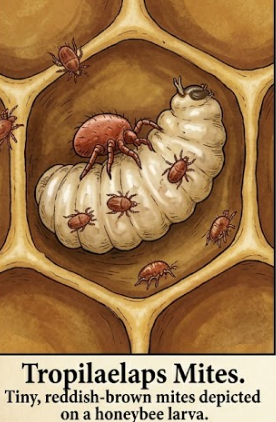
Tropilaelaps Mites are highly destructive external parasites of honey bees and are considered one of the most serious threats to beekeeping in Asia. Belonging to the genus Tropilaelaps, these mites attack developing honey bee brood and adult bees, feeding on their tissues and weakening entire colonies. Species such as Tropilaelaps clareae, Tropilaelaps mercedesae, and related mites have caused significant losses in regions where they occur naturally. While often compared to the notorious Varroa mite, Tropilaelaps mites reproduce more rapidly and can overwhelm colonies in a shorter period of time. Heavy infestations result in malformed bees, reduced worker populations, poor colony performance, and eventual colony collapse. Because they pose a major threat to the European Honey Bee (Apis mellifera), they are classified as high-priority quarantine pests in many countries worldwide.
Taxonomy and Classification
Tropilaelaps Mites belong to the class Arachnida and the subclass Acari, making them close relatives of ticks and other mites. They are not insects and possess eight legs as adults.
Several species have been identified within the genus Tropilaelaps, including:
- Tropilaelaps clareae
- Tropilaelaps mercedesae
- Tropilaelaps koenigerum
- Tropilaelaps thaii
These mites originally evolved alongside Asian honey bee species, particularly Apis dorsata (the Giant Honey Bee), but some species have successfully adapted to infest managed colonies of Apis mellifera.
Unlike many parasites, Tropilaelaps mites reproduce almost exclusively inside sealed honey bee brood cells, where developing larvae and pupae provide food and protection.
Identification
Tropilaelaps mites are extremely small but can be observed with magnification or careful inspection.
- Size: Less than 1 millimeter long.
- Color: Reddish-brown to dark brown.
- Shape: Elongated and oval.
- Body Form: More slender and longer than Varroa mites.
- Mobility: Extremely fast-moving compared to Varroa mites.
- Visibility: May occasionally be observed on adult bees or within brood cells.
Their elongated shape is one of the easiest ways to distinguish them from the broader, flatter Varroa mite.
Distribution and Habitat
Tropilaelaps mites are native to South and Southeast Asia and are commonly associated with tropical and subtropical environments.
Regions where they have been reported include:
- India
- Thailand
- Vietnam
- Myanmar
- Malaysia
- Indonesia
- Philippines
- China
- Pakistan
- Nepal
Their habitat consists entirely of honey bee colonies, particularly:
- Brood cells
- Bee larvae
- Bee pupae
- Adult worker bees
- Drone brood
- Hive combs
Unlike Varroa mites, Tropilaelaps mites cannot survive long periods without access to developing brood.
Life Cycle
The life cycle of Tropilaelaps mites is closely synchronized with honey bee brood development.
- Brood Cell Invasion: Female mites enter brood cells shortly before they are capped.
- Egg Laying: Eggs are deposited within the sealed cell.
- Development: Immature mites develop while feeding on the developing bee.
- Emergence: Adult mites leave the cell with the emerging bee.
- Dispersal: Mites quickly locate new brood cells to continue reproduction.
Because reproduction occurs rapidly, populations can increase dramatically within a single season.
Behavior and Conflict
Tropilaelaps mites are considered among the most damaging parasites of honey bees due to their rapid reproductive rate and heavy impact on brood.
- Brood Dependency: Reproduction occurs only within brood cells.
- Fast Reproduction: Population growth often exceeds that of Varroa mites.
- High Mobility: Mites move rapidly throughout the hive.
- Drone Brood Preference: Many infestations begin in drone brood cells.
- Continuous Damage: Colonies with year-round brood production are especially vulnerable.
Because they spend little time attached to adult bees, they constantly seek new brood cells where reproduction can continue.
Damage to Honey Bees
Tropilaelaps mites feed on developing brood and adult bees, damaging tissues that are essential for normal growth and survival.
Common symptoms include:
- Deformed Wings: Newly emerged bees may have shriveled or twisted wings.
- Malformed Legs: Developmental abnormalities are common.
- Reduced Body Size: Bees may emerge smaller than normal.
- Shortened Lifespan: Infested workers often die prematurely.
- Weak Colonies: Population growth declines rapidly.
- Poor Honey Production: Reduced worker numbers affect nectar collection.
- Brood Mortality: Developing bees may die before emergence.
Severe infestations can destroy entire colonies within a relatively short period.
Signs of Infestation
Beekeepers monitor colonies for several warning signs associated with Tropilaelaps mites.
- Pinhole Openings: Small holes in capped brood cells.
- Irregular Brood Pattern: Spotty or uneven brood development.
- Deformed Adult Bees: Crippled or abnormal workers emerging from cells.
- Visible Mites: Fast-moving reddish mites within brood combs.
- Population Decline: Rapid loss of worker bees.
- Colony Collapse: Failure of the colony to survive.
Economic Importance
Tropilaelaps mites are among the most feared pests in commercial beekeeping because honey bees provide essential pollination services for agriculture.
Potential impacts include:
- Reduced honey production.
- Loss of pollination services.
- Increased colony replacement costs.
- Trade restrictions on bees and equipment.
- Threats to food production systems.
For these reasons, many countries maintain strict surveillance and quarantine programs.
Management and Prevention
Managing Tropilaelaps mites requires an integrated approach focused on detection, treatment, and prevention.
Quarantine Measures
- Import Inspections: Examine imported bees and equipment.
- Movement Restrictions: Limit transportation from infested regions.
- Rapid Reporting: Investigate suspected infestations immediately.
Cultural Controls
- Brood Interruption: Temporarily stopping brood production disrupts mite reproduction.
- Queen Caging: Restricts egg laying and creates a brood break.
- Brood Removal: Eliminates infested developing bees.
Chemical Controls
- Formic Acid: Effective against mites within colonies.
- Thymol: Used in approved mite management programs.
- Other Miticides: Applied according to local regulations and recommendations.
Treatments are most effective when mites are exposed outside sealed brood cells.
Research and Future Control Strategies
Tropilaelaps mites remain a major focus of international apicultural research. Scientists are working to improve early detection systems, develop safer miticides, and identify genetic traits associated with mite resistance.
Current research areas include:
- DNA-based diagnostic testing.
- Honey bee hygienic behavior.
- Mite-resistant bee breeding programs.
- Biological control options.
- Improved quarantine surveillance.
- Sustainable integrated pest management techniques.
Preventing the spread of Tropilaelaps mites remains one of the highest priorities in global beekeeping and pollinator protection efforts.