Overview
Trogoderma Beetles (Trogoderma spp.) are a group of highly destructive stored-product pests belonging to the family Dermestidae. Although small in size, these beetles are responsible for significant economic losses worldwide through the contamination and destruction of stored grains, seeds, dried foods, animal products, textiles, and museum collections. Several species within the genus are considered among the most serious storage pests known, with the infamous Khapra Beetle (Trogoderma granarium) ranking as one of the world’s most feared quarantine pests.
The primary damage is caused by the larval stage, which feeds on a wide range of organic materials. Larvae contaminate products with shed skins, hairs, frass, and dead insects, rendering food and stored materials unsuitable for consumption or sale. Their ability to survive extreme conditions, hide in tiny cracks, and enter prolonged dormancy makes infestations difficult and costly to eliminate.
Trogoderma beetles are found in warehouses, grain elevators, food processing facilities, feed mills, museums, homes, and agricultural storage sites. Because many species can remain hidden for extended periods before being detected, they represent a major challenge for stored-product pest management programs worldwide.
Quick Facts
- Common Name: Trogoderma Beetles
- Scientific Name: Trogoderma spp.
- Order: Coleoptera
- Family: Dermestidae
- Diet: Stored grains, seeds, dried foods, animal products
- Primary Damage: Product contamination and destruction
- Distribution: Worldwide
- Status: Major stored-product and quarantine pest
Taxonomy and Classification
Trogoderma beetles belong to the dermestid beetle family, a group known for feeding on dried organic materials. While many dermestids naturally recycle animal remains in the environment, several Trogoderma species have adapted to human food storage systems.
- Kingdom: Animalia
- Phylum: Arthropoda
- Class: Insecta
- Order: Coleoptera
- Family: Dermestidae
- Genus: Trogoderma
Important pest species include:
- Trogoderma granarium (Khapra Beetle)
- Trogoderma variabile (Warehouse Beetle)
- Trogoderma inclusum (Larger Cabinet Beetle)
- Trogoderma glabrum
- Trogoderma sternale
Identification
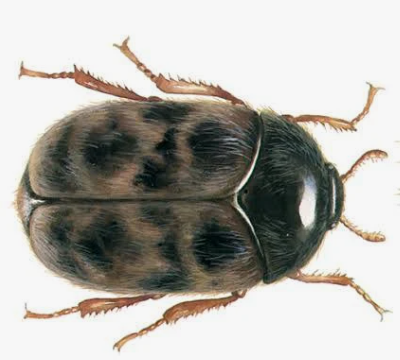
Adult Trogoderma beetles are tiny insects, typically measuring between 1/16 and 1/8 inch long. Their small size often allows infestations to go unnoticed until damage becomes extensive.
Adult Beetles
- Oval-shaped body
- Dark brown, reddish-brown, or black coloration
- Fine scales or hairs covering the body
- Short clubbed antennae
- Poor flying ability in many species
- Often feign death when disturbed
Larvae
The larval stage is the most destructive and easiest to identify.
- Yellowish-brown to reddish-brown coloration
- Dense covering of hairs and bristles
- Distinct tuft of longer hairs near the tail end
- Up to 1/4 inch long when mature
- Active crawlers that seek sheltered pupation sites
The larvae are often mistaken for carpet beetle larvae because of their similar appearance.
Distribution and Habitat
Trogoderma beetles occur throughout much of the world and thrive wherever dry organic materials are stored.
Common habitats include:
- Grain elevators
- Warehouses
- Food processing plants
- Feed mills
- Pantries
- Storage sheds
- Museums
- Animal feed storage facilities
They prefer dark, undisturbed environments where food remains available for long periods.
Larvae frequently hide in:
- Cracks and crevices
- Wall voids
- Equipment seams
- Storage containers
- Packaging materials
Life Cycle
Trogoderma beetles undergo complete metamorphosis consisting of four stages:
- Egg
- Larva
- Pupa
- Adult
Egg Stage
Females deposit eggs directly on or near suitable food sources. Depending on temperature, eggs hatch within several days.
Larval Stage
The larval stage is responsible for virtually all feeding damage. Larvae may remain active for months while consuming stored products.
Under unfavorable conditions, larvae can enter a dormant state known as diapause, allowing survival for extended periods without food.
Pupal Stage
Mature larvae seek protected areas to pupate, often inside cracks, packaging materials, or hidden structural voids.
Adult Stage
Adults emerge, mate, and begin laying eggs. Depending on environmental conditions, multiple generations may occur annually.
Behavior and Feeding
Trogoderma beetles are highly adaptable scavengers capable of utilizing a wide variety of food sources.
Common foods include:
- Stored grains
- Rice
- Wheat
- Corn
- Seeds
- Flour
- Animal feed
- Dried milk products
- Dried fruits
- Nuts
- Spices
- Wool
- Leather
- Museum specimens
Unlike many stored-product pests, Trogoderma larvae can survive extremely long periods without food, making eradication particularly difficult.
Damage and Economic Impact
The economic impact of Trogoderma infestations can be substantial.
Damage includes:
- Consumption of stored products
- Weight loss in grain inventories
- Contamination by larval hairs
- Contamination by cast skins
- Accumulation of frass
- Reduced product quality
- Regulatory penalties
- Export restrictions
Infested products often become unsuitable for sale or human consumption.
In severe infestations, entire storage facilities may require shutdown, fumigation, and sanitation procedures.
The Khapra Beetle Threat
The most notorious member of the genus is the Khapra Beetle (Trogoderma granarium).
This species is considered one of the world’s most dangerous stored-product pests because it:
- Survives years without food
- Resists many insecticides
- Rapidly contaminates products
- Causes severe trade restrictions
- Requires costly eradication efforts
Many countries maintain strict inspection and quarantine programs specifically to prevent Khapra Beetle introductions.
Signs of Infestation
Common indicators include:
- Small beetles near stored products
- Hairy larvae in grain or food
- Shed larval skins
- Fine powdery debris
- Larval hairs mixed with products
- Damaged packaging
- Reduced product quality
Because infestations often begin deep within storage materials, early detection can be difficult.
Management and Prevention
Successful control requires a comprehensive Integrated Pest Management (IPM) program.
Sanitation
- Remove all spilled food products.
- Vacuum cracks and crevices.
- Discard heavily infested materials.
- Clean equipment regularly.
Inspection
- Inspect incoming shipments.
- Monitor storage areas frequently.
- Use pheromone traps for detection.
Physical Control
- Heat treatments above 130°F
- Commercial freezing treatments
- Controlled atmosphere storage
- Proper humidity management
Chemical Control
Severe infestations may require professional fumigation using approved products such as phosphine gas.
Quarantine species often require government-supervised treatment programs.
Conservation and Research
Trogoderma beetles are considered major stored-product pests rather than organisms of conservation concern. Scientific research focuses on improving early detection methods, understanding diapause mechanisms, enhancing pheromone trap technology, and developing alternatives to traditional fumigants.
Researchers continue investigating environmentally sustainable management strategies that reduce economic losses while minimizing pesticide reliance.
Conclusion
Trogoderma beetles are among the most important stored-product pests worldwide. Their ability to contaminate food, survive harsh conditions, and remain hidden for extended periods makes them a serious threat to food storage facilities, agricultural operations, and commercial trade. Through rigorous sanitation, routine monitoring, physical treatments, and professional pest management, infestations can be detected early and controlled before significant losses occur.