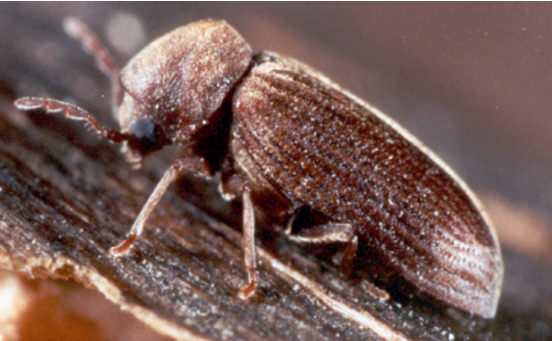
Overview
Timber Beetles is a broad term used to describe several groups of wood-boring beetles that attack standing trees, freshly cut logs, lumber, and wood products. These insects are among the most economically important forest pests in the world because their feeding activities can kill valuable trees, reduce timber quality, introduce destructive fungi, and cause significant losses in forestry and lumber industries.
The term commonly includes Bark Beetles, Ambrosia Beetles, and various species of Wood-Boring Beetles such as Longhorned Beetles and Metallic Wood Borers. While their biology differs, all share a common trait: they utilize wood as a breeding and feeding habitat during part of their life cycle.
Some timber beetles primarily attack weakened or recently dead trees, helping recycle forest resources. Others are capable of killing healthy trees during outbreaks, resulting in large-scale forest mortality. Their impact extends from natural ecosystems to commercial timber operations, urban landscapes, orchards, and residential properties.
Quick Facts
- Common Name: Timber Beetles
- Order: Coleoptera
- Primary Groups: Bark Beetles, Ambrosia Beetles, Wood Borers
- Diet: Wood tissues, fungi, cambium, sapwood
- Damage: Tree death, tunneling, wood staining, lumber loss
- Distribution: Worldwide
- Economic Importance: Major forest and timber pests
Taxonomy and Classification
Timber beetles belong to several different beetle families and subfamilies.
- Kingdom: Animalia
- Phylum: Arthropoda
- Class: Insecta
- Order: Coleoptera
Important groups commonly referred to as timber beetles include:
- Scolytinae – Bark Beetles
- Platypodinae – Ambrosia Beetles
- Cerambycidae – Longhorned Beetles
- Buprestidae – Metallic Wood-Boring Beetles
- Bostrichidae – Powderpost and Branch Borers
All timber beetles undergo complete metamorphosis consisting of egg, larva, pupa, and adult stages.
Identification
Because the term encompasses many species, appearance varies significantly.
Bark Beetles
- Typically 1/16 to 1/4 inch long.
- Cylindrical bodies.
- Dark brown or black coloration.
- Often hidden beneath bark.
Ambrosia Beetles
- Small and cylindrical.
- Usually dark brown to black.
- Create precise entry holes in wood.
- Often associated with fungal growth.
Longhorned Beetles
- May exceed 2 inches in length.
- Possess extremely long antennae.
- Strong wood-boring larvae.
- Often brightly patterned.
Larvae
Most timber beetle larvae are creamy white, legless or weakly legged grubs with brown head capsules. They spend much of their lives hidden inside wood.
Distribution and Habitat
Timber beetles occur throughout the world wherever trees and woody plants are present.
They are commonly found in:
- Forests
- Woodlands
- Sawmills
- Lumber yards
- Urban landscapes
- Parks
- Tree plantations
- Stored logs
Most species spend their lives beneath bark, within sapwood, or deep inside timber where they remain protected from predators and environmental conditions.
Life Cycle
Timber beetles undergo complete metamorphosis.
- Egg
- Larva
- Pupa
- Adult
Adult females deposit eggs beneath bark, within cracks, or directly into wood.
After hatching, larvae tunnel extensively through wood tissues while feeding. Depending on species and environmental conditions, larval development may take several months or even several years.
When mature, larvae construct pupal chambers and transform into adults. Newly emerged adults exit the wood through characteristic round or oval holes and begin searching for new host trees.
Major Types of Timber Beetles
Bark Beetles
Bark beetles attack the cambium layer located between bark and wood. Their galleries disrupt nutrient transport and can effectively girdle trees.
Notable examples include:
- Mountain Pine Beetle
- Southern Pine Beetle
- Spruce Beetle
- Ips Beetles
Mass attacks often kill otherwise healthy trees.
Ambrosia Beetles
Ambrosia beetles do not consume wood directly. Instead, they cultivate specialized fungi within their tunnels.
The beetles introduce fungal spores into wood, and both adults and larvae feed on fungal growth.
This process frequently stains wood and may introduce serious tree diseases.
Wood Borers
Wood-boring beetles, including Longhorned Beetles and Metallic Wood Borers, excavate extensive tunnels deep within timber.
Their feeding can significantly weaken structural wood and reduce lumber value.
Damage and Economic Importance
Tree Mortality
Bark beetles are responsible for the death of millions of trees worldwide.
Large outbreaks can devastate entire forests and alter ecosystems for decades.
Wood Staining
Ambrosia beetles introduce fungi that cause discoloration and staining.
Although structural strength may remain intact, stained lumber often loses substantial market value.
Structural Damage
Wood-boring larvae create galleries that weaken timber products and reduce durability.
Economic Losses
Timber beetles contribute to:
- Reduced lumber quality
- Tree removal costs
- Forest management expenses
- Lost timber revenue
- Increased fire risk from dead trees
Signs of Infestation
Several symptoms may indicate timber beetle activity.
- Sawdust-like frass around trees or lumber.
- Tiny entry or exit holes.
- Pitch tubes on bark.
- Woodpecker activity.
- Fungal staining.
- Dying branches or crowns.
- Loose bark.
- Distinctive gallery patterns beneath bark.
Early detection is critical because much of the damage occurs hidden from view.
Behavior and Ecology
Many timber beetles rely on chemical communication known as pheromones.
When a suitable host tree is located, pioneering beetles release aggregation pheromones that attract additional beetles.
This mass attack strategy allows populations to overwhelm tree defenses.
Some species preferentially attack stressed trees affected by:
- Drought
- Storm damage
- Fire injury
- Disease
- Mechanical wounds
Others are capable of attacking healthy trees during outbreak conditions.
Management and Prevention
Effective management requires a combination of monitoring, sanitation, and tree health maintenance.
Sanitation
- Remove infested trees promptly.
- Destroy heavily infested logs.
- Process harvested timber quickly.
- Eliminate breeding material.
Sanitation remains one of the most effective control measures.
Maintain Tree Health
- Provide adequate irrigation during drought.
- Avoid trunk injuries.
- Reduce overcrowding.
- Promote vigorous growth.
Healthy trees are more resistant to beetle attacks.
Monitoring
Pheromone traps help detect population increases before serious outbreaks occur.
Regular inspections allow forest managers to identify problems early.
Chemical Protection
Preventative bark sprays may protect valuable ornamental trees and stored logs from attack.
These treatments are most effective before beetle flight begins.
Natural Enemies
Many organisms naturally suppress timber beetle populations.
- Woodpeckers
- Predatory beetles
- Parasitic wasps
- Nematodes
- Entomopathogenic fungi
These natural enemies can significantly reduce beetle populations under favorable conditions.
Conservation and Research
Timber beetles remain a major focus of forest health research. Scientists study their pheromone communication systems, fungal relationships, climate-related outbreak patterns, and biological control opportunities.
Current research also explores resistant tree varieties, improved monitoring technologies, and environmentally sustainable management methods that reduce reliance on chemical insecticides.
Conclusion
Timber beetles represent some of the most economically significant forest pests in the world. Whether attacking living trees, stored logs, or processed lumber, these insects can cause extensive damage through tunneling, fungal introduction, and tree mortality. Early detection, proper sanitation, tree health management, and integrated pest management strategies remain essential for minimizing losses and protecting valuable forest resources.