Overview
Tarnished Plant Bugs (Lygus lineolaris) are among the most economically important agricultural pests in North America. These highly adaptable insects attack hundreds of plant species, making them one of the most destructive members of the plant bug family. They are especially problematic in commercial production of strawberries, cotton, alfalfa, soybeans, vegetables, tree fruits, and ornamental plants.
The damage caused by Tarnished Plant Bugs is unique because it results not only from sap removal but also from the injection of toxic saliva into plant tissues. This feeding method causes developing buds, flowers, seeds, and fruit to become distorted, aborted, or scarred. Even relatively low populations can cause significant economic losses when feeding occurs during critical growth stages.
Because of their broad host range, strong flight capabilities, and ability to move rapidly between wild plants and cultivated crops, Tarnished Plant Bugs are difficult to manage. They remain one of the most studied agricultural pests in integrated pest management (IPM) programs throughout the United States and Canada.
Quick Facts
- Common Name: Tarnished Plant Bug
- Scientific Name: Lygus lineolaris
- Order: Hemiptera
- Family: Miridae
- Size: Approximately 1/4 inch long
- Diet: Plant sap, buds, flowers, seeds, and fruit tissue
- Primary Damage: Deformed fruit, bud loss, flower abortion, and stunted growth
- Status: Major agricultural pest
Taxonomy and Classification
Tarnished Plant Bugs belong to the family Miridae, commonly known as plant bugs. This family contains thousands of species worldwide, many of which feed on plants.
- Kingdom: Animalia
- Phylum: Arthropoda
- Class: Insecta
- Order: Hemiptera
- Family: Miridae
- Genus: Lygus
- Species: Lygus lineolaris
Unlike chewing insects, Tarnished Plant Bugs possess specialized piercing-sucking mouthparts that allow them to inject saliva and feed internally on plant tissues.
Identification
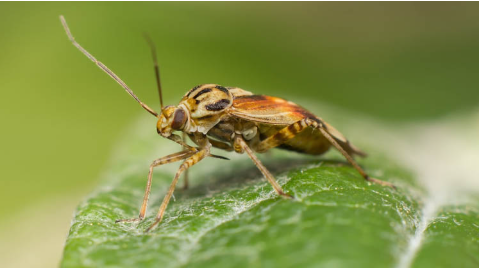
Adult Tarnished Plant Bugs are small, oval-shaped insects measuring approximately 1/4 inch in length.
- Color: Mottled combinations of brown, green, yellow, and tan.
- Key Marking: Distinct yellow or pale triangular area located behind the head on the scutellum.
- Antennae: Long and slender.
- Wings: Fully developed, allowing strong flight.
- Movement: Quick runners that readily fly when disturbed.
Nymphs are bright green and resemble aphids at first glance. However, they move much faster and lack the cornicles found on aphids. Older nymphs develop characteristic black spots on the thorax and wing pads.
Distribution and Habitat
Tarnished Plant Bugs are found throughout North America and occur in virtually every agricultural region.
Preferred habitats include:
- Alfalfa fields
- Pastures
- Roadside vegetation
- Weedy field margins
- Fruit plantings
- Vegetable crops
- Cotton fields
- Ornamental landscapes
Common weed hosts include pigweed, goldenrod, curly dock, ragweed, fleabane, and numerous other broadleaf plants.
Life Cycle
Tarnished Plant Bugs undergo incomplete metamorphosis consisting of egg, nymph, and adult stages.
Egg Stage
Females insert eggs directly into stems, flower buds, petioles, and other soft plant tissues where they remain hidden from predators.
Nymph Stage
Eggs hatch into green nymphs that resemble miniature adults. Nymphs pass through five developmental stages while actively feeding on plant tissues.
Adult Stage
Adults emerge capable of flying long distances between host plants. Several generations may occur each year depending on climate and host availability.
In northern regions, adults typically overwinter in protected vegetation and emerge in spring to begin feeding and reproduction.
Behavior and Feeding
Tarnished Plant Bugs are highly mobile insects that constantly move among host plants.
Using their piercing-sucking mouthparts, they puncture plant tissues and inject digestive enzymes and toxic saliva. These compounds liquefy plant cells, allowing the insect to consume the contents.
Feeding targets include:
- Flower buds
- Developing flowers
- Young fruit
- Seeds
- Tender shoots
- Growing tips
The resulting damage often exceeds what would be expected from such a small insect because the saliva disrupts normal plant development.
Damage and Economic Importance
Tarnished Plant Bugs cause significant losses across multiple agricultural commodities.
Fruit Deformation
One of the most recognizable symptoms is cat-facing, a condition where fruit develops puckered, scarred, or distorted surfaces. Strawberries and peaches are particularly susceptible.
Bud Abortion
Feeding on flower buds frequently causes buds to shrivel and fall before opening.
Flower Damage
Flowers may fail to develop normally, resulting in reduced pollination and lower yields.
Stunted Growth
Damage to terminal growing points can cause abnormal branching and reduced plant vigor.
Seed Loss
In crops such as cotton and soybeans, feeding on reproductive structures can significantly reduce seed production.
Signs of Infestation
- Distorted strawberries or peaches
- Puckered fruit surfaces
- Flower buds dropping prematurely
- Stunted plant growth
- Blackened feeding punctures
- Misshapen leaves and shoots
- Presence of green nymphs on flowers
- Adults quickly flying from plants when disturbed
Management and Control
Effective management relies on an integrated pest management (IPM) approach.
Monitoring
Sweep nets are widely used to monitor Tarnished Plant Bug populations in fields and surrounding vegetation.
Regular scouting helps identify migration events before economic damage occurs.
Weed Management
Reducing preferred weed hosts around crop fields lowers breeding opportunities and migration pressure.
- Remove pigweed and dock species.
- Mow field borders strategically.
- Manage volunteer host plants.
Trap Crops
Highly attractive plants such as alfalfa can be used as trap crops to concentrate populations away from valuable commodities.
Biological Control
Several natural enemies attack Tarnished Plant Bugs, including:
- Parasitic wasps
- Damsel bugs
- Big-eyed bugs
- Minute pirate bugs
- Spiders
Preserving beneficial insects can help suppress populations naturally.
Chemical Control
When economic thresholds are exceeded, targeted insecticide applications may be necessary.
Applications are most effective when timed to vulnerable life stages and sensitive crop growth periods.
Prevention
- Monitor fields regularly.
- Control nearby weeds.
- Maintain healthy crops.
- Use trap crops where appropriate.
- Preserve beneficial insects.
- Apply treatments only when necessary.
Conservation and Research
Tarnished Plant Bugs remain a major focus of agricultural research due to their broad host range and economic impact. Current studies investigate resistant crop varieties, biological control agents, pheromone-based monitoring systems, and improved IPM strategies.
Researchers are also exploring precision agriculture technologies that allow growers to detect infestations earlier and reduce reliance on broad-spectrum insecticides.
Conclusion
Tarnished Plant Bugs are among the most damaging and economically important crop pests in North America. Their toxic feeding behavior, ability to attack hundreds of host plants, and tendency to migrate rapidly between habitats make them difficult to manage. Through regular monitoring, weed management, biological control conservation, and targeted interventions, growers can significantly reduce crop losses caused by this highly adaptable agricultural pest.