Overview
Tapinoma Ants are a group of small ants in the genus Tapinoma, with the most familiar species being the Odorous House Ant (Tapinoma sessile). These ants are among the most common household ant pests in North America and are notorious for invading homes, kitchens, restaurants, and commercial buildings in search of food and moisture. Their ability to establish large colonies, create multiple nesting sites, and rapidly relocate when disturbed makes them particularly challenging to control.
Their common name, Odorous House Ant, comes from the distinctive smell they produce when crushed. Many people describe the odor as resembling rotten coconut, rancid butter, or a pungent chemical scent. While they do not sting and rarely bite, their persistent foraging behavior and ability to contaminate food supplies make them significant nuisance pests.
Tapinoma ants are highly adaptable and can nest both indoors and outdoors. Colonies often contain multiple queens and thousands of workers, allowing populations to expand rapidly. Once established, they frequently form interconnected satellite colonies that can spread throughout an entire property.
Quick Facts
- Common Names: Tapinoma Ants, Odorous House Ants
- Scientific Name: Tapinoma sessile and related species
- Order: Hymenoptera
- Family: Formicidae
- Size: 1/16 to 1/8 inch long
- Color: Dark brown to black
- Diet: Sugars, honeydew, proteins, and household foods
- Primary Conflict: Indoor infestations and food contamination
Taxonomy and Classification
Tapinoma ants belong to the ant family Formicidae and are among the most successful urban ant species in North America.
- Kingdom: Animalia
- Phylum: Arthropoda
- Class: Insecta
- Order: Hymenoptera
- Family: Formicidae
- Genus: Tapinoma
- Species: Tapinoma sessile (Odorous House Ant)
Like all ants, Tapinoma species undergo complete metamorphosis consisting of egg, larva, pupa, and adult stages.
Identification
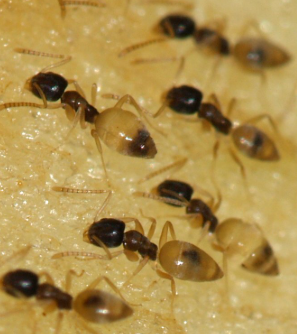
Adult worker Tapinoma ants are extremely small and often mistaken for other dark-colored household ant species.
- Size: Approximately 1/16 to 1/8 inch long.
- Color: Uniform dark brown or black.
- Body Shape: Slender with a hidden petiole node that is difficult to see from above.
- Antennae: Long and segmented.
- Workers: Similar in appearance throughout the colony.
The most reliable identifying feature is the odor produced when workers are crushed. This unpleasant smell immediately distinguishes them from most other household ant species.
Distribution and Habitat
Tapinoma ants are widespread throughout North America and can be found in nearly every state and province. Their adaptability allows them to thrive in both natural and urban environments.
Outdoor nesting sites include:
- Under rocks and stones
- Beneath landscape mulch
- Inside rotting logs
- Under boards and debris
- Within soil around foundations
- Under patios and sidewalks
Indoor colonies may establish themselves in:
- Wall voids
- Attics
- Ceiling spaces
- Behind cabinets
- Around plumbing penetrations
- Crawl spaces
- Insulation
Their preference for moisture often brings them into kitchens, bathrooms, laundry rooms, and utility areas.
Life Cycle
Tapinoma ants undergo complete metamorphosis.
- Egg: Tiny white eggs are laid by queens.
- Larva: Legless larvae are fed by workers.
- Pupa: Developing ants transform into adults.
- Adult: Workers begin foraging and colony maintenance.
Under favorable conditions, colonies can grow rapidly due to the presence of multiple reproductive queens.
Behavior and Foraging
Tapinoma ants are highly organized foragers that establish well-defined trails between food sources and nesting locations.
Workers are especially attracted to:
- Sugary liquids
- Syrups
- Fruit juices
- Honey
- Pet food
- Grease
- Dead insects
During certain times of the year, colonies may shift dietary preferences from sweet foods to protein-rich foods depending on brood development.
Honeydew and Outdoor Food Sources
One of the most important food sources for Tapinoma ants is honeydew produced by sap-feeding insects such as:
- Aphids
- Scale insects
- Whiteflies
- Mealybugs
Workers actively protect these insects from predators and harvest their sugary secretions. Heavy aphid infestations on landscape plants often contribute directly to indoor ant invasions.
Why Tapinoma Ants Are Difficult to Control
Several biological traits make these ants particularly challenging pests.
Multiple Queens
Colonies often contain numerous reproductive queens. Eliminating a portion of the colony rarely solves the problem if queens survive elsewhere.
Satellite Colonies
Large infestations frequently consist of interconnected nests spread throughout a property.
Budding Behavior
When colonies are disturbed by repellents or improper pesticide applications, queens and workers may split off to form entirely new nests.
This process, known as budding, often causes infestations to worsen rather than improve.
Damage and Conflict
Although Tapinoma ants do not damage structures directly, they create significant nuisance issues.
- Food Contamination: Workers invade food storage areas.
- Persistent Trails: Ant lines can appear throughout kitchens and bathrooms.
- Large Populations: Colonies may contain thousands of workers.
- Commercial Concerns: Restaurants and food facilities may experience sanitation problems.
- Recurring Infestations: Colonies often reappear after incomplete treatments.
Management and Prevention
Successful control requires a comprehensive Integrated Pest Management (IPM) approach.
Baiting (Most Effective)
Slow-acting sweet baits are the preferred control method.
- Use sugar-based liquid or gel baits.
- Allow workers to transport bait back to the colony.
- Target queens through food sharing.
- Avoid disturbing active foraging trails.
Exclusion
- Seal cracks around foundations.
- Repair gaps around windows and doors.
- Seal utility penetrations.
- Install weather stripping where necessary.
Moisture Reduction
- Repair plumbing leaks.
- Improve drainage around structures.
- Reduce excessive moisture in crawl spaces.
- Ventilate damp areas.
Landscape Management
- Control aphids and scale insects.
- Remove excess mulch near foundations.
- Trim vegetation touching structures.
- Eliminate debris that provides nesting sites.
Avoid Repellent Sprays
Repellent insecticides often cause colony budding and can significantly worsen infestations. Non-repellent products and professional baiting programs typically produce better long-term results.
Natural Enemies
In natural ecosystems, Tapinoma ants face predation from:
- Spiders
- Ground beetles
- Antlions
- Predatory ants
- Parasitic flies
However, natural enemies rarely provide sufficient control in urban settings.
Conservation and Research
Research on Tapinoma ants focuses on improving bait formulations, understanding colony structure, and developing more effective management techniques for multi-queen infestations.
Scientists are also investigating the chemical compounds responsible for their characteristic odor and studying how colony communication influences foraging and nest expansion.
Conclusion
Tapinoma ants, particularly the Odorous House Ant, are among the most common household ant pests in North America. Their multi-queen colonies, strong attraction to food sources, and tendency to form satellite nests make them difficult to eliminate once established. Successful management depends on proper identification, strategic baiting, exclusion, moisture control, and addressing outdoor food sources that support colony growth.