Overview
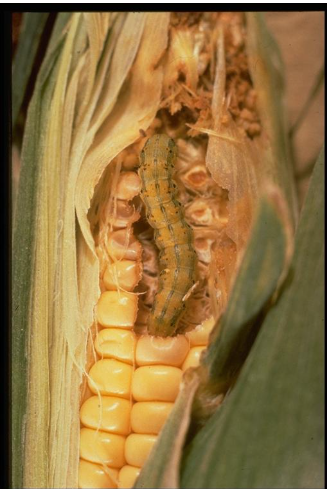
Sweet Corn Earworms are among the most destructive and economically important pests of sweet corn production. The primary species responsible is the Corn Earworm (Helicoverpa zea), a highly adaptable caterpillar that attacks not only corn but also tomatoes, peppers, cotton, beans, and numerous other crops. In sweet corn, however, its damage is especially significant because the larvae feed directly on the marketable portion of the crop—the ears.
Adult moths are strongly attracted to fresh green corn silks where they lay eggs. After hatching, the larvae crawl down the silk channel and begin feeding on developing kernels. Once inside the ear, they are protected from predators, weather, and many insecticide applications. Even a single caterpillar can render an ear unmarketable due to kernel destruction and contamination with frass.
Because the pest attacks the harvestable portion of the plant, growers must focus heavily on prevention, monitoring, and timing. Sweet corn earworms remain one of the most challenging pests for both commercial producers and home gardeners.
Taxonomy and Classification
Sweet Corn Earworms belong to the order Lepidoptera (Moths and Butterflies) and the family Noctuidae.
- Kingdom: Animalia
- Phylum: Arthropoda
- Class: Insecta
- Order: Lepidoptera
- Family: Noctuidae
- Genus: Helicoverpa
- Species: Helicoverpa zea
The Corn Earworm is one of North America’s most economically damaging agricultural pests because of its extremely broad host range and ability to produce multiple generations annually.
Physical Description
The destructive larval stage reaches approximately 1.5 inches (40 mm) long.
- Larva (Key ID): Robust caterpillar with alternating light and dark longitudinal stripes.
- Color Variation: Green, tan, pink, reddish-brown, dark brown, or nearly black.
- Micro-Spines: Tiny thorn-like projections visible under magnification.
- Adult Moth: Buff, olive-brown, or tan moth with a wingspan of approximately 1.5 inches.
- Egg: Tiny, pale cream-colored egg laid singly on fresh silks.
- Conflict: Direct kernel feeding, contamination, and market loss.
Distribution and Habitat
Sweet Corn Earworms are found throughout North America and much of the Western Hemisphere.
They occur wherever suitable host plants are available, including:
- Sweet corn fields
- Field corn plantings
- Tomato crops
- Pepper fields
- Cotton fields
- Bean crops
- Home vegetable gardens
Adult moths are highly mobile and capable of long-distance migration, allowing populations to rapidly colonize new growing areas each year.
Life Cycle
Sweet Corn Earworms undergo complete metamorphosis consisting of egg, larva, pupa, and adult stages.
Egg Stage
Females lay eggs individually on fresh corn silks and nearby plant tissues.
Eggs typically hatch within 2–5 days depending on temperature.
Larval Stage
Newly hatched larvae immediately begin feeding on silks before moving down into the ear.
This stage causes all economically significant damage.
Larvae pass through several growth stages over a period of approximately two to three weeks.
Pupal Stage
Mature caterpillars exit the ear and burrow into the soil where pupation occurs.
Adult Stage
Adult moths emerge and begin mating and egg laying shortly afterward.
Multiple generations occur annually, especially in warm climates.
Behavior and Feeding Habits
Sweet Corn Earworms are highly opportunistic feeders. In sweet corn, females specifically target ears that have fresh silks because these provide easy access for newly hatched larvae.
Once larvae enter the silk channel, they move toward the ear tip where they begin feeding on tender kernels.
One notable characteristic is their aggressive cannibalistic behavior.
- Cannibalism: Multiple larvae may hatch on an ear, but typically only one survives to maturity.
- Protected Feeding: Larvae remain hidden beneath the husk.
- Kernel Preference: Feeding is concentrated near the ear tip.
- Rapid Development: Warm temperatures accelerate growth and damage.
Damage and Symptoms
Sweet Corn Earworms damage both crop quality and marketability.
Silk Feeding
Young larvae consume silks, potentially interfering with pollination and kernel development.
Kernel Destruction
Larvae hollow out developing kernels, particularly near the ear tip.
Frass Contamination
Large amounts of dark excrement accumulate within the ear.
Secondary Decay
Damaged kernels often attract fungi, bacteria, sap beetles, and other opportunistic pests.
Reduced Marketability
Even minimal feeding damage can cause ears to be rejected by consumers and fresh markets.
Economic Importance
Sweet Corn Earworms are among the most costly insect pests affecting sweet corn production.
Economic impacts include:
- Reduced fresh-market quality
- Lower yields
- Increased management costs
- Consumer rejection
- Processing losses
- Secondary pest and disease problems
For small-scale growers and gardeners, earworms are often the primary insect pest limiting successful sweet corn harvests.
Management and Control (IPM)
Integrated Pest Management (IPM) focuses on protecting ears during the critical silking stage.
Monitoring
- Use pheromone traps to monitor moth activity.
- Track moth flights throughout the growing season.
- Inspect fresh silks regularly.
Biological Control
Natural enemies include:
- Parasitic wasps
- Predatory insects
- Spiders
- Birds
Biological control helps reduce populations but rarely provides complete protection during heavy infestations.
Microbial Control
Bacillus thuringiensis (Bt) products can be effective when applied directly to fresh silks before larvae enter the ear.
Cultural Control
- Select varieties with long, tight husks.
- Plant early when possible.
- Stagger plantings carefully.
- Maintain field sanitation.
Home Garden Techniques
- Apply food-grade mineral oil to silks after pollination.
- Use clothespins or bands to close ear tips.
- Inspect ears regularly.
Chemical Control
In commercial production, insecticides are often timed to coincide with moth flights and silk emergence.
Applications must occur before larvae become established inside ears.
Research and Future Management
Researchers continue to study improved pheromone trapping systems, resistant corn varieties, biological control agents, and precision treatment timing to reduce insecticide dependence while maintaining ear quality.
Advances in monitoring and predictive models are helping growers target treatments more effectively and economically.
Conclusion
Sweet Corn Earworms are among the most important pests of sweet corn because they attack the harvestable portion of the crop directly. Their protected feeding behavior makes prevention and early intervention essential. Through careful monitoring, timely management, and integrated pest management practices, growers can reduce losses and protect the quality of sweet corn harvests.