Overview
Strawberry Root Weevils (Otiorhynchus ovatus and related species) are destructive root-feeding beetles that attack strawberries, raspberries, blueberries, ornamental shrubs, and numerous landscape plants. While adult weevils cause visible leaf damage by chewing characteristic notches along leaf edges, the most serious injury comes from the underground larvae, which feed on roots and crowns. Heavy infestations can stunt growth, reduce yields, weaken plants, and even cause plant death.
Strawberry Root Weevils are particularly troublesome because much of their life cycle occurs hidden in the soil. Gardeners often notice plant decline long before discovering the larvae responsible for the damage.
Taxonomy and Classification
- Kingdom: Animalia
- Phylum: Arthropoda
- Class: Insecta
- Order: Coleoptera
- Family: Curculionidae
- Genus: Otiorhynchus
- Species: Otiorhynchus ovatus
Strawberry Root Weevils belong to the large weevil family Curculionidae, a group characterized by their distinctive snouts and plant-feeding habits. Several related root weevil species may also attack berries and ornamental plants.
Physical Description
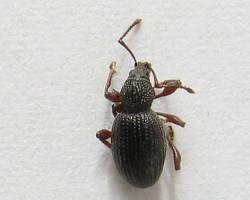
Adult Strawberry Root Weevils are small beetles measuring approximately 1/4 inch long.
- Adult (Key ID): Dark brown to black beetle with a short, broad snout and pear-shaped body.
- Wing Covers: Fused wing covers prevent flight; adults move entirely by crawling.
- Leaf Damage (Key ID): Distinctive crescent-shaped notches chewed along leaf margins.
- Larva (Key ID): Cream-colored, legless, C-shaped grub with a brown head capsule.
- Conflict: Root destruction, leaf damage, plant decline, and occasional indoor nuisance invasions.
Distribution and Habitat
Strawberry Root Weevils are widely distributed throughout North America and are especially common in cooler regions of the Pacific Northwest, Northeast, and parts of Canada.
They thrive in:
- Strawberry fields
- Berry plantings
- Nurseries
- Landscape beds
- Wooded gardens
- Greenhouses
Adults hide in mulch, soil cracks, leaf litter, and other sheltered locations during daylight hours.
Host Plants
Although named for strawberries, these weevils attack a wide variety of plants.
Common hosts include:
- Strawberries
- Raspberries
- Blueberries
- Blackberries
- Azaleas
- Rhododendrons
- Arborvitae
- Hemlock
- Yew
- Various ornamental shrubs
This broad host range makes them important pests in both agricultural and landscape settings.
Life Cycle
Strawberry Root Weevils undergo complete metamorphosis with four developmental stages:
- Egg
- Larva
- Pupa
- Adult
Egg Stage
Females deposit eggs in soil, mulch, or around host plants during spring and summer.
Larval Stage
Larvae hatch and immediately begin feeding on roots. This stage causes the majority of economic damage.
- Fine root consumption
- Crown feeding
- Root girdling
- Reduced water uptake
Pupal Stage
Mature larvae pupate in earthen cells within the soil.
Adult Stage
Adults emerge during summer and feed on foliage at night. Because they cannot fly, infestations spread slowly through crawling.
Damage and Symptoms
Both adults and larvae contribute to plant injury.
Adult Feeding Damage
- C-shaped notches along leaf edges
- Scalloped foliage appearance
- Reduced ornamental quality
Adult feeding is usually cosmetic but serves as an important indicator of larval activity below ground.
Larval Root Damage
- Root pruning
- Crown injury
- Wilting
- Yellowing foliage
- Reduced fruit production
- Plant collapse
Young plants are especially vulnerable and may die when root systems are heavily damaged.
Behavior and Conflict
The greatest challenge with Strawberry Root Weevils is that the damaging larval stage remains hidden underground.
- Nocturnal Feeding: Adults feed almost exclusively at night.
- Flightless Adults: Movement occurs through crawling rather than flight.
- Hidden Larvae: Root feeding often goes unnoticed until symptoms become severe.
- Indoor Nuisance: Adults occasionally wander into homes and buildings, particularly during warm weather.
- Long-Term Damage: Chronic root feeding weakens plants over multiple seasons.
Economic Importance
Strawberry Root Weevils are significant pests in berry production, nurseries, and ornamental landscapes.
- Reduced berry yields
- Plant mortality
- Nursery crop losses
- Landscape replacement costs
- Reduced plant vigor
Commercial berry operations can experience substantial losses when root infestations go undetected.
Management and Control (IPM)
Integrated Pest Management (IPM) provides the most effective long-term control.
Monitoring
- Inspect foliage for leaf notching.
- Conduct nighttime inspections for adults.
- Examine root systems of declining plants.
- Monitor soil for grubs during spring and fall.
Cultural Control
- Remove heavily infested plants.
- Reduce excessive mulch layers.
- Maintain proper irrigation practices.
- Improve soil drainage.
Physical Control
- Hand-pick adults at night.
- Use sticky barriers around containers and raised beds.
- Apply trunk barriers on susceptible ornamental plants.
Biological Control
Beneficial nematodes are among the most effective organic treatments.
- Steinernema feltiae
- Heterorhabditis bacteriophora
These microscopic organisms actively seek out and kill root-feeding larvae in the soil.
Chemical Control
- Target adults during peak feeding periods.
- Apply soil treatments when larvae are actively feeding.
- Follow local recommendations and label directions.
Prevention
- Inspect nursery stock before planting.
- Avoid moving infested soil.
- Maintain healthy root systems.
- Use clean planting material.
- Monitor susceptible plants regularly.
Research and Conservation
Current research focuses on improving biological control methods, developing more effective beneficial nematode applications, and identifying resistant plant varieties. Scientists are also studying the environmental factors that influence weevil survival and reproduction in agricultural systems.
Conclusion
Strawberry Root Weevils are serious pests of strawberries, berries, and ornamental plants. While adult feeding creates distinctive leaf notches, the hidden root-feeding larvae cause the most significant damage. Early detection, beneficial nematodes, cultural controls, and integrated pest management practices are essential for protecting susceptible plants and maintaining healthy landscapes.