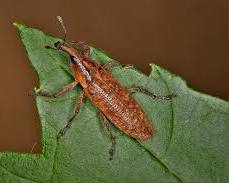
Overview
Stem Weevils are a diverse group of beetles in the family Curculionidae whose larvae bore into and feed within plant stems, crowns, and lower stalk tissues. These hidden pests affect a wide range of crops including cereals, grasses, forage crops, oilseeds, vegetables, and ornamental plants. Because much of the damage occurs inside the plant, infestations often remain unnoticed until symptoms such as wilting, lodging, stem breakage, or poor growth become apparent.
Unlike leaf-feeding insects that are easily observed, stem weevil larvae spend most of their development protected within plant tissues. As they tunnel through stems, they disrupt water and nutrient movement, weaken structural integrity, and create entry points for plant diseases. In agricultural systems, severe infestations can reduce yields, lower crop quality, and increase harvest losses.
Several species are considered important economic pests worldwide, including sunflower stem weevils, cabbage stem weevils, alfalfa stem weevils, and cereal stem weevils. While individual species vary in host preference and biology, they share a common habit of internal stem feeding that makes management particularly challenging.
Taxonomy and Classification
Stem Weevils belong to the order Coleoptera (Beetles) and the family Curculionidae, one of the largest insect families on Earth.
- Kingdom: Animalia
- Phylum: Arthropoda
- Class: Insecta
- Order: Coleoptera
- Family: Curculionidae
Important stem-feeding species include:
- Cylindrocopturus adspersus (Sunflower Stem Weevil)
- Ceutorhynchus pallidactylus (Cabbage Stem Weevil)
- Listronotus bonariensis (Argentine Stem Weevil)
- Hypera postica (Alfalfa Weevil)
Most stem weevils undergo complete metamorphosis and spend their immature stages concealed inside plant tissues.
Physical Description
Adult stem weevils are generally small beetles measuring between 3 and 8 mm long.
- Adult (Key ID): Compact beetle with a distinctive elongated snout (rostrum) and elbowed antennae.
- Coloration: Usually brown, gray, black, or mottled with scales that provide camouflage.
- Larva (Key ID): Cream-colored, legless grub with a brown head capsule.
- Egg-Laying Scars: Small punctures or feeding marks may appear on stems where females deposit eggs.
- Conflict: Internal stem tunneling, weakened plants, lodging, and reduced yields.
Distribution and Habitat
Stem Weevils occur throughout North America and many agricultural regions around the world.
They are commonly found in:
- Grain fields
- Forage crops
- Vegetable gardens
- Oilseed production areas
- Pastures
- Ornamental plantings
- Grasslands
Many species are host-specific, while others attack a broader range of plants.
Life Cycle
Stem Weevils undergo complete metamorphosis consisting of egg, larva, pupa, and adult stages.
Egg Stage
Females deposit eggs in stems, leaf sheaths, crowns, or near the base of host plants.
Larval Stage
After hatching, larvae immediately bore into plant tissue where they feed internally.
This stage causes the majority of plant damage.
Pupal Stage
Pupation may occur inside the stem, within the crown, or in nearby soil depending on the species.
Adult Stage
Adults emerge from plants or soil and begin feeding, mating, and laying eggs.
Many species produce one generation annually, although warmer climates may support multiple generations.
Behavior and Feeding Habits
Adult stem weevils typically feed on foliage, petioles, or stems, producing relatively minor damage compared to their larvae.
The larvae are the destructive stage. Once inside the stem, they:
- Tunnel through pith tissues
- Feed on vascular tissues
- Create galleries inside stems
- Reduce nutrient transport
- Weaken structural support
Their concealed feeding habit protects them from predators and many insecticide applications.
Damage and Symptoms
Stem weevil infestations often become noticeable only after significant internal injury has occurred.
Stem Tunneling
Larvae create internal galleries that weaken stems and crowns.
Lodging
Damaged plants may bend, break, or fall over, particularly during storms or strong winds.
Wilting and Stunting
Disruption of water and nutrient movement can cause reduced growth and premature decline.
Reduced Tillering
In cereals and grasses, stem damage may reduce the number of productive tillers.
Disease Entry Points
Tunneling injuries often allow fungal and bacterial pathogens to enter plant tissues.
Yield Reduction
Infested crops frequently produce fewer seeds, lower-quality forage, or reduced harvestable biomass.
Economic Importance
Stem Weevils can cause substantial economic losses in agricultural systems.
Potential impacts include:
- Reduced grain yields
- Lower forage production
- Plant mortality
- Harvest difficulties
- Increased lodging losses
- Reduced crop quality
Because damage often remains hidden until late in the season, infestations can be particularly costly.
Management and Control (IPM)
Integrated Pest Management (IPM) focuses on preventing infestations and targeting vulnerable life stages.
Monitoring
- Scout fields regularly during early growth stages.
- Inspect stems for feeding scars and egg-laying punctures.
- Use sweep nets where appropriate to detect adults.
Crop Rotation
Rotating susceptible crops helps break pest life cycles and reduce local populations.
Crop Residue Management
- Destroy or remove infested plant material.
- Reduce overwintering habitat.
- Incorporate residues where appropriate.
Biological Control
Natural enemies include:
- Parasitic wasps
- Predatory beetles
- Birds
- Ground-dwelling predators
Conserving beneficial insects can help suppress weevil populations.
Host Plant Resistance
Some crop varieties show greater tolerance to stem tunneling and lodging.
Chemical Control
Insecticides are most effective when applied against adults or newly hatched larvae before stem penetration occurs.
Once larvae are established inside stems, control becomes significantly more difficult.
Research and Future Management
Current research focuses on improving monitoring techniques, identifying resistant crop varieties, enhancing biological control programs, and developing predictive models that help growers target management efforts more effectively.
Scientists are also studying plant traits that reduce egg-laying or limit larval survival within stems.
Conclusion
Stem Weevils are hidden but potentially destructive pests whose larvae weaken plants from the inside. Their tunneling behavior disrupts nutrient movement, increases lodging risk, and reduces crop productivity. Because infestations are often difficult to detect early, successful management depends on monitoring, crop rotation, residue management, biological control, and timely intervention before larvae become established within stems.