Overview
Stable Flies (Stomoxys calcitrans) are among the most important biting fly pests affecting livestock worldwide. Although they closely resemble common house flies, stable flies differ significantly because both males and females feed on blood. Their painful bites cause stress, irritation, and economic losses in livestock operations, making them a major concern for cattle producers, horse owners, dairies, and agricultural facilities.
Unlike house flies that feed on organic waste and food residues, stable flies use a specialized piercing mouthpart to obtain blood meals from mammals. Heavy infestations can severely impact animal welfare and productivity, reducing weight gain, milk production, and overall herd performance.
Stable flies also readily bite humans, making them a significant nuisance around farms, beaches, parks, and residential areas located near breeding sites.
Taxonomy and Classification
- Kingdom: Animalia
- Phylum: Arthropoda
- Class: Insecta
- Order: Diptera
- Family: Muscidae
- Genus: Stomoxys
- Species: Stomoxys calcitrans
Stable flies belong to the same family as house flies but have evolved specialized blood-feeding behavior. They undergo complete metamorphosis, progressing through egg, larva, pupa, and adult stages.
Physical Description
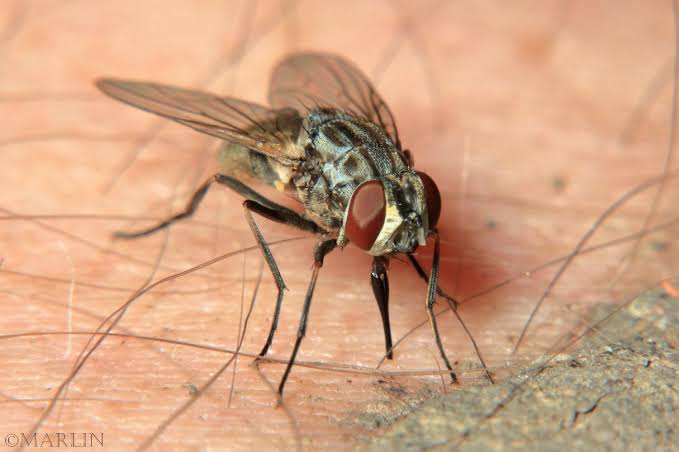
Adult stable flies measure approximately 1/4 to 3/8 inch (6–9 mm) long.
- Body Color: Gray with several dark longitudinal stripes on the thorax.
- Abdomen: Checkered appearance with four distinct dark spots.
- Proboscis: Prominent forward-pointing, bayonet-like mouthpart used for piercing skin.
- Wings: Clear wings held flat over the back when resting.
- Legs: Long and adapted for clinging to hosts during feeding.
The piercing proboscis is the easiest way to distinguish stable flies from house flies. House flies have sponge-like mouthparts, while stable flies possess a rigid beak capable of penetrating skin.
Distribution and Habitat
Stable flies occur worldwide and are found on every continent except Antarctica.
They are commonly associated with:
- Cattle operations
- Dairies
- Horse stables
- Feedlots
- Poultry facilities
- Zoos
- Pastures
- Beach communities
Their larvae require moist, decaying organic matter for development. Common breeding sites include:
- Wet hay
- Spoiled silage
- Grass clippings
- Manure mixed with straw
- Compost piles
- Feed waste
- Decaying vegetation
Even relatively small accumulations of moist organic material can support large stable fly populations.
Life Cycle
Stable flies complete their life cycle in approximately 3 to 6 weeks depending on temperature and moisture conditions.
Egg Stage
Females deposit eggs directly into moist organic matter.
A single female can lay several hundred eggs during her lifetime.
Larval Stage
The larvae, commonly called maggots, feed on decomposing organic material rather than blood.
Warm temperatures accelerate larval development and population growth.
Pupal Stage
After completing larval development, pupation occurs within the breeding substrate.
The pupal stage generally lasts several days to several weeks depending on environmental conditions.
Adult Stage
Adults emerge ready to seek hosts for blood meals.
Both male and female stable flies require blood for survival and reproduction.
Behavior and Feeding Habits
Stable flies are aggressive daytime feeders.
Unlike mosquitoes, which primarily feed during dawn and dusk, stable flies actively seek hosts throughout daylight hours.
Preferred feeding locations include:
- Lower legs of cattle
- Flanks of livestock
- Bellies of horses
- Ankles and legs of humans
The bite is often described as sharp and painful. Livestock frequently react by stomping, kicking, tail-switching, or bunching together to avoid attacks.
Adult flies generally spend only a few minutes feeding before leaving the host.
Damage and Economic Importance
Stable flies are considered one of the most economically damaging livestock pests worldwide.
Reduced Weight Gain
Animals spend less time feeding and more time avoiding flies.
Research has shown that heavy infestations can significantly reduce weight gain in beef cattle.
Milk Production Losses
Dairy cows exposed to large stable fly populations often experience reduced milk production due to stress and decreased feeding activity.
Animal Stress
Persistent biting causes:
- Restlessness
- Excessive movement
- Reduced grazing
- Poor feed conversion
- Lower productivity
Skin Damage
Repeated feeding creates small wounds that may become irritated or infected.
Human Nuisance
Humans frequently experience painful bites around farms, beaches, and recreational areas.
The bites often leave itchy red welts that may persist for several days.
Disease Transmission
Stable flies can mechanically transmit several pathogens affecting livestock.
Although they are not as efficient as some specialized vectors, they are capable of spreading:
- Anthrax bacteria
- Equine Infectious Anemia virus
- Anaplasmosis organisms
- Various bacterial infections
Because stable flies frequently move between hosts, they can contribute to disease spread within livestock operations.
Signs of Infestation
Common indicators include:
- Livestock stomping their feet frequently
- Tail switching and skin twitching
- Animals bunching together
- Reduced grazing activity
- Visible flies on legs and lower body areas
- Painful bites on humans
- Presence of moist organic breeding materials
Economic losses often become noticeable before large numbers of flies are observed.
Management and Control (IPM)
Effective stable fly control requires an integrated pest management approach focused on breeding site elimination and adult suppression.
Sanitation (Most Important)
Source reduction is the foundation of stable fly management.
- Remove spoiled hay and feed.
- Clean manure accumulation regularly.
- Eliminate wet organic waste.
- Improve drainage around facilities.
- Spread accumulated vegetation to promote drying.
Without breeding habitat, stable fly populations decline dramatically.
Biological Control
Several beneficial insects naturally attack stable flies.
- Parasitic Wasps: Spalangia and Muscidifurax species attack pupae.
- Predatory Beetles: Feed on larvae and pupae.
- Predatory Mites: Consume fly eggs and young larvae.
Commercial releases of parasitic wasps are often used in livestock facilities.
Trapping
Specialized stable fly traps can reduce adult populations.
- Sticky traps
- Alsynite cylinder traps
- Walk-through livestock traps
- Blue and black attraction traps
Chemical Control
When necessary, insecticides may be applied to:
- Barn walls
- Resting surfaces
- Animal housing structures
- Perimeter vegetation
Rotating insecticide classes helps prevent resistance development.
Animal Protection
- Fly repellents
- Protective sprays
- Fly sheets for horses
- Insecticide ear tags in some operations
Research and Future Management
Current stable fly research focuses on:
- Improved biological control programs
- Insecticide resistance management
- Novel trapping technologies
- Behavioral attractants
- Sustainable livestock protection methods
Scientists continue to develop environmentally friendly strategies that reduce reliance on chemical insecticides while maintaining effective population control.
Conclusion
Stable Flies are among the most important biting fly pests affecting livestock and humans worldwide. Their painful blood-feeding behavior causes significant stress, reduces animal productivity, and contributes to substantial economic losses in agricultural systems. Effective management depends on rigorous sanitation, breeding site elimination, biological controls, monitoring, and targeted interventions. By combining multiple control strategies, livestock producers can significantly reduce stable fly populations and protect animal health and performance.