Overview
Squash Vine Borers (Melittia cucurbitae) are among the most destructive insect pests of squash, pumpkins, gourds, and certain other cucurbit crops in North America. Unlike many garden pests that feed on leaves or fruit, squash vine borer larvae tunnel directly into the stems of host plants, disrupting the flow of water and nutrients. Infested plants often appear healthy one day and suddenly wilt and collapse the next.
Home gardeners frequently mistake the symptoms for drought stress or disease, but the real cause is usually hidden deep inside the stem. Because the larvae remain protected within the vine, infestations can be difficult to detect and control once established.
Taxonomy and Classification
- Kingdom: Animalia
- Phylum: Arthropoda
- Class: Insecta
- Order: Lepidoptera
- Family: Sesiidae
- Genus: Melittia
- Species: Melittia cucurbitae
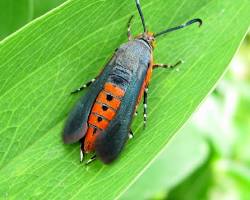
Squash Vine Borers belong to the clearwing moth family (Sesiidae). Adult moths resemble wasps rather than typical moths, an example of protective mimicry that helps deter predators.
Physical Description
The damaging larval stage measures approximately 1 inch long when fully grown.
- Adult Moth (Key ID): Day-flying moth with metallic green-black forewings, clear hindwings, and a bright orange-red abdomen marked with black spots.
- Larva (Key ID): Creamy-white caterpillar with a brown head capsule and wrinkled body.
- Eggs: Tiny, flattened, reddish-brown eggs deposited individually on stems near the soil line.
- Frass (Key ID): Moist, yellow-orange or greenish sawdust-like material pushed from entry holes in the stem.
- Conflict: Stem tunneling, plant collapse, fruit loss, and reduced yields.
Distribution and Habitat
Squash Vine Borers are widely distributed throughout the eastern and central United States, southern Canada, and portions of the Southwest. They are particularly common in home gardens where squash and pumpkins are grown annually.
Host plants include:
- Summer squash
- Zucchini
- Pumpkins
- Gourds
- Some winter squash varieties
Cucumbers and melons are generally less susceptible than squash and pumpkins.
Life Cycle
Squash Vine Borers undergo complete metamorphosis with four life stages:
- Egg
- Larva
- Pupa
- Adult
Egg Stage
Adult females lay eggs individually near the base of host plants. Eggs typically hatch within one to two weeks depending on temperature.
Larval Stage
After hatching, larvae immediately bore into stems where they remain protected from predators and most insecticides. Feeding continues for four to six weeks.
Pupal Stage
Mature larvae exit the vine and enter the soil, where they pupate inside earthen cocoons.
Adult Stage
Adults emerge during late spring and summer. In warmer regions, multiple generations may occur annually.
Damage and Symptoms
Most damage results from internal stem tunneling by larvae.
Early Symptoms
- Slight leaf wilting during afternoon heat
- Reduced vigor
- Small entry holes near the stem base
- Frass accumulation around stems
Advanced Symptoms
- Sudden vine collapse
- Permanent wilting
- Yellowing leaves
- Stem splitting
- Fruit abortion
- Plant death
Once tunneling becomes extensive, water movement through the stem is severely restricted, causing rapid decline.
Signs of Infestation
- Sawdust-like frass near the soil line
- Small holes in stems
- Wilted vines despite adequate watering
- Hollow stems containing white caterpillars
- Stem rot near feeding sites
The presence of frass at the base of a squash plant is one of the most reliable indicators of infestation.
Economic Importance
Squash Vine Borers are major pests of cucurbit production because a single larva can destroy an entire plant.
- Reduced yields
- Plant mortality
- Fruit loss
- Increased management costs
- Crop failure in severe infestations
Home gardens often suffer complete losses when infestations go undetected.
Behavior and Conflict
The primary challenge of Squash Vine Borers is that most of their damaging activity occurs inside the stem where they are protected.
- Internal Feeding: Larvae remain hidden within vines.
- Rapid Collapse: Plants may wilt suddenly after weeks of unnoticed feeding.
- Stem Rot: Tunneling creates entry points for bacteria and fungi.
- Host Preference: Summer squash and zucchini are especially vulnerable.
Management and Control (IPM)
Successful management relies heavily on prevention and early detection.
Monitoring
- Inspect stems weekly.
- Watch for adult moth activity.
- Look for eggs and frass near the stem base.
Physical Control
- Remove and destroy infested vines.
- Use yellow traps to monitor adults.
- Wrap lower stems with aluminum foil or protective barriers.
- Perform stem surgery to remove larvae when detected early.
Cultural Control
- Rotate cucurbit crops annually.
- Remove crop residue after harvest.
- Hill soil around stems to encourage secondary root formation.
- Plant resistant or less susceptible varieties.
Exclusion
- Use floating row covers immediately after planting.
- Remove covers once flowering begins to allow pollination.
Biological Control
- Encourage parasitic wasps and beneficial insects.
- Apply Bacillus thuringiensis (Bt) to susceptible stems before larvae enter.
Chemical Control
- Apply labeled insecticides during adult egg-laying periods.
- Treat stems before larvae bore inside.
- Follow local recommendations regarding timing and application intervals.
Research and Conservation
Current research focuses on improved monitoring methods, pheromone traps, biological control agents, resistant squash varieties, and more effective timing of preventative treatments.
Scientists are also investigating integrated management approaches that reduce pesticide use while maintaining effective protection of cucurbit crops.
Conclusion
Squash Vine Borers are among the most devastating pests of squash and pumpkin crops. Their hidden larval feeding inside stems often results in sudden plant collapse and significant yield loss. Early detection, exclusion techniques, cultural practices, and integrated pest management strategies remain the most effective methods for protecting susceptible plants.