Overview
Spruce Budworms (Choristoneura fumiferana and related species) are among the most destructive forest pests in North America. These caterpillars feed primarily on the developing buds and needles of spruce and fir trees, causing extensive defoliation, reduced growth, and widespread tree mortality during outbreak periods. The Eastern Spruce Budworm (Choristoneura fumiferana) is particularly notorious for causing some of the largest insect outbreaks ever recorded in North American forests.
Spruce budworm outbreaks are natural ecological events that occur in cycles, typically every 30 to 40 years. However, during severe outbreaks, millions of acres of forest can be affected, resulting in significant economic losses to the timber industry and major ecological changes across entire landscapes.
Because spruce and fir forests dominate large portions of Canada and the northern United States, spruce budworms are considered one of the most important forest pests on the continent.
Taxonomy and Classification
- Kingdom: Animalia
- Phylum: Arthropoda
- Class: Insecta
- Order: Lepidoptera
- Family: Tortricidae
- Genus: Choristoneura
- Species: Choristoneura fumiferana (Eastern Spruce Budworm)
Spruce budworms belong to the tortricid moth family, which includes many economically important agricultural and forestry pests. Several related species occur throughout North America, each adapted to specific conifer hosts and geographic regions.
Physical Description
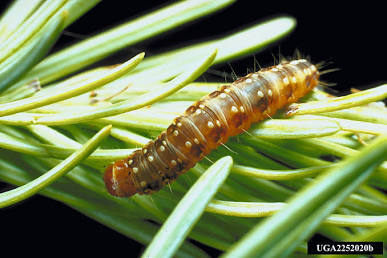
The larval stage is responsible for all significant damage.
Larvae
- Length: 3/4 to 1 inch (18–25 mm)
- Head: Dark brown to black
- Body: Reddish-brown to olive-brown
- Markings: Distinct pale yellow or whitish spots along the body
- Texture: Smooth-bodied caterpillar
Older larvae are easily recognized by their dark heads and rows of pale spots along the back.
Pupae
Pupae are brown and typically found within silken shelters among damaged foliage.
Adult Moths
- Wingspan: Approximately 20–25 mm
- Color: Mottled gray, brown, or reddish-brown
- Activity: Nocturnal
Adult moths are relatively inconspicuous and are rarely noticed by homeowners.
Distribution and Habitat
Spruce budworms are found throughout the boreal and temperate conifer forests of North America.
Their range extends from:
- Newfoundland and Nova Scotia
- Quebec and Ontario
- The Great Lakes region
- New England
- The Appalachian Mountains
- Western Canada
- Alaska
The primary hosts include:
- Balsam Fir (Abies balsamea)
- White Spruce (Picea glauca)
- Black Spruce (Picea mariana)
- Red Spruce (Picea rubens)
- Engelmann Spruce (Picea engelmannii)
Balsam fir is particularly vulnerable and often experiences the highest mortality rates during outbreaks.
Life Cycle
Spruce budworms complete one generation per year.
Egg Stage
Female moths deposit egg masses on host tree needles during summer.
Each female may lay over 100 eggs.
Larval Stage
After hatching, tiny larvae do not immediately begin heavy feeding.
Instead, they construct protective silken shelters beneath bark scales or within branch crevices and enter a dormant overwintering stage.
Spring Feeding
As temperatures rise in spring, larvae emerge and move toward developing buds.
Young larvae bore directly into unopened buds where they feed on tender tissues.
This behavior provides protection from predators and environmental conditions while allowing access to nutrient-rich new growth.
Pupation
After completing development, larvae spin silken cocoons among foliage and pupate.
Adult Emergence
Adult moths emerge in midsummer, mate, and begin the cycle again.
Behavior and Feeding Habits
Spruce budworms specialize in feeding on new growth.
Preferred feeding sites include:
- Developing buds
- Young needles
- Flowers and cones
- Tender shoots
As larvae mature, they consume larger quantities of foliage and frequently web needles together using silk.
This webbing creates one of the most recognizable signs of infestation.
Damage and Economic Importance
Spruce budworms cause damage on a scale rarely seen with other forest insects.
Defoliation
Larvae consume newly emerging foliage, reducing the tree’s ability to photosynthesize.
Repeated defoliation results in:
- Growth reduction
- Canopy thinning
- Loss of vigor
- Increased susceptibility to disease
Tree Mortality
Balsam fir is especially vulnerable.
After four to five years of severe defoliation, many trees die.
Spruce species generally survive longer but often experience substantial growth loss.
Forest Appearance
Infested forests often develop a distinctive reddish-brown appearance.
The dead needles remain attached to branches, creating the appearance of scorched or burned forests.
Economic Impact
Spruce budworm outbreaks have caused billions of dollars in losses throughout North America.
Impacts include:
- Reduced timber production
- Tree mortality
- Increased harvesting costs
- Reduced forest productivity
- Impacts on recreation and tourism
Signs of Infestation
Common indicators include:
- Webbed needles and shoots
- Brown or red foliage in tree crowns
- Partially eaten needles
- Silk-covered branch tips
- Large amounts of caterpillar frass beneath trees
- Visible larvae feeding on buds and shoots
Heavy infestations may be visible from considerable distances due to canopy discoloration.
Outbreak Cycles
One of the most remarkable aspects of spruce budworm biology is its cyclical outbreak pattern.
Populations generally remain low for many years before rapidly increasing.
Major outbreaks typically:
- Occur every 30–40 years
- Last 10–15 years
- Spread across millions of acres
- Cause extensive forest mortality
Scientists continue to study the factors responsible for these population cycles.
Management and Control (IPM)
Managing spruce budworms requires large-scale forest management strategies.
Forest Management
Long-term prevention focuses on creating more resilient forests.
- Promote mixed-species forests.
- Reduce overabundance of balsam fir.
- Encourage hardwood diversity.
- Harvest vulnerable stands before outbreaks.
Monitoring Programs
Forestry agencies monitor populations using:
- Pheromone traps
- Aerial surveys
- Ground inspections
- Defoliation assessments
Early detection helps managers respond before severe damage occurs.
Biological Control
The biological insecticide Bacillus thuringiensis var. kurstaki (Bt) is widely used during outbreaks.
Benefits include:
- Selective caterpillar control
- Minimal environmental impact
- Reduced effects on beneficial insects
Aerial Applications
Large-scale aerial spraying programs are commonly used to protect high-value forests.
Applications target young larvae shortly after emergence.
Natural Enemies
Numerous predators and parasites attack spruce budworms.
- Parasitic wasps
- Parasitic flies
- Birds
- Predatory insects
- Pathogens
Although natural enemies help regulate populations, they often cannot prevent major outbreaks.
Ecological Importance
Despite their destructive reputation, spruce budworms play an important ecological role.
Outbreaks:
- Create wildlife habitat
- Increase forest diversity
- Recycle nutrients
- Promote forest succession
- Provide food for numerous predators
Many forest ecosystems have evolved alongside periodic budworm outbreaks.
Research and Future Management
Current research focuses on:
- Outbreak prediction models
- Climate change impacts
- Forest resistance strategies
- Improved biological controls
- Landscape-level management planning
Advances in remote sensing and population monitoring continue to improve outbreak forecasting and management effectiveness.
Conclusion
Spruce Budworms are among the most significant forest pests in North America. Their cyclical outbreaks can affect millions of acres of spruce and fir forests, causing extensive defoliation, reduced growth, and widespread tree mortality. While these outbreaks are a natural component of forest ecosystems, their economic and ecological impacts can be immense. Integrated forest management, biological controls, and long-term monitoring remain essential tools for minimizing damage and maintaining healthy forest landscapes.