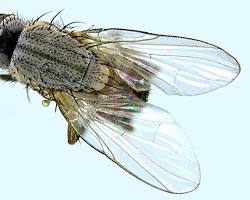
Overview
Sorghum Shoot Flies (Atherigona soccata) are among the most destructive early-season pests of sorghum crops worldwide. These small flies attack young seedlings and cause a characteristic condition known as dead heart, where the central growing point is destroyed, preventing normal plant development. Sorghum Shoot Flies are particularly damaging in tropical, subtropical, and semi-arid regions where sorghum serves as an important grain, forage, and biofuel crop.
Because they attack plants during the seedling stage, even low populations can significantly reduce stand establishment and final yields. Severe infestations may require replanting entire fields, making Sorghum Shoot Flies one of the most economically important pests of young sorghum.
Taxonomy and Classification
Sorghum Shoot Flies belong to the order Diptera and the family Muscidae, the same family that includes house flies and several agricultural pest species.
- Kingdom: Animalia
- Phylum: Arthropoda
- Class: Insecta
- Order: Diptera
- Family: Muscidae
- Genus: Atherigona
- Species: Atherigona soccata
Unlike many related flies that feed on decaying organic matter, Sorghum Shoot Flies have evolved as highly specialized pests of cereal crops, particularly sorghum.
Physical Description
Although the adults resemble small house flies, the damaging stage is the larva.
- Adult Fly (Key ID): Small gray fly measuring approximately 4–5 mm long with transparent wings and a yellowish-gray abdomen.
- Egg (Key ID): Tiny white cigar-shaped eggs deposited singly on young sorghum leaves.
- Larva (Key ID): Pale yellow or white legless maggot that burrows toward the plant’s growing point.
- Pupa: Brown seed-like puparium located near the plant base or in surrounding soil.
- Conflict: Seedling death, stand reduction, and yield loss.
Distribution and Habitat
Sorghum Shoot Flies are widespread throughout Africa, Asia, Australia, and parts of the Americas. They thrive in warm climates where sorghum is cultivated extensively.
In the United States, they are primarily monitored in regions where sorghum production is significant, including:
- Texas
- Kansas
- Oklahoma
- Arizona
- New Mexico
- California
The flies are most commonly associated with newly planted sorghum fields, volunteer sorghum, and related grass hosts.
Host Plants
Sorghum Shoot Flies primarily attack sorghum but can also utilize related grasses.
Common hosts include:
- Grain sorghum
- Forage sorghum
- Sudangrass
- Pearl millet
- Johnson grass
- Wild grasses
Volunteer plants and unmanaged grass hosts often serve as reservoirs for developing populations.
Life Cycle
Sorghum Shoot Flies undergo complete metamorphosis.
Egg Stage
Females lay eggs individually on the undersides of leaves of young sorghum seedlings, usually when plants are between one and five weeks old.
Larval Stage
After hatching, the maggot moves down the leaf sheath and tunnels into the central growing point.
As the larva feeds, it destroys the plant’s meristematic tissue, preventing normal development.
Pupal Stage
Mature larvae pupate inside the stem base or in nearby soil.
Adult Stage
Adult flies emerge, mate, and begin laying eggs shortly afterward. Under favorable conditions, multiple generations may develop during a single growing season.
Damage and Symptoms
The most recognizable symptom of Sorghum Shoot Fly infestation is the development of dead heart.
Dead Heart Symptoms
- Central leaf dries out and turns brown.
- Outer leaves remain green initially.
- The dead central shoot can be pulled out easily.
- Damaged tissue often emits a foul odor.
Stand Reduction
Plants killed early in development leave gaps throughout the field, reducing overall plant density.
Excessive Tillering
Some damaged plants survive by producing side shoots known as tillers.
- Tillers are often less productive.
- Grain production is significantly reduced.
- Maturity becomes uneven across the field.
Yield Loss
Heavy infestations may reduce grain production dramatically, especially when attacks occur during the first month after planting.
Behavior and Conflict
The success of Sorghum Shoot Flies stems from their ability to precisely target vulnerable seedlings.
- Seedling Specialist: Young plants are highly susceptible.
- Hidden Feeding: Larvae remain protected inside stems.
- Rapid Development: Multiple generations can occur annually.
- Host Synchronization: Adults preferentially attack newly emerged crops.
- Localized Outbreaks: Populations often build rapidly in areas with staggered planting dates.
Economic Importance
Sorghum Shoot Flies are among the most damaging pests of young sorghum plants.
Economic consequences include:
- Reduced plant populations
- Lower grain yields
- Uneven crop development
- Replanting expenses
- Increased management costs
Yield losses can range from minor reductions to near-total stand failure during severe outbreaks.
Management and Control (IPM)
Integrated Pest Management (IPM) focuses on preventing damage during the vulnerable seedling stage.
Early Planting
Planting sorghum as early as environmental conditions permit allows seedlings to outgrow the most susceptible stage before fly populations peak.
Resistant Varieties
Many breeding programs have developed sorghum varieties with improved resistance to shoot fly attack.
- Reduced egg laying
- Improved seedling vigor
- Greater tolerance of feeding damage
Seed Treatments
Systemic insecticide seed treatments provide protection during the first several weeks after emergence.
This period corresponds to the crop’s greatest vulnerability.
Cultural Control
- Remove volunteer sorghum.
- Control grass weeds.
- Maintain uniform planting dates.
- Destroy crop residues when appropriate.
Biological Control
Natural enemies contribute to population suppression.
- Parasitic wasps
- Predatory beetles
- Spiders
- Earwigs
Conserving beneficial insects helps reduce pest pressure naturally.
Chemical Control
Foliar insecticides may be used when monitoring indicates economically damaging populations.
However, preventative measures and seed treatments generally provide more effective protection than rescue applications.
Prevention
- Plant early when possible.
- Use resistant hybrids.
- Treat seed before planting.
- Maintain field sanitation.
- Control volunteer host plants.
- Monitor seedling fields regularly.
Research and Conservation
Current research focuses on improving host-plant resistance, identifying new biological control agents, refining economic thresholds, and developing sustainable management programs. Scientists are also studying fly behavior and host-selection mechanisms to improve monitoring and forecasting systems.
Conclusion
Sorghum Shoot Flies are highly specialized pests capable of causing severe stand loss and reduced grain production by destroying the central growing point of young sorghum plants. Their characteristic dead-heart damage makes them one of the most important seedling pests in sorghum production systems. Early planting, resistant varieties, seed treatments, and integrated pest management strategies remain the most effective tools for minimizing losses and maintaining healthy crop stands.