Overview
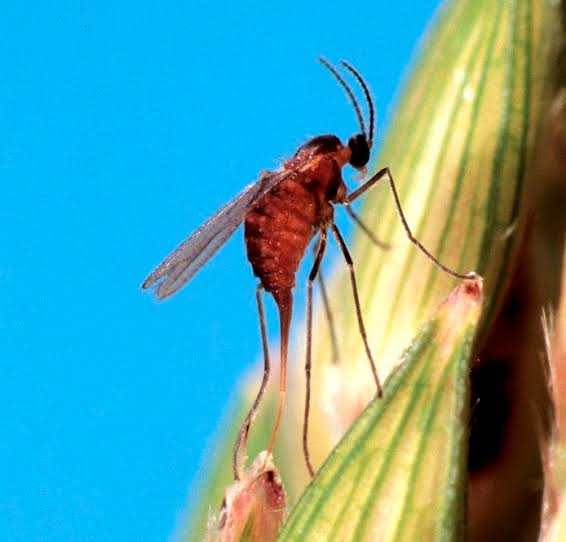
Sorghum Midge (Stenodiplosis sorghicola) is one of the most destructive insect pests of grain sorghum worldwide. This tiny orange-red fly causes damage by laying eggs inside flowering sorghum heads, where the developing larvae feed directly on the reproductive tissues of the plant. Unlike many crop pests that reduce yield through leaf feeding or stem damage, sorghum midge attacks the developing grain itself, often preventing kernels from forming entirely.
Because even small infestations can destroy large numbers of developing seeds, sorghum midge is considered a major economic pest in commercial sorghum production. Severe outbreaks can reduce yields dramatically and, under favorable conditions, cause nearly complete crop failure.
Taxonomy and Classification
- Kingdom: Animalia
- Phylum: Arthropoda
- Class: Insecta
- Order: Diptera
- Family: Cecidomyiidae
- Species: Stenodiplosis sorghicola
Sorghum midges belong to the family Cecidomyiidae, commonly known as gall midges. Although many gall midges induce plant galls, the sorghum midge specializes in attacking sorghum flowers and developing grain.
Physical Description
Sorghum midge adults are extremely small and often go unnoticed in the field.
- Adult Fly: Bright orange to reddish-orange, approximately 1.5–2 mm long.
- Wings: Transparent and delicate.
- Antennae: Long and bead-like.
- Larvae: Tiny orange-red maggots hidden inside sorghum florets.
- Pupae: Found within spikelets or crop residues.
Because of their small size, infestations are often detected only after damage becomes visible on developing seed heads.
Distribution and Habitat
Sorghum midge is found throughout major sorghum-growing regions of the world, including:
- United States
- Mexico
- South America
- Africa
- India
- Australia
- Southeast Asia
The insect’s habitat is closely tied to flowering sorghum plants. Females require blooming sorghum heads for egg-laying, making crop flowering periods critical for infestation development.
Life Cycle
Sorghum midge undergoes complete metamorphosis and can complete its life cycle in as little as two weeks under warm conditions.
Egg Stage
Females lay eggs directly inside freshly opened sorghum flowers during anthesis. Eggs hatch within a few days.
Larval Stage
The maggots feed on the developing ovary and young kernel tissue. Feeding prevents normal seed formation and destroys grain potential.
Pupal Stage
After feeding, larvae pupate within the flower structures or crop residue.
Adult Stage
Adults emerge shortly afterward and immediately seek flowering sorghum plants for reproduction.
Depending on climate, nine to twelve generations may occur during a single growing season, allowing populations to increase rapidly.
Damage and Economic Importance
Sorghum midge causes direct destruction of developing grain.
Kernel Loss
Larval feeding destroys the ovary before seed development can occur.
The result is empty florets that fail to produce grain.
“Blasted” Seed Heads
Heavily infested heads may appear normal at first glance but contain few or no mature kernels.
This condition is commonly called a “blasted” head.
Yield Reduction
Even moderate infestations can significantly reduce harvestable grain.
Under severe outbreak conditions, losses may exceed 80% and occasionally approach complete crop failure.
Economic Impact
Because sorghum is an important food, feed, and biofuel crop, midge infestations can have substantial economic consequences for producers.
Signs of Infestation
Common indicators include:
- Empty Spikelets: Flowers fail to produce grain.
- Shriveled Floral Structures: Damaged florets appear pale or dried.
- Poor Seed Set: Sparse grain development across seed heads.
- Orange Maggots: Visible inside florets when opened.
- Uneven Grain Fill: Portions of heads contain grain while others remain empty.
- Adult Midges: Tiny orange flies hovering around flowering sorghum during morning hours.
Behavior and Conflict
Sorghum midge is particularly difficult to manage because of its precise synchronization with flowering sorghum.
- Short Vulnerability Window: Females attack flowers during a narrow blooming period.
- Hidden Feeding: Larvae remain protected inside florets.
- Rapid Reproduction: Multiple generations develop throughout the season.
- Continuous Infestation: Staggered planting dates provide a constant supply of flowering hosts.
- Dormancy: Some larvae enter diapause and survive between growing seasons.
These factors make sorghum midge one of the most challenging pests facing sorghum producers.
Management and Control (IPM)
Effective management requires a combination of cultural, genetic, monitoring, and chemical strategies.
Resistant Hybrids
Planting midge-resistant sorghum varieties is the most reliable long-term management strategy.
Resistant hybrids significantly reduce larval survival and yield losses.
Uniform Planting
Synchronizing planting dates allows fields to flower simultaneously, reducing the period during which crops are vulnerable.
Crop Residue Management
Destroying crop residues after harvest helps reduce overwintering populations.
- Plowing under stubble
- Removing volunteer sorghum
- Managing wild host grasses
Monitoring
Regular scouting during flowering is critical.
Growers should inspect seed heads early in the morning when adults are most active.
Chemical Control
Insecticides may be applied when adult populations exceed economic thresholds.
Applications must be precisely timed because adults are active for only a short period and larvae quickly become protected within florets.
Treatments are typically most effective during the 50–75% bloom stage.
Natural Enemies
Several beneficial insects help suppress sorghum midge populations.
- Parasitic wasps
- Predatory bugs
- Predatory beetles
- Generalist predators
Conserving natural enemies can contribute to long-term population suppression.
Research and Future Management
Researchers continue developing improved management tools for sorghum midge.
Current research areas include:
- Enhanced resistant hybrids
- Improved monitoring systems
- Pheromone-based detection
- Biological control programs
- Climate-related outbreak forecasting
- Integrated pest management strategies
Advances in these areas may help reduce future crop losses while minimizing pesticide dependence.
Conclusion
Sorghum Midge is among the most economically important pests of grain sorghum worldwide. By attacking flowers and preventing kernel formation, this tiny fly can cause severe yield losses and significant economic damage. Successful management depends on resistant hybrids, synchronized planting, careful monitoring, crop sanitation, and properly timed interventions. An integrated pest management approach remains the most effective strategy for protecting sorghum production from this destructive pest.