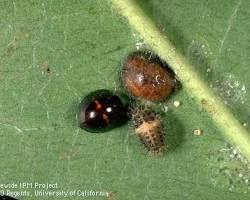
Overview
Scale-Feeding Lady Beetles are beneficial predatory insects that play a critical role in controlling scale insects, mealybugs, and other sap-feeding pests. Unlike many pests featured on Pestipedia, these beetles are valuable allies in integrated pest management (IPM) programs. Their presence often indicates that natural biological control is occurring within a landscape, orchard, greenhouse, or garden.
Several species of lady beetles specialize in feeding on armored scales, soft scales, and mealybugs. Both adults and larvae actively hunt prey, helping to suppress infestations that might otherwise cause severe damage to ornamental plants, fruit trees, shrubs, and agricultural crops.
Because they are frequently found among pest colonies, homeowners sometimes mistake them for part of the infestation. In reality, these beetles are among the most effective natural enemies available for scale insect management.
Taxonomy and Classification
Scale-feeding lady beetles belong to the order Coleoptera and the family Coccinellidae, the same family that includes the familiar ladybugs found in gardens.
- Kingdom: Animalia
- Phylum: Arthropoda
- Class: Insecta
- Order: Coleoptera
- Family: Coccinellidae
Important scale-feeding species include:
- Mealybug Destroyer (Cryptolaemus montrouzieri)
- Twice-Stabbed Lady Beetle (Chilocorus stigma)
- Various Chilocorus species
- Various Rhyzobius species
These predators undergo complete metamorphosis, progressing through egg, larval, pupal, and adult stages.
Physical Description
Appearance varies considerably depending on species.
- Adult Mealybug Destroyer: Small, dark beetle with metallic-black wing covers and a contrasting orange-brown head and thorax.
- Twice-Stabbed Lady Beetle: Glossy black beetle featuring two bright red spots on its back.
- Larvae: Elongated, active predators often described as “alligator-shaped.”
- Mealybug Mimic Larvae: Some species, especially Cryptolaemus montrouzieri, produce waxy white filaments that make them resemble giant mealybugs.
- Conflict: None. These insects are beneficial predators that attack plant pests.
Distribution and Habitat
Scale-feeding lady beetles occur worldwide and are found wherever scale insects and mealybugs are present.
Common habitats include:
- Citrus orchards
- Fruit tree plantings
- Greenhouses
- Landscape shrubs
- Urban gardens
- Nurseries
- Tropical and subtropical plantings
They are especially valuable in warm climates where scale insects can reproduce throughout much of the year.
Life Cycle
Scale-feeding lady beetles undergo complete metamorphosis.
Egg Stage
Females lay eggs near colonies of scales or mealybugs.
This ensures newly hatched larvae have immediate access to food.
Larval Stage
Larvae are voracious predators and consume large numbers of scale insects and mealybugs.
This stage provides the greatest biological control benefit.
Pupal Stage
Mature larvae attach themselves to protected surfaces and pupate.
The pupal stage may last several days to several weeks depending on temperature.
Adult Stage
Adults emerge ready to feed, disperse, and reproduce.
Both adults and larvae contribute to pest suppression.
Behavior and Ecological Importance
Scale-feeding lady beetles are specialized predators that help maintain ecological balance.
- Predation: Consume scales, mealybugs, eggs, crawlers, and other soft-bodied pests.
- Biological Control: Provide natural suppression without chemical pesticides.
- Honeydew Reduction: By reducing sap-feeding pests, they indirectly decrease honeydew accumulation and sooty mold development.
- Scale Removal: Some species pry armored scales from their protective coverings before feeding.
- Population Response: Predator numbers often increase following pest outbreaks.
Their presence is generally considered a positive sign in gardens and agricultural systems.
Relationship with Scale Insects
Scale insects are difficult pests because they often hide beneath waxy coverings and feed in protected locations.
Scale-feeding lady beetles have evolved specialized behaviors that allow them to locate and consume these pests effectively.
Many species target:
- Armored scales
- Soft scales
- Mealybugs
- Scale eggs
- Crawler stages
A single larva may consume hundreds of pests during development.
Large populations can dramatically reduce infestations without additional intervention.
Benefits in Integrated Pest Management (IPM)
Scale-feeding lady beetles are among the most valuable biological control agents used in IPM programs.
Their benefits include:
- Reduced pesticide dependence
- Natural suppression of pest outbreaks
- Improved plant health
- Lower management costs
- Reduced environmental impact
- Long-term pest control stability
Commercial growers often purchase and release certain species to manage greenhouse and orchard pests.
Conservation and Management
Because these beetles are beneficial, management focuses on protecting and encouraging their populations.
Protect Beneficial Insects
- Avoid unnecessary insecticide applications.
- Use selective products when treatment is required.
- Monitor pest populations before spraying.
Control Ants
Ants often protect scale insects and mealybugs in exchange for honeydew.
Reducing ant activity helps predators access pest colonies.
Encourage Habitat Diversity
- Plant diverse flowering plants.
- Provide shelter for beneficial insects.
- Maintain healthy landscapes.
Biological Releases
Commercially available species such as the Mealybug Destroyer can be released in greenhouses, citrus groves, and ornamental landscapes where scale insects are problematic.
Common Misidentifications
The larvae of some scale-feeding lady beetles are frequently mistaken for pests.
The wax-covered larvae of the Mealybug Destroyer closely resemble mealybugs themselves.
Key differences include:
- Greater mobility
- Predatory behavior
- Larger size
- Lack of long waxy tail filaments found on some mealybug species
Correct identification prevents accidental destruction of beneficial populations.
Research and Biological Control Programs
Researchers continue studying scale-feeding lady beetles as environmentally friendly alternatives to chemical pest management. Current research focuses on predator-prey relationships, release strategies, conservation methods, and compatibility with modern IPM programs.
Many commercial biological control operations rely heavily on these predators to suppress persistent scale and mealybug infestations.
Conclusion
Scale-Feeding Lady Beetles are beneficial predators that provide valuable control of scale insects and mealybugs in gardens, orchards, greenhouses, and landscapes. Their ability to locate and consume hidden pests makes them essential components of successful integrated pest management programs. Protecting these natural enemies can reduce pesticide use, improve plant health, and provide long-term biological control of some of the most difficult sap-feeding pests.