Rusty Tussock Moths
Rusty Tussock Moths (Orgyia antiqua), also known as Vaporer Moths, are distinctive hairy caterpillars found throughout much of North America, Europe, and Asia. These insects are highly adaptable and feed on a wide variety of deciduous and coniferous trees and shrubs. Although healthy, mature plants can often tolerate occasional feeding, large infestations may result in severe defoliation and reduced plant vigor. The caterpillars are also notable because their hairs can cause skin irritation and allergic reactions in sensitive individuals.
Taxonomy and Classification
Rusty Tussock Moths belong to the family Erebidae, a diverse group that includes many well-known tussock moth species.
- Order: Lepidoptera
- Family: Erebidae
- Subfamily: Lymantriinae
- Genus: Orgyia
- Species: Orgyia antiqua
Like other tussock moths, the larval stage is responsible for virtually all feeding damage.
Physical Description
Rusty Tussock Moths exhibit extreme sexual dimorphism, meaning males and females look dramatically different.
- Larva (Key ID): Caterpillars grow up to 35 mm long and are covered in dense hairs. The body features four prominent brush-like tufts on the back, long black hair pencils projecting from the front and rear, and bright red or orange tubercles along the sides.
- Coloration: Caterpillars vary from gray to black with yellow, tan, or cream-colored tussocks.
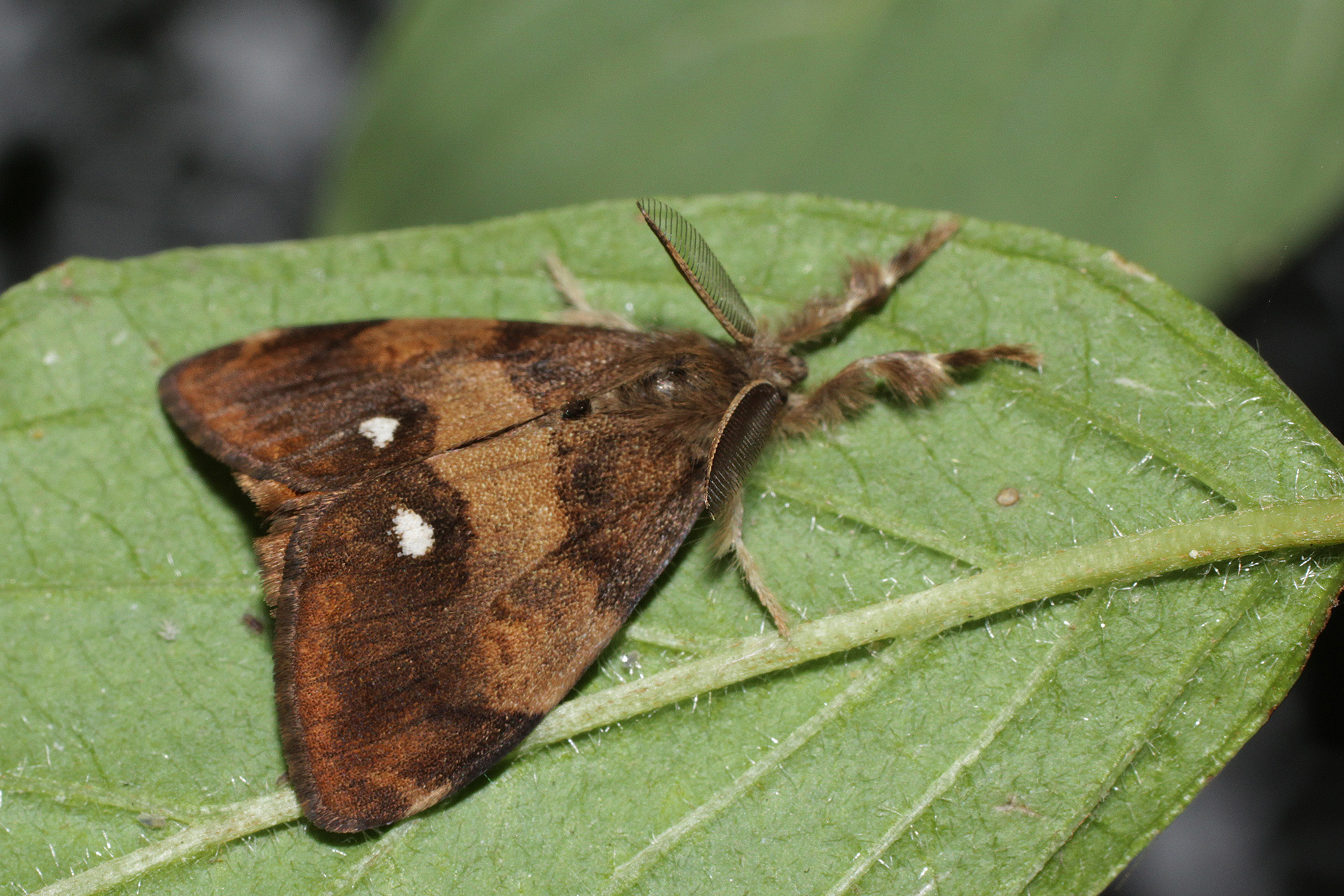
- Male Adult: Adult males are rusty-brown moths with feathery antennae and a distinctive white comma-shaped marking on each forewing. Wingspans typically range from 25-35 mm.
- Female Adult: Females are wingless, grayish, and grub-like. They remain near their cocoon throughout adulthood.
- Egg Masses: Eggs are deposited in dense masses directly on or near the female’s cocoon and are often covered with protective hairs.
Distribution and Habitat
Rusty Tussock Moths occur throughout cooler regions of North America and are commonly found in:
- Forests and woodlands
- Orchards
- Urban landscapes
- Parks and gardens
- Nurseries
- Hedgerows and shelterbelts
They utilize hundreds of host plants, making them one of the most adaptable defoliating insects in temperate regions.
Host Plants
Rusty Tussock Moth caterpillars feed on a broad range of woody plants, including:
- Apple
- Pear
- Cherry
- Willow
- Birch
- Oak
- Rose
- Hawthorn
- Spruce
- Pine
- Fir
- Cedar
Their wide host range contributes to their occasional pest status in orchards and ornamental landscapes.
Life Cycle
Rusty Tussock Moths undergo complete metamorphosis with four life stages: egg, larva, pupa, and adult.
Egg Stage
Eggs overwinter in masses attached to the female’s cocoon, bark, fences, outdoor furniture, or other sheltered surfaces.
Larval Stage
Caterpillars hatch in spring and begin feeding on young foliage. Early instars often feed in groups before dispersing as they mature.
Larvae may disperse by “ballooning,” releasing silk threads that allow wind currents to transport them to new host plants.
Pupal Stage
Fully grown larvae spin silken cocoons on bark, leaves, fences, buildings, or other protected surfaces where pupation occurs.
Adult Stage
Males emerge as winged moths and actively seek females using pheromones. Wingless females remain on their cocoons, mate, lay eggs, and die shortly afterward.
Depending on climate, one to three generations may occur annually.
Damage and Symptoms
Defoliation
Young caterpillars skeletonize leaves by consuming soft tissues between veins. Older larvae consume entire leaves, leaving only major veins or petioles behind.
Reduced Plant Vigor
Repeated defoliation can weaken trees and shrubs, reducing growth and increasing susceptibility to drought, disease, and other insect pests.
Fruit Production Loss
Heavy infestations on fruit trees may reduce flowering, fruit set, and overall yield.
Nuisance Infestations
Large populations may migrate onto homes, outdoor furniture, fences, and recreational areas, becoming significant nuisance pests.
Human Health Concerns
The caterpillars possess irritating hairs that may trigger a condition known as tussockosis.
- Skin irritation
- Redness and itching
- Rash or dermatitis
- Eye irritation
- Occasional respiratory reactions in sensitive individuals
Direct handling should be avoided, and gloves should be worn when removing caterpillars or egg masses.
Management and Control (IPM)
Monitoring
- Inspect susceptible plants regularly during spring and summer.
- Look for egg masses, feeding damage, and young caterpillar colonies.
- Monitor ornamental trees and orchard plantings for early infestations.
Mechanical Control
- Remove and destroy egg masses during winter.
- Prune heavily infested branches.
- Handpick caterpillars when populations are low.
Biological Control
Numerous natural enemies help regulate populations, including:
- Parasitic wasps
- Tachinid flies
- Predatory beetles
- Birds
- Nuclear Polyhedrosis Virus (NPV)
Microbial Control
Bacillus thuringiensis var. kurstaki (Bt) is highly effective against young caterpillars and is commonly recommended for organic management programs.
Chemical Control
Insecticides may be used when severe infestations threaten valuable landscape or orchard plants. Applications are most effective against newly hatched larvae.
Prevention
- Inspect nursery stock before planting.
- Remove overwintering egg masses.
- Encourage beneficial insects and birds.
- Maintain plant health through proper watering and fertilization.
- Monitor susceptible plants regularly.
Economic Importance
Rusty Tussock Moths occasionally become important pests in orchards, nurseries, and ornamental landscapes. Although healthy trees can usually recover from a single defoliation event, repeated infestations may lead to reduced vigor, diminished aesthetic value, and increased maintenance costs.