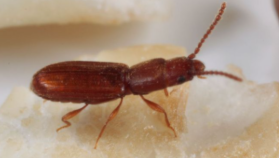
Rusty Grain Beetles (Cryptolestes ferrugineus) are among the most important and widespread pests of stored grain throughout the world. These tiny, flattened beetles primarily infest stored wheat, barley, oats, corn, rice, and processed grain products. Although considered secondary pests because they prefer damaged or broken kernels, their ability to penetrate deep into grain masses and reproduce under cool conditions makes them a serious threat in commercial storage facilities.
Rusty grain beetles are especially problematic in temperate regions, where their exceptional tolerance to low temperatures allows populations to remain active long after many other stored-product insects have become dormant. Heavy infestations can reduce grain quality, lower germination rates, contaminate food products, and contribute to significant economic losses.
Taxonomy and Classification
Rusty grain beetles belong to the family Laemophloeidae, commonly known as flat grain beetles or flat bark beetles.
- Kingdom: Animalia
- Phylum: Arthropoda
- Class: Insecta
- Order: Coleoptera
- Family: Laemophloeidae
- Genus: Cryptolestes
- Species: Cryptolestes ferrugineus
Like other beetles, rusty grain beetles undergo complete metamorphosis consisting of egg, larval, pupal, and adult stages.
Physical Description
Adult rusty grain beetles are extremely small, measuring approximately 1.5 to 2.5 millimeters in length.
- Adult (Key ID): Slender, flattened, reddish-brown beetle with long antennae and a narrow body that allows movement through tightly packed grain.
- Thorax: The thorax possesses distinctive parallel grooves and projections that aid identification.
- Larva (Key ID): Creamy-white, elongated larva with a brown head capsule that feeds primarily on grain fragments and germ tissue.
- Damage ID: Reduced grain quality, contamination, weight loss, and reduced seed viability.
- Conflict: Agricultural, Stored Product.
The beetle’s flattened body enables it to penetrate deep into grain masses, making infestations difficult to detect and control.
Distribution and Habitat
Rusty grain beetles have a nearly worldwide distribution and are especially common in temperate and cooler climates.
They are frequently found in:
- Commercial grain elevators
- Farm grain bins
- Flour mills
- Food processing facilities
- Warehouses
- Feed storage areas
- Stored cereal products
The species thrives in stored commodities such as:
- Wheat
- Corn
- Barley
- Oats
- Rice
- Sorghum
- Flour
- Cereal products
- Animal feed
Life Cycle
The life cycle of the rusty grain beetle varies depending on temperature, humidity, and food availability.
Egg Stage
Females deposit tiny white eggs directly among grain kernels or within cracks and crevices in storage structures. A single female may lay hundreds of eggs during her lifetime.
Larval Stage
After hatching, larvae feed on damaged kernels, grain dust, and germ tissue. They pass through several molts while developing.
Unlike primary grain pests such as rice weevils, rusty grain beetles typically cannot penetrate intact kernels and instead rely on pre-existing damage or cracked grain.
Pupal Stage
Larvae pupate within grain masses or in protected areas among stored products.
Adult Stage
Adults emerge and continue feeding and reproducing. Under favorable conditions, several generations may occur annually.
Development is greatly influenced by environmental conditions, with warmer temperatures accelerating reproduction.
Damage and Economic Impact
Although small, rusty grain beetles can cause substantial economic losses when populations become large.
Common forms of damage include:
- Grain Contamination: Adults, larvae, shed skins, and fecal material contaminate stored commodities.
- Weight Loss: Feeding reduces grain mass and overall market value.
- Reduced Germination: Larval feeding on the embryo decreases seed viability.
- Quality Reduction: Infested grain may fail to meet commercial quality standards.
- Hot Spots: Heavy infestations contribute to moisture accumulation and localized heating within grain masses.
- Secondary Mold Growth: Increased moisture can encourage fungal development and spoilage.
Severe infestations may result in rejected shipments, processing losses, and increased storage costs.
Behavior and Conflict
Rusty grain beetles possess several characteristics that make them especially troublesome stored-product pests.
- Cold Tolerance: They remain active and reproduce at temperatures that suppress many competing insects.
- Deep Penetration: Their flattened bodies allow movement deep within grain bulks.
- Hidden Infestations: Populations often remain undetected until they become severe.
- Rapid Reproduction: Favorable storage conditions can support explosive population growth.
- Insecticide Resistance: Some populations have developed resistance to commonly used insecticides and fumigants.
These traits make rusty grain beetles among the most challenging stored-grain pests to manage.
Management and Prevention
Effective management relies on integrated pest management (IPM) practices that combine sanitation, monitoring, environmental control, and treatment.
Sanitation (Key Strategy)
- Remove old grain and debris before loading new grain.
- Clean bins, augers, trucks, and handling equipment thoroughly.
- Eliminate spilled grain around storage facilities.
- Seal cracks and crevices where insects may hide.
Moisture Management
Maintaining low grain moisture levels is essential.
- Store grain below 12% moisture whenever possible.
- Monitor moisture regularly throughout storage.
- Avoid condensation and moisture migration inside bins.
Aeration
Proper aeration helps maintain uniform grain temperatures and suppress insect activity.
- Use aeration fans to cool grain masses.
- Monitor grain temperature routinely.
- Reduce temperature fluctuations during storage.
Monitoring
Early detection greatly improves management success.
- Use probe traps inside grain bins.
- Inspect grain regularly for insects and damage.
- Monitor temperature and moisture hot spots.
- Sample grain from multiple depths.
Chemical Control
When infestations exceed acceptable thresholds, chemical treatments may be necessary.
- Protectant insecticides may be applied to stored grain.
- Residual treatments can be used on empty storage structures.
- Phosphine fumigation remains one of the most effective methods for eliminating deep infestations.
Because insecticide resistance has been documented, treatments should always follow label recommendations and resistance-management guidelines.
Research and Future Management
Current research focuses on improving detection and management of rusty grain beetles through:
- Advanced probe trap technologies
- Improved fumigation techniques
- Resistance monitoring programs
- Development of alternative control methods
- Enhanced grain storage technologies
- Biological control investigations
Scientists continue to study the genetic basis of insecticide resistance and develop sustainable integrated pest management programs for stored-grain facilities.
Conclusion
Rusty Grain Beetles are highly adaptable stored-product pests capable of surviving and reproducing under conditions unfavorable to many other grain insects. Their small size, cold tolerance, and ability to infest deep grain masses make them especially challenging pests in commercial storage systems. Proper sanitation, moisture management, monitoring, and timely intervention remain essential for protecting stored grain quality and minimizing economic losses.