Overview
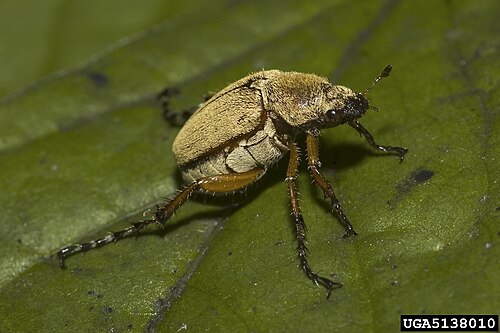
Rose Chafers (Macrodactylus subspinosus) are slender, tan-colored scarab beetles native to North America. Although they are named for their fondness for roses, these insects feed on more than 100 species of ornamental, fruit, and agricultural plants. Adult rose chafers emerge in late spring and early summer, often appearing suddenly in large numbers and causing significant damage within a short period.
The adults feed aggressively on flowers, buds, leaves, and developing fruit, frequently skeletonizing foliage and destroying blossoms. While the adult stage causes the most visible injury, the immature larvae live underground as white grubs and feed on the roots of grasses and weeds. Rose chafers are particularly abundant in areas with sandy soils, where their larvae develop successfully.
Although adult populations are typically active for only three to four weeks each year, severe infestations can result in extensive aesthetic damage to ornamental landscapes and substantial economic losses in vineyards, orchards, and nurseries.
Taxonomy and Classification
Rose chafers belong to the scarab beetle family Scarabaeidae.
- Kingdom: Animalia
- Phylum: Arthropoda
- Class: Insecta
- Order: Coleoptera
- Family: Scarabaeidae
- Subfamily: Melolonthinae
- Genus: Macrodactylus
- Species: Macrodactylus subspinosus
Like other scarab beetles, rose chafers undergo complete metamorphosis consisting of egg, larva, pupa, and adult stages.
Physical Description
Adult rose chafers are easily recognized by their distinctive body shape and long legs.
- Adult Size: Approximately 8 to 12 millimeters (about 10 mm average).
- Color: Yellowish-tan, straw-colored, or grayish-brown.
- Body Shape: Slender, elongated body covered with fine yellowish hairs.
- Legs: Long, spindly reddish-brown legs.
- Larva: Typical C-shaped, creamy-white scarab grub found underground.
- Conflict: Agricultural and ornamental pest.
Adults are often seen clustered together on flowers and foliage during their brief but destructive feeding period.
Distribution and Habitat
Rose chafers are widespread throughout eastern North America and parts of central North America.
They are especially common in regions with:
- Sandy soils
- Coastal areas
- Dry grasslands
- Vineyards
- Orchards
- Home landscapes
- Nurseries
The larvae develop in light-textured soils where they feed on grass and weed roots.
Adult beetles migrate to host plants during late spring and early summer to feed and reproduce.
Host Plants
Rose chafers feed on a remarkably wide range of plants.
Common host plants include:
- Roses
- Grapes
- Apples
- Peaches
- Cherries
- Strawberries
- Raspberries
- Blueberries
- Virginia creeper
- Hollyhocks
- Peonies
- Elm trees
- Linden trees
Many ornamental shrubs, trees, and flowering plants are also susceptible.
Life Cycle
Rose chafers typically complete one generation per year.
Egg Stage
Females lay eggs in sandy soils during early summer, usually a few inches below the surface.
Larval Stage
After hatching, larvae develop as white grubs and feed on the roots of grasses and weeds.
The grub stage lasts throughout summer and autumn. Larvae overwinter in the soil below the frost line.
Pupal Stage
In spring, mature larvae move upward in the soil and pupate.
Adult Stage
Adults emerge from the soil between late May and early July, depending on local climate.
Adult activity generally lasts only three to four weeks, but feeding during this period can be intense.
Behavior and Conflict
The primary conflict associated with rose chafers stems from their gregarious feeding behavior.
- Mass Aggregation: Adults congregate in large groups on favored plants.
- Rapid Feeding: Large numbers of beetles can strip flowers and foliage within days.
- Short Outbreak Period: Damage is concentrated during a brief seasonal window.
- High Mobility: Adults readily move between host plants.
Heavy infestations can overwhelm individual plants, especially ornamentals and fruit crops.
Damage and Symptoms
Adult rose chafers are responsible for nearly all visible plant injury.
Foliage Damage
- Skeletonized leaves
- Irregular holes between leaf veins
- Complete defoliation under severe infestations
Flower Damage
- Chewed petals
- Destroyed flower buds
- Tattered blossoms
- Premature flower drop
Fruit Damage
- Scarring of developing fruit
- Chewed fruit surfaces
- Reduced market quality
In grapes, rose chafers frequently consume flower clusters and young fruit, significantly reducing yields.
Agricultural and Economic Importance
Rose chafers are important pests in both commercial agriculture and residential landscapes.
Economic impacts include:
- Reduced fruit yields
- Lower crop quality
- Loss of ornamental value
- Increased management costs
- Nursery stock damage
Commercial vineyards are particularly vulnerable because adult beetles feed heavily on grape foliage and flower clusters.
Toxicity to Animals
Rose chafers contain toxins that can affect certain animals if consumed in large quantities.
Cases of poisoning have been reported in:
- Poultry
- Chickens
- Small livestock
Consumption of numerous beetles may cause illness or death in susceptible animals.
Management and Control (IPM)
Management typically focuses on protecting susceptible plants during the short adult emergence period.
Physical Control (Key Strategy)
- Hand Removal: Shake beetles from plants into buckets of soapy water during cool morning hours.
- Netting: Cover high-value plants with fine mesh netting during adult activity.
Hand-picking can be highly effective in home gardens.
Cultural Control
- Maintain healthy plants to reduce stress.
- Monitor susceptible plants during late spring.
- Reduce grassy and weedy areas near vulnerable crops when practical.
Biological Control
Beneficial organisms may help suppress larval populations.
- Entomopathogenic nematodes
- Predatory beetles
- Birds
- Parasitic insects
Beneficial nematodes applied to sandy soils may reduce white grub populations.
Chemical Control
When severe infestations occur, insecticides labeled for ornamental or agricultural use may provide temporary protection.
Because adults are highly mobile, repeated applications may be necessary during heavy outbreaks.
Prevention
- Monitor plants regularly during late spring and early summer.
- Protect valuable ornamentals with exclusion netting.
- Encourage beneficial insects and natural enemies.
- Inspect plants frequently for early signs of feeding.
- Apply biological controls to grub-infested soils.
Research and Future Directions
Current research focuses on understanding population dynamics, improving pheromone-based monitoring systems, and evaluating biological control options for both adult beetles and subterranean grubs. Scientists are also studying landscape factors that influence outbreaks in agricultural and ornamental settings.
Conclusion
Rose Chafers are highly destructive scarab beetles capable of causing rapid and severe damage to roses, grapes, fruit trees, and ornamental plants. Although adult activity is relatively brief, mass feeding events can significantly affect both crop production and landscape aesthetics. Early detection, physical removal, exclusion, and integrated pest management practices provide the most effective long-term control strategies.