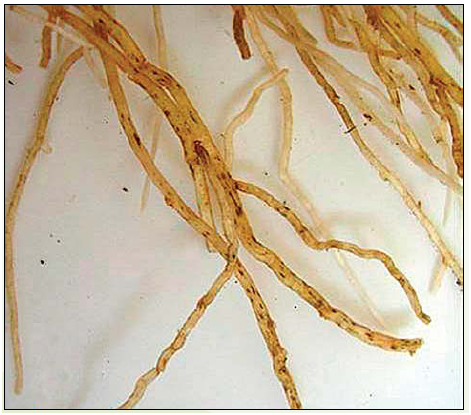
Root Lesion Nematodes (Pratylenchus spp.) are migratory plant-parasitic nematodes that invade and move through plant roots, causing extensive internal damage. Unlike Root-Knot Nematodes, these microscopic roundworms do not induce gall formation. Instead, they tunnel through root tissues, creating dark lesions and destroying the root cortex. Root Lesion Nematodes are among the most economically important nematode pests worldwide, affecting cereals, potatoes, corn, soybeans, fruit trees, ornamentals, and many vegetable crops.
Taxonomy and Classification
Root Lesion Nematodes belong to the phylum Nematoda and are members of the family Pratylenchidae.
- Phylum: Nematoda
- Class: Chromadorea
- Order: Tylenchida
- Family: Pratylenchidae
- Genus: Pratylenchus
More than 70 species of Pratylenchus have been described worldwide. Important agricultural species include Pratylenchus penetrans, Pratylenchus neglectus, Pratylenchus thornei, and Pratylenchus vulnus.
Physical Description
Root Lesion Nematodes are microscopic and invisible to the naked eye.
- Adult (Key ID): Slender, transparent, worm-shaped nematodes measuring approximately 0.4 to 0.8 mm long.
- Stylet: Possess a short, needle-like stylet used to puncture and feed on plant cells.
- Damage ID: Distinct elongated brown or black lesions on roots rather than swollen galls.
- Conflict: Agricultural, Ornamental, Greenhouse.
Because these nematodes remain hidden within roots and soil, laboratory analysis is usually necessary for accurate identification.
Distribution and Habitat
Root Lesion Nematodes are distributed worldwide and occur in nearly every agricultural region.
They are commonly found in:
- Field crops
- Vegetable gardens
- Fruit orchards
- Nurseries
- Greenhouses
- Turfgrass systems
- Ornamental landscapes
These nematodes thrive in a wide range of soil types but are especially problematic in sandy and well-drained soils.
Life Cycle
Root Lesion Nematodes undergo a relatively simple life cycle consisting of egg, juvenile, and adult stages.
Egg Stage
Females deposit eggs singly or in small groups within root tissue or directly into the surrounding soil.
Juvenile Stages
After hatching, juveniles actively migrate through the soil searching for roots. All juvenile stages and adults are capable of feeding.
Root Invasion
Once inside the root, nematodes migrate through the cortex while feeding and reproducing. Their movement destroys cells and leaves behind extensive areas of dead tissue.
Unlike sedentary nematodes, Root Lesion Nematodes continually move between roots and soil throughout their lives.
Adult Stage
Adults continue feeding, reproducing, and migrating throughout the growing season. Under favorable conditions, multiple generations may occur annually.
Damage and Symptoms
Root Lesion Nematodes damage plants directly through feeding and indirectly by increasing susceptibility to other diseases.
Below-Ground Symptoms
- Dark brown or black root lesions
- Root decay and tissue collapse
- Reduced feeder roots
- Root pruning and deterioration
- “Rat-tail” roots caused by loss of the root cortex
Above-Ground Symptoms
- Stunted growth
- Yellowing foliage
- Poor vigor
- Wilting during hot weather
- Uneven crop growth
- Reduced yields
Above-ground symptoms often resemble drought stress or nutrient deficiencies, making diagnosis difficult without root inspection.
Disease Complexes
Root Lesion Nematodes frequently interact with soil-borne pathogens, creating destructive disease complexes.
- Verticillium Wilt
- Fusarium Root Rot
- Rhizoctonia Diseases
- Pythium Root Rot
The feeding wounds created by the nematodes provide entry points for fungal pathogens, often greatly increasing plant losses.
Host Plants
Root Lesion Nematodes attack numerous crops, including:
- Potatoes
- Corn
- Wheat
- Soybeans
- Barley
- Alfalfa
- Fruit trees
- Strawberries
- Vegetables
- Ornamental plants
- Turfgrass
Management and Control (IPM)
Long-term suppression relies on integrated management strategies.
Crop Rotation
- Rotate with poor-host or non-host crops.
- Avoid planting susceptible crops repeatedly in the same area.
Cover Crops and Biofumigation
- Use mustard cover crops for biofumigation.
- Incorporate sudangrass or resistant cover crop species.
- Select cover crops carefully because some species may support nematode populations.
Resistant Varieties
Plant resistant or tolerant cultivars whenever available.
Soil Health Improvement
- Add organic matter regularly.
- Encourage beneficial soil microorganisms.
- Maintain proper soil fertility.
Sanitation
- Use certified nematode-free planting material.
- Prevent movement of contaminated soil and equipment.
- Remove infected plant debris.
Soil Treatment
- Steam sterilization may be used in greenhouse production.
- Soil solarization can help reduce populations in small planting areas.
- Nematicides may be used in commercial agriculture when economically justified.
Economic Importance
Root Lesion Nematodes cause substantial economic losses worldwide through reduced crop yields, lower quality, and increased disease susceptibility. In many cropping systems, they are among the most damaging soil pests because infestations often go undetected until severe root damage has occurred.
Research and Future Management
Current research focuses on biological control agents, resistant crop varieties, soil health enhancement, and molecular diagnostic techniques. Scientists are also investigating beneficial fungi and bacteria that naturally suppress lesion nematode populations.