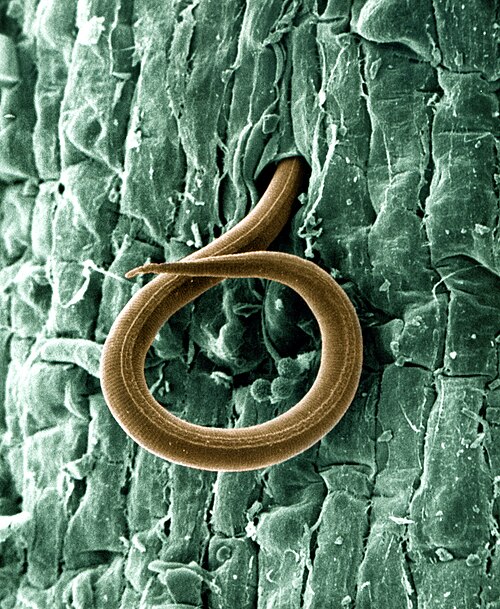
Root-Knot Nematodes (Meloidogyne spp.) are microscopic parasitic roundworms that attack plant roots and are considered among the most economically destructive soil pests worldwide. These nematodes infest thousands of plant species, including vegetables, fruits, field crops, ornamentals, and turfgrass. Their feeding activity causes characteristic swellings known as root galls or “knots,” which interfere with the plant’s ability to absorb water and nutrients. Severe infestations can result in stunted growth, poor yields, and even complete crop failure.
Taxonomy and Classification
Root-Knot Nematodes belong to the phylum Nematoda and are members of the family Meloidogynidae. Several species are responsible for agricultural losses worldwide.
- Phylum: Nematoda
- Class: Chromadorea
- Order: Tylenchida
- Family: Meloidogynidae
- Genus: Meloidogyne
Common species include Meloidogyne incognita, Meloidogyne javanica, Meloidogyne arenaria, and Meloidogyne hapla.
Physical Description
Root-Knot Nematodes are microscopic and cannot usually be seen without magnification. However, the damage they cause is often readily visible.
- Juveniles (Key ID): Slender, transparent, worm-like organisms measuring approximately 0.3 to 0.5 mm long. The second-stage juvenile is the infective stage.
- Adult Female (Key ID): Pear-shaped, creamy-white, sedentary nematodes found embedded within root tissue.
- Adult Male: Slender and worm-shaped, rarely observed in field populations.
- Damage ID: Characteristic swollen root galls or “knots” that cannot be removed without tearing the root tissue.
- Conflict: Agricultural, Ornamental, Greenhouse.
Distribution and Habitat
Root-Knot Nematodes occur worldwide and are especially problematic in warm climates and sandy soils.
They are commonly found in:
- Vegetable gardens
- Commercial crop fields
- Greenhouses
- Nurseries
- Orchards
- Landscape plantings
- Turfgrass systems
Warm temperatures and moist soils favor nematode reproduction and population growth.
Life Cycle
The Root-Knot Nematode undergoes several developmental stages consisting of egg, juvenile, and adult phases.
Egg Stage
Adult females deposit eggs in gelatinous masses attached to or embedded within root tissue. A single female may produce several hundred to more than one thousand eggs.
Juvenile Stage
The second-stage juvenile (J2) hatches from the egg and moves through the soil searching for suitable roots.
After penetrating the root, the juvenile migrates toward the vascular tissue and establishes a permanent feeding site.
Feeding Site Formation
Nematodes inject secretions into plant cells, stimulating the formation of enlarged “giant cells.” These specialized cells provide a continuous nutrient source for the developing nematode.
As feeding continues, surrounding tissues enlarge and form visible galls.
Adult Stage
Females remain embedded within the root, while males, when present, leave the root after development.
Under favorable conditions, the complete life cycle may be completed in as little as three to four weeks, allowing multiple generations annually.
Damage and Symptoms
Root-Knot Nematodes damage plants by disrupting normal root function.
Below-Ground Symptoms
- Root galls or knots
- Distorted, swollen root systems
- Reduced feeder roots
- Root cracking and decay
- Secondary root rot infections
Above-Ground Symptoms
- Stunted growth
- Wilting during hot weather
- Yellowing leaves (chlorosis)
- Nutrient deficiency symptoms
- Reduced fruit size and yield
- Poor plant vigor
Plants often wilt despite adequate irrigation because damaged roots cannot efficiently absorb water.
Host Plants
Root-Knot Nematodes attack a wide range of economically important plants, including:
- Tomatoes
- Peppers
- Cucumbers
- Melons
- Beans
- Carrots
- Potatoes
- Cotton
- Soybeans
- Fruit trees
- Roses and ornamentals
Management and Control (IPM)
Effective management requires an integrated approach because eradication is rarely possible once nematodes become established.
Resistant Varieties
- Select resistant cultivars whenever available.
- Look for the “N” designation in tomato variety labels, indicating nematode resistance.
Crop Rotation
- Rotate susceptible crops with non-host or resistant plants.
- Use cereals or grasses when appropriate.
Soil Solarization
Cover moist soil with clear plastic during the hottest part of summer for four to six weeks. Solarization can significantly reduce nematode populations in the upper soil layers.
Organic Amendments
- Add compost to improve soil health.
- Incorporate organic matter to encourage beneficial microorganisms.
- Use marigold cover crops where appropriate.
Biological Control
Beneficial fungi, bacteria, and predatory nematodes may help suppress populations naturally.
Sanitation
- Remove and destroy heavily infested plants.
- Clean equipment to prevent movement of contaminated soil.
- Use nematode-free transplants and potting media.
Economic Importance
Root-Knot Nematodes cause billions of dollars in agricultural losses worldwide every year. Their broad host range, rapid reproduction, and persistence in soil make them among the most challenging crop pests to manage.
Infestations may reduce both crop quantity and quality, significantly affecting profitability for commercial growers and home gardeners alike.
Research and Future Management
Researchers continue to investigate resistant crop varieties, biological control agents, soil health management practices, and environmentally sustainable nematode suppression techniques. Advances in molecular diagnostics are also improving early detection and species identification.