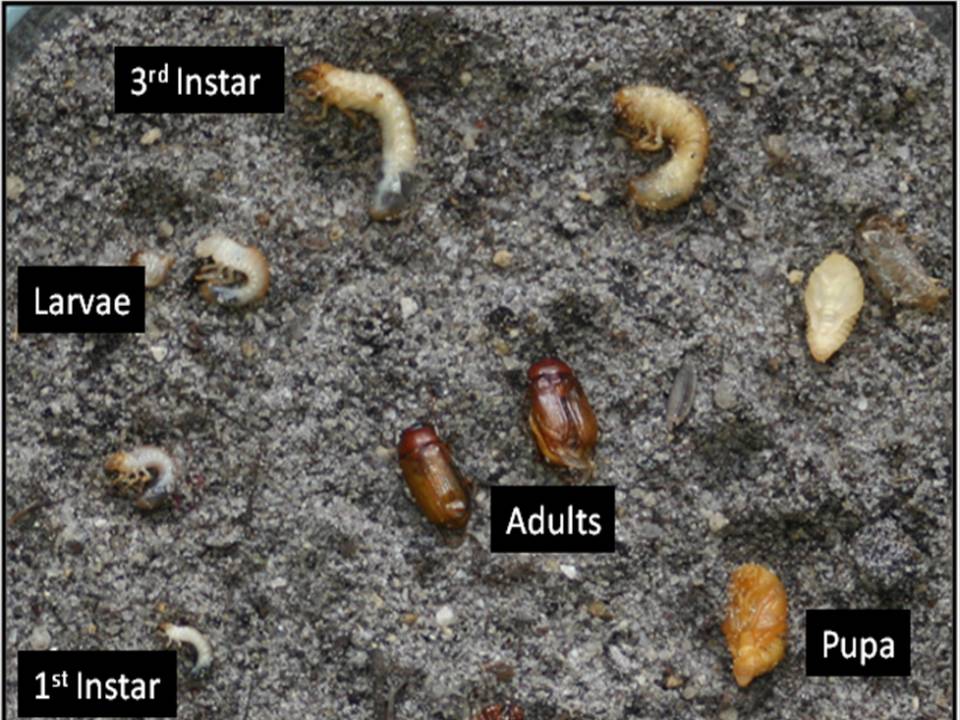
Root-Feeding Grubs are the immature larval stage of various scarab beetles and represent some of the most destructive soil-dwelling pests affecting lawns, ornamental landscapes, nurseries, and agricultural crops. These subterranean larvae feed on plant roots, reducing water and nutrient uptake and causing extensive damage to turfgrass and other plants. Severe infestations may result in widespread plant death and costly landscape repairs.
Taxonomy and Classification
Root-feeding grubs belong primarily to the family Scarabaeidae, one of the largest beetle families in the world.
- Order: Coleoptera
- Family: Scarabaeidae
- Common Species: Japanese Beetles (Popillia japonica), June Beetles (Phyllophaga spp.), European Chafers (Amphimallon majale), and Masked Chafers (Cyclocephala spp.)
While adult beetles may feed on foliage, flowers, or fruit, the larval stage is responsible for the majority of below-ground damage.
Physical Description
Root-feeding grubs are easily recognized by their distinctive body shape.
- Larva (Key ID): Creamy-white, soft-bodied, C-shaped larvae with a reddish-brown head capsule and six well-developed legs near the front of the body.
- Size: Depending on species and age, grubs range from 0.5 to 2 inches (12-50 mm) long.
- Raster Pattern: The arrangement of hairs and spines on the underside of the last abdominal segment helps specialists identify individual grub species.
- Conflict: Turfgrass, Agricultural, Ornamental.
Grubs are typically found within the upper 2 to 6 inches of soil where roots are most abundant.
Distribution and Habitat
Root-feeding grubs occur throughout North America and many other regions worldwide.
Preferred habitats include:
- Lawns and residential landscapes
- Golf courses
- Parks and sports fields
- Nurseries and ornamental plantings
- Pastures
- Agricultural fields
Most species prefer moist, well-irrigated soils that provide abundant root material for feeding.
Life Cycle
The life cycle of root-feeding grubs consists of complete metamorphosis with four stages: egg, larva, pupa, and adult.
Egg Stage
Adult beetles lay eggs in the soil during summer. Females typically select moist soil containing healthy turf or host plants.
Larval Stage
Eggs hatch into young grubs that immediately begin feeding on roots. The larvae pass through several developmental stages, known as instars, while continuously consuming root tissue.
This stage causes nearly all economic damage.
Pupal Stage
After completing development, mature grubs move deeper into the soil and pupate in earthen cells.
Adult Stage
Adults emerge from the soil and feed, mate, and lay eggs to begin a new generation. Most species complete one generation annually, although development may take two or three years in some June beetles.
Damage and Symptoms
Root-feeding grubs damage plants by consuming feeder roots and larger root structures.
Turfgrass Damage
- Irregular brown patches in lawns
- Wilting despite adequate irrigation
- Spongy or soft turf underfoot
- Grass that lifts easily from the soil like loose carpet
Severely damaged turf may die completely during periods of drought or heat stress.
Secondary Damage
Infested lawns frequently attract predators such as:
- Skunks
- Raccoons
- Armadillos
- Moles
- Birds
These animals often dig extensively while searching for grubs, creating additional landscape damage.
Agricultural Damage
In crop systems, grub feeding reduces plant vigor, stunts growth, lowers yields, and may kill seedlings and young plants.
Behavior and Conflict
Root-feeding grubs spend nearly their entire larval lives underground.
- Subterranean Feeding: Grubs remain hidden below the soil surface, making infestations difficult to detect until damage appears.
- Seasonal Activity: Feeding activity typically peaks during late summer and early autumn when grubs are largest.
- Drought Sensitivity: Damaged turf becomes highly susceptible to drought stress because root systems are greatly reduced.
Management and Control (IPM)
Integrated pest management provides the most effective long-term control.
Monitoring
- Inspect turf by cutting and lifting sections of sod.
- Count grubs per square foot to determine infestation levels.
- Monitor for animal digging and spongy turf.
Economic thresholds vary by species, but populations exceeding 8 to 10 grubs per square foot often warrant treatment.
Cultural Control
- Maintain healthy turf through proper irrigation and fertilization.
- Avoid excessive watering during beetle egg-laying periods.
- Reduce thatch accumulation where beetles prefer to lay eggs.
Biological Control
- Apply beneficial nematodes such as Heterorhabditis bacteriophora.
- Use Milky Spore (Paenibacillus popilliae) against Japanese beetle grubs.
- Encourage natural predators whenever possible.
Chemical Control
- Preventative insecticides are most effective against newly hatched grubs.
- Curative treatments target actively feeding larger larvae.
- Always follow product labels and local regulations.
Economic Importance
Root-feeding grubs cause millions of dollars in annual damage to lawns, golf courses, sod farms, nurseries, and agricultural crops. Treatment expenses, turf replacement, and secondary wildlife damage can significantly increase management costs.
Research and Future Management
Current research focuses on improved biological controls, precision application technologies, and sustainable turf management practices that reduce grub populations while minimizing impacts on beneficial organisms and pollinators.