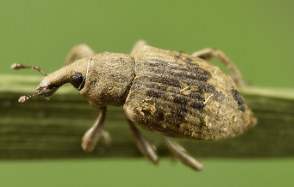
Rice Water Weevils (Lissorhoptrus oryzophilus) are among the most economically important pests of rice production in North America. These small aquatic weevils are particularly damaging in flooded rice systems, where their larvae feed beneath the waterline on rice roots. Heavy infestations can significantly reduce yields by weakening plants, delaying maturity, and decreasing nutrient uptake.
Taxonomy and Classification
Rice Water Weevils belong to the order Coleoptera and the family Curculionidae, commonly known as the snout beetles or true weevils.
- Order: Coleoptera
- Family: Curculionidae
- Genus: Lissorhoptrus
- Species: Lissorhoptrus oryzophilus
Native to North America, the Rice Water Weevil has expanded its range to numerous rice-growing regions worldwide and is now considered one of the most significant pests of cultivated rice.
Physical Description
Adult Rice Water Weevils are small beetles measuring approximately 3 to 4 millimeters in length.
- Adult (Key ID): Small grayish-brown beetle with a distinctive dark V-shaped marking on the back and a prominent snout.
- Larva (Key ID): White, legless grub with a small brown head capsule, typically found feeding on submerged rice roots.
- Leaf Damage: Adults create narrow, elongated feeding scars that run parallel to leaf veins.
- Behavior: Adults often drop into water and remain motionless when disturbed.
- Conflict: Agricultural.
Distribution and Habitat
Rice Water Weevils are widely distributed throughout rice-producing regions of the United States, particularly in:
- Arkansas
- Louisiana
- Mississippi
- Texas
- California
- Missouri
The species has also spread internationally to Asia and Europe, where it has become an important invasive agricultural pest.
Rice Water Weevils thrive in flooded rice fields, wetlands, and other aquatic environments associated with rice cultivation. Adults overwinter in grasses, field borders, and plant debris surrounding rice paddies.
Life Cycle
The life cycle consists of egg, larval, pupal, and adult stages.
Egg Stage
Females lay eggs inside leaf sheaths shortly after permanent flooding is established. Eggs hatch within several days depending on temperature.
Larval Stage
After hatching, larvae migrate downward through the water and begin feeding on rice roots. The larval stage is responsible for the majority of crop damage.
Larvae pass through four instars while feeding on root tissue beneath the soil surface.
Pupal Stage
Pupation occurs underwater in mud chambers attached to rice roots. Adults emerge after approximately one week.
Adult Stage
Newly emerged adults feed on rice foliage before seeking overwintering sites. Depending on climate, one to two generations may occur annually.
Behavior and Damage
The Rice Water Weevil is unique because both adults and larvae damage rice plants.
- Adult Feeding: Adults scrape leaf surfaces, creating narrow white feeding scars.
- Root Feeding: Larvae consume fine roots and tunnel into larger roots.
- Nutrient Loss: Damaged roots cannot efficiently absorb water and nutrients.
- Plant Weakening: Severe infestations result in poor plant vigor and reduced yields.
Common symptoms of infestation include:
- Stunted growth
- Yellowing foliage (chlorosis)
- Delayed maturity
- Reduced tillering
- Poor root development
- Lodging of mature plants
Heavy infestations may reduce yields by 25% to 50% if left unmanaged.
Economic Importance
Rice Water Weevils are considered the most important insect pest of rice in the United States. Annual economic losses and management costs amount to millions of dollars across major rice-producing states.
Because larval feeding occurs below the water surface, infestations often remain unnoticed until plants begin showing visible signs of stress. This hidden feeding behavior makes early detection and preventive management essential.
Management and Control (IPM)
Successful management relies on an integrated pest management approach combining cultural, chemical, and monitoring practices.
Monitoring
- Scout fields regularly after flooding.
- Inspect leaves for feeding scars.
- Sample roots to determine larval populations.
- Monitor adult populations before and after flooding.
Cultural Control
- Delayed Flooding: Postponing permanent flooding allows plants to develop stronger root systems.
- Field Sanitation: Remove grassy weeds and crop residue from field borders.
- Water Management: Temporary drainage may reduce larval survival in some situations.
- Tillage: Fall and winter tillage can destroy overwintering sites.
Seed Treatments
Systemic seed treatments provide highly effective early-season protection.
- Chlorantraniliprole seed treatments
- Cyantraniliprole seed treatments
- Other registered systemic insecticides
Seed treatments are widely used throughout U.S. rice production systems.
Chemical Control
Foliar and water-applied insecticides may be used when economic thresholds are exceeded.
- Apply treatments according to local extension recommendations.
- Target applications during peak adult activity.
- Rotate insecticide classes to reduce resistance development.
Prevention
- Use certified seed and recommended seed treatments.
- Maintain healthy, vigorous rice stands.
- Monitor fields regularly throughout the growing season.
- Manage weeds around field margins.
- Follow regional integrated pest management recommendations.
Research and Future Management
Current research focuses on improving integrated pest management programs, developing resistant rice varieties, refining flood management practices, and reducing reliance on conventional insecticides. Scientists are also investigating biological control agents and improved monitoring systems to enhance sustainable rice production.