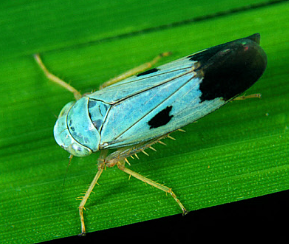
Rice leafhoppers are small, sap-sucking insects that pose a significant threat to rice production worldwide. Belonging to the family Cicadellidae, these pests feed on plant sap by piercing leaf tissues, weakening plants and reducing crop yields. In addition to direct feeding damage, rice leafhoppers are known vectors of plant pathogens, making them particularly dangerous in agricultural systems.
Adult leafhoppers are typically slender, wedge-shaped insects that range in color from green to brown. Their ability to jump quickly when disturbed makes them difficult to catch and observe. Nymphs resemble smaller, wingless versions of adults and are equally destructive.
The Iridescent Vector: Rice Leafhoppers
The Rice Leafhopper (primarily Nephotettix spp., though in the United States, related Draeculacephala and Macrosteles species affect rice) is a “noxious” sap-sucking pest. While they are a global threat to food security, in the U.S. Rice Belt (Arkansas, Louisiana, California, and Texas), they are monitored with extreme precision. These “O” pests are not just damaging because they drain the plant’s fluids; they are the primary delivery system for devastating viral diseases like Rice Tungro and Hoja Blanca, which can wipe out a Tucson-area specialty grain patch or a multi-acre commercial field in weeks.
Identification: The “Wedge-Shaped” Hopper
Identifying Rice Leafhoppers requires distinguishing them from larger grasshoppers or smaller aphids. For Pestipedia.com users, the “wedge” profile and active jumping are the key markers:
- Appearance: Small (3mm to 5mm), bright green to yellowish-green insects. They have a characteristic wedge-shaped body that is widest at the head and tapers to a point at the wing tips.
- The “Black Spot” Clue: Many species feature a distinct black spot on the center of their face or at the very tips of their wings.
- Movement: They are famous for “sideways” walking when disturbed on a leaf blade. When threatened, they use powerful hind legs to “hop” or fly several feet to a new host.
- The Nymphs: Younger hoppers are wingless and lighter green. They often congregate in the “shady” mid-section of the rice plant to avoid the direct Arizona or Southern sun.
The “Hopperburn” and Viral Damage
The “noxious” impact of Rice Leafhoppers is twofold: physical “burning” and pathological “wilting”:
- Hopperburn: As thousands of hoppers suck sap from the vascular bundles, they inject toxic saliva that plugs the plant’s “plumbing.” This causes the leaves to turn yellow, then brown and crispy, a condition known as “Hopperburn.”
- Tungro Virus: This is the most serious threat. The hoppers transmit a virus that stunts the plant, prevents “heading” (grain production), and causes the leaves to turn a sickly orange-yellow.
- Honeydew Mess: Like their aphid cousins, they excrete sticky honeydew. In the humid conditions of a rice paddy, this encourages Sooty Mold, which coats the leaves and stops photosynthesis.
U.S. Management: Water and Resistance
In the United States, managing Rice Leafhoppers is an integrated process that focuses on Physical Disruption and Varietal Resistance.
- Water Level Management: Some U.S. growers use “Flash Flooding.” By briefly raising the water level in the paddy and then lowering it, the nymphs are physically washed off the stems and drowned or exposed to predators.
- The “Sweep Net” Audit: For Pestipedia.com users, the standard U.S. intervention threshold is typically 5 to 10 hoppers per sweep. If you catch more than this in your net, a treatment is necessary to prevent a viral outbreak.
- Resistant Varieties: The most effective “organic” defense is planting U.S.-developed rice varieties that have been bred with “non-preference” traits, meaning the leafhoppers find the stalks too tough or unappealing to bite.
- Natural Predator Support: Spiders (especially Wolf Spiders) and Mirid Bugs are the primary enemies of leafhoppers in the U.S. Avoiding broad-spectrum “calendar sprays” allows these beneficial hunters to keep the hopper population below the “noxious” level naturally.
Damage and Symptoms
Rice leafhoppers damage plants by extracting sap from leaves, which leads to yellowing, curling, and reduced photosynthesis. Heavy infestations can cause “hopperburn,” a condition where leaves dry out and plants appear scorched. This damage can significantly reduce grain production.
Even more concerning is their role as disease vectors. Rice leafhoppers transmit viral diseases that can spread rapidly through crops, compounding damage and making control more challenging.
Life Cycle and Behavior
Leafhoppers undergo incomplete metamorphosis, with egg, nymph, and adult stages. Females lay eggs within plant tissue, providing protection from predators and environmental conditions. Nymphs emerge and begin feeding immediately, molting several times before reaching adulthood.
Populations can build quickly under favorable conditions, particularly in warm climates with abundant host plants.
Management Strategies
- Use resistant rice varieties when available
- Monitor populations with field scouting
- Encourage natural predators such as spiders and parasitic wasps
- Apply targeted insecticides when thresholds are exceeded
- Practice crop rotation and field sanitation
Integrated pest management approaches are essential to reduce reliance on chemical controls and prevent resistance development.