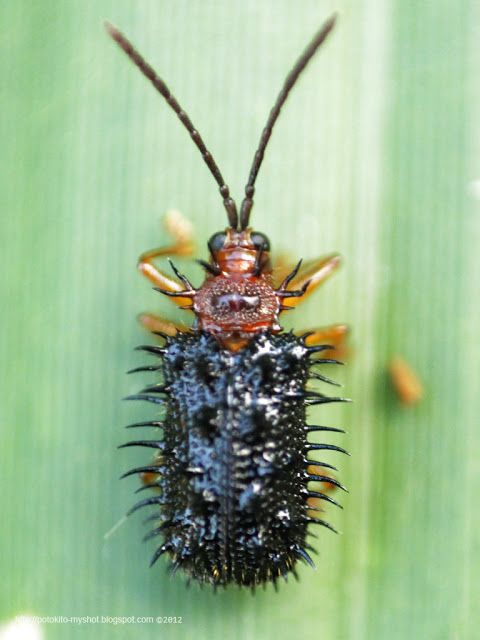
Rice hispa beetles are small, spiny beetles that are serious pests of rice crops, particularly in Asia and other rice-producing regions. Both adults and larvae feed on rice plants, causing damage that reduces photosynthesis and ultimately lowers yield. Their distinctive spiny bodies make them easy to identify, but infestations can still escalate quickly if left unmanaged.
Adult beetles scrape the leaf surface, leaving white streaks and scars, while larvae mine within leaf tissues, creating visible tunnels. This dual feeding behavior increases the overall damage potential compared to pests that feed externally or internally alone.
The Spiny Leaf-Miner: Rice Hispa
The Rice Hispa (Dicladispa armigera) is a “noxious” and highly specialized leaf-feeding beetle. While it is a major pest in Southeast Asia, it is a high-priority “quarantine alert” species in the United States, particularly in the rice-growing regions of California and the Gulf Coast. The Rice Hispa is unique because it attacks the plant in two distinct ways: the adults “scrape” the leaf surface, while the larvae “mine” inside the leaf tissue. In the U.S. Rice Belt, an undetected outbreak can lead to “total leaf parchment,” where an entire field turns white and brittle as if scorched by a chemical burn.
Identification: The “Spiny Black” Beetle
Identifying the Rice Hispa requires looking for its characteristic “armor.” For Pestipedia.com users, the small, thorny body is the definitive diagnostic key:
- The Adult: A very small (5mm), square-shaped beetle. It is entirely bluish-black and covered in numerous sharp, black spines protruding from its wing covers (elytra) and thorax.
- The Larva: A flattened, pale yellow “grub” that lives entirely inside the leaf. Because it is a leaf-miner, it lacks functional legs and has a hardened, wedge-shaped head for tunneling through plant cells.
- The “Window” Sign: Look for clear, longitudinal “windows” on the leaf blade. Adults scrape off the green chlorophyll in long parallel lines, leaving only the transparent lower epidermis.
- The “Blister” Mine: Near the leaf tips, look for slightly swollen, brownish “blisters.” This is where the larva is feeding and pupating between the leaf layers.
The “White Leaf” Damage
The “noxious” impact of the Rice Hispa is the rapid destruction of the plant’s photosynthetic “factory”:
- Leaf Scorching: As the “windowpane” streaks merge, the entire leaf loses its ability to capture sunlight. The leaves turn white, wither, and eventually die, starting from the tips.
- Stunted Heading: If the attack occurs during the “tillering” stage, the plant will produce fewer stalks and smaller grain heads.
- Vulnerability to Wind: Heavily mined leaves become structurally weak and “shred” easily during Gulf Coast storms or California valley winds, further stressing the plant.
U.S. Monitoring and Integrated Management
In the United States, managing the Rice Hispa is focused on Early Detection and Habitat Modification to prevent the pest from establishing a foothold.
- The “Leaf-Tip” Clip: Since 70–80% of Hispa eggs and larvae are found in the top 2-3 inches of the leaf, some growers use “clipping” in early-stage infestations. The leaf tips are trimmed and destroyed to physically remove the next generation.
- The “Sweep Net” Alert: For Pestipedia.com users, the U.S. scouting threshold is typically 1 adult per hill or 1 “fresh” mine per leaf. Exceeding this during the vegetative stage requires immediate intervention.
- Nitrogen Balancing: Like many leaf-feeders, the Hispa is attracted to “luxury” nitrogen levels. Reducing excessive fertilization in Tucson-area specialty grain plots makes the leaves less succulent and harder for the larvae to mine.
- Weed Sanitation: The adults overwinter on wild grasses (like Echinochloa) near the edges of fields. Mowing or tilling these “bridge” habitats in late autumn destroys the adult hiding spots and reduces the spring “surge.”
Damage and Symptoms
Rice hispa damage is characterized by whitish streaks on leaves caused by adult feeding, along with serpentine mines created by larvae inside leaf tissues. Heavy infestations can cause leaves to dry out, reducing the plant’s ability to photosynthesize effectively.
Severely affected fields may show reduced plant vigor, delayed growth, and lower grain production. Damage is particularly severe during early plant growth stages.
Life Cycle
Females lay eggs on rice leaves, and once hatched, larvae begin mining inside the leaf. After completing development, larvae pupate within the leaf tissue. Adults emerge and continue feeding, restarting the cycle.
The life cycle is relatively short, allowing populations to build rapidly under favorable environmental conditions.
Management and Control
- Monitor fields regularly for early signs of feeding damage
- Use resistant rice varieties when available
- Maintain proper water management in fields
- Encourage natural enemies such as parasitoids
- Apply insecticides if infestation levels exceed economic thresholds
Timely intervention is critical to minimizing yield loss and preventing widespread infestation.