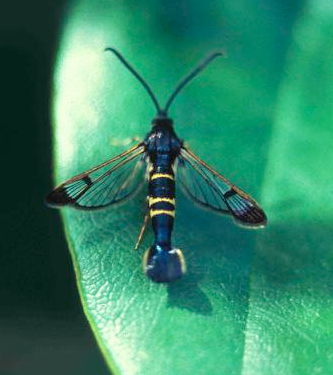
Rhododendron Borers (Synanthedon rhododendri) are clearwing moth larvae that tunnel into the stems and branches of rhododendrons, azaleas, mountain laurels, and related ornamental shrubs. These hidden pests are among the most destructive borers affecting established landscape plantings because their feeding occurs deep within woody tissues, often going unnoticed until severe damage becomes apparent. Heavy infestations can weaken or kill branches and, in extreme cases, destroy entire shrubs.
Taxonomy and Classification
Rhododendron borers belong to the order Lepidoptera and the family Sesiidae, commonly known as clearwing moths. Members of this family are notable for their remarkable resemblance to bees and wasps.
- Order: Lepidoptera
- Family: Sesiidae
- Genus: Synanthedon
- Species: Synanthedon rhododendri
Unlike most moths, clearwing moths are active during daylight hours and rely on mimicry rather than camouflage for protection from predators.
Physical Description
Rhododendron borers spend most of their life cycle concealed inside woody stems.
- Adult (Key ID): Small, day-flying moth with transparent wings and a slender black body marked with yellow bands, giving it a wasp-like appearance.
- Larva (Key ID): Creamy-white caterpillar with a dark brown head capsule, typically measuring up to 20 mm long when fully developed.
- Pupa: Brown and enclosed within the stem tunnel prior to adult emergence.
- Damage ID: Circular emergence holes, branch dieback, and accumulations of reddish-brown frass (sawdust) around stems and branch crotches.
- Conflict: Ornamental, Structural Plant Damage.
Distribution and Habitat
Rhododendron borers are widely distributed throughout eastern North America and occur wherever rhododendrons and related host plants are grown.
Preferred habitats include:
- Residential landscapes
- Botanical gardens
- Commercial nurseries
- Woodland gardens
- Parks and public landscapes
Infestations are most common in older, stressed, or poorly maintained shrubs.
Life Cycle
Rhododendron borers generally complete one generation every one to two years, depending on environmental conditions.
Egg Stage
Adult females lay eggs on bark crevices, pruning wounds, branch crotches, or areas of damaged bark.
Larval Stage
After hatching, larvae bore directly into stems and begin feeding beneath the bark and within woody tissues. Larvae may tunnel extensively for many months.
Pupal Stage
When development is complete, larvae pupate within their tunnels. Shortly before emergence, pupae move toward the stem surface.
Adult Stage
Adults emerge during late spring and early summer, leaving behind characteristic circular exit holes. Adult moths live only a short time and focus primarily on reproduction.
Damage and Symptoms
Damage caused by rhododendron borers is often subtle during early infestation stages but becomes increasingly severe over time.
Branch Dieback
Larval feeding disrupts water and nutrient movement, causing affected branches to wilt and die.
Frass Accumulation
Fine, reddish-brown sawdust-like frass may accumulate at branch unions, bark cracks, or around the base of the shrub.
Stem Weakening
Tunneling hollows out stems and branches, making them brittle and susceptible to breakage during storms or high winds.
Secondary Disease
Borer entry and feeding wounds provide entry points for fungal pathogens and canker diseases, further accelerating plant decline.
Behavior and Ecology
Rhododendron borers exhibit several behaviors that make them difficult to detect and control.
- Hidden Feeding: Larvae remain concealed inside woody tissues throughout development.
- Stress Preference: Females preferentially lay eggs on weakened, wounded, or stressed shrubs.
- Daytime Activity: Adults are active during daylight and often resemble wasps in flight.
- Localized Damage: Infestations usually begin in individual branches before spreading throughout the shrub.
Management and Control
Management focuses on prevention, early detection, and removal of infested wood.
Cultural Control
- Maintain proper irrigation and mulching to reduce plant stress.
- Avoid unnecessary wounding of stems and branches.
- Prune during recommended periods to minimize attraction to egg-laying females.
Mechanical Control
- Prune and destroy infested branches immediately.
- Cut several inches below visible damage to ensure larvae are removed.
- Dispose of pruned material by burning, chipping, or sealing in bags.
Monitoring
Pheromone traps designed for clearwing borers can help detect adult activity and determine optimal treatment timing.
Chemical Control
Preventive bark applications of appropriately labeled insecticides may protect susceptible plants during peak adult flight periods. Once larvae enter stems, insecticides become far less effective.
Prevention
Healthy, vigorously growing rhododendrons are less attractive to borers. Proper site selection, adequate moisture, mulching, and regular inspection are essential preventive measures.
Economic Importance
Rhododendron borers are significant pests in ornamental landscapes and nurseries because mature shrubs often represent substantial financial and aesthetic investments. Severe infestations can necessitate costly replacement of established plants.
Research and Conservation
Current research focuses on improving pheromone-based monitoring systems, identifying resistant cultivars, and developing more sustainable integrated pest management programs for ornamental landscapes.