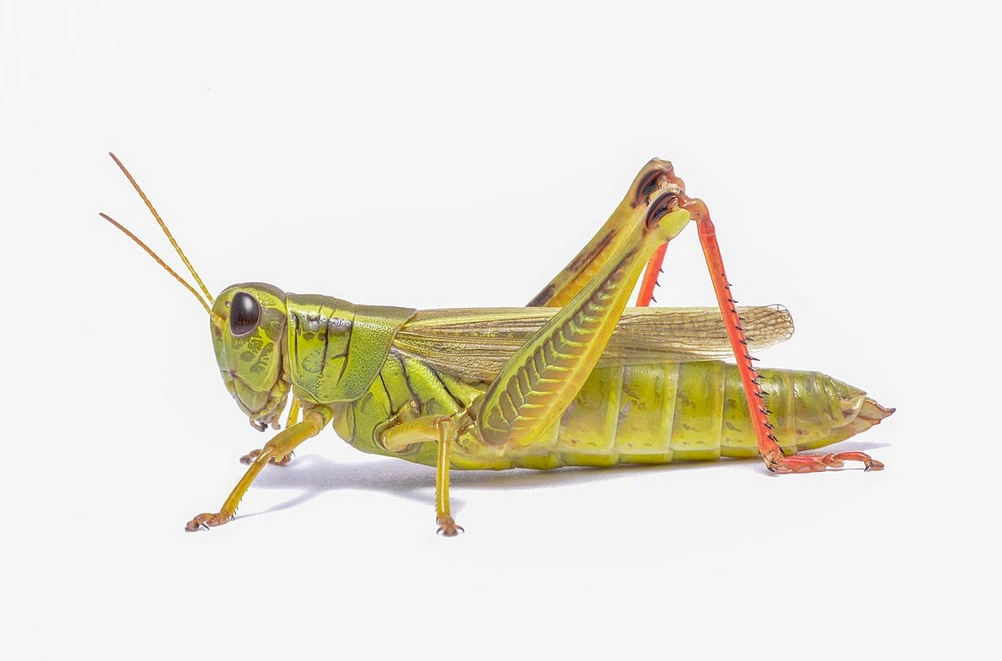
Redlegged Grasshoppers
Redlegged Grasshoppers (Melanoplus femurrubrum) are among the most widespread and economically important grasshopper species in North America. These highly mobile insects feed on a broad range of agricultural crops, grasses, weeds, and ornamental plants. During outbreak years, large populations can cause severe defoliation, reducing crop yields and damaging landscapes. Their adaptability and broad host range make them significant pests in both agricultural and urban environments.
Taxonomy and Classification
Redlegged Grasshoppers belong to the family Acrididae, commonly known as short-horned grasshoppers.
- Order: Orthoptera
- Family: Acrididae
- Genus: Melanoplus
- Species: Melanoplus femurrubrum
This species is considered a generalist feeder and is one of the most abundant grasshoppers found throughout the United States and southern Canada.
Physical Description
Adult Redlegged Grasshoppers are medium-sized insects recognized by their distinctive hind legs.
- Adult (Key ID): Medium-sized grasshopper measuring approximately 20-30 mm long.
- Coloration: Body coloration ranges from olive-green and brown to gray, often with yellowish undersides.
- The “Red Leg”: The hind tibiae are typically bright red or reddish-orange, giving the species its common name.
- Hind Femur Pattern: The upper hind legs often display distinctive black chevron or herringbone markings.
- Wings: Adults possess fully developed wings and are strong fliers.
- Nymphs: Immature stages resemble adults but lack wings and are smaller.
- Conflict: Agricultural, Ornamental, Landscape, Turf.
Distribution and Habitat
Redlegged Grasshoppers occur throughout most of North America and are especially abundant in temperate regions.
Common habitats include:
- Pastures
- Alfalfa fields
- Crop fields
- Roadsides
- Grasslands
- Gardens
- Urban landscapes
- Weedy field margins
They thrive in areas containing abundant grasses and broadleaf vegetation and frequently move between wild habitats and cultivated crops.
Life Cycle
Redlegged Grasshoppers undergo incomplete metamorphosis consisting of egg, nymph, and adult stages.
Egg Stage
Females deposit eggs in pods within the soil during late summer and autumn. Eggs remain dormant throughout winter.
Nymph Stage
Nymphs emerge during spring and pass through several molts while feeding heavily on surrounding vegetation.
Adult Stage
Adults typically appear during mid to late summer. They continue feeding, mating, and dispersing until killed by cold temperatures.
Most populations complete one generation annually, although development rates vary according to climate.
Behavior and Feeding
Redlegged Grasshoppers are highly active during warm, sunny weather.
- Generalist Feeding: They feed on more than 100 species of plants.
- Daily Activity: Feeding activity peaks during the hottest parts of the day.
- Migration: Grasshoppers often move from drying weeds or pastures into irrigated gardens and crop fields.
- Powerful Flight: Adults readily disperse to new feeding sites when food becomes scarce.
Damage and Symptoms
Redlegged Grasshoppers possess chewing mouthparts capable of consuming large quantities of plant tissue.
Defoliation
They feed on leaves, significantly reducing plant biomass and photosynthetic capacity.
Ragged Feeding Injury
Grasshoppers create large, irregular holes and scalloped leaf edges as they consume foliage.
Seedling Loss
Young plants and seedlings may be completely destroyed when stems are clipped near the soil surface.
Fruit Damage
When foliage becomes scarce, adults may feed directly on fruits and vegetables, creating scars and entry points for decay organisms.
Yield Reduction
Heavy infestations in agricultural fields can significantly reduce crop yields and forage production.
Signs of Infestation
- Large numbers of grasshoppers jumping or flying when disturbed
- Irregular holes in leaves
- Scalloped leaf margins
- Missing seedlings or clipped stems
- Chewed fruits and vegetables
- Defoliated garden plants or crops
Management and Control (IPM)
Successful management relies on early detection and integrated pest management strategies.
Monitoring
- Scout gardens and crop fields regularly.
- Monitor field edges and weedy areas where populations often develop first.
- Record population levels to determine treatment thresholds.
Cultural Control
- Reduce weedy vegetation near crops and gardens.
- Till soil during autumn to expose overwintering egg pods.
- Maintain healthy plants capable of tolerating feeding injury.
Mechanical Control
- Use floating row covers to protect young plants.
- Install heavy-duty screening or netting around high-value crops.
- Hand-capture grasshoppers in small gardens when practical.
Biological Control
- Encourage birds, spiders, robber flies, and predatory beetles.
- Beneficial fungi and pathogens naturally suppress populations.
- Nosema locustae bait products may help reduce populations over time.
Chemical Control
In severe infestations, insecticides may be necessary. Treatments are generally most effective against young nymphs before they develop wings.
Prevention
- Maintain weed-free buffer zones around gardens.
- Inspect plants regularly during summer.
- Protect seedlings with barriers early in the season.
- Encourage natural enemies by minimizing broad-spectrum insecticide use.
Economic Importance
Redlegged Grasshoppers are important pests of forage crops, vegetables, grains, ornamentals, and turfgrass. During outbreak years, economic losses can be substantial due to reduced crop yields, defoliation, and increased management costs.
Conservation and Research
Current research focuses on sustainable grasshopper management, biological control agents, habitat manipulation, and improved forecasting systems designed to predict population outbreaks before widespread damage occurs.