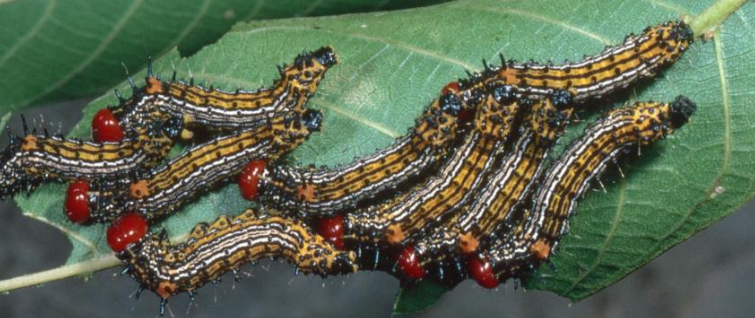
Redhumped Caterpillars
Redhumped Caterpillars (Schizura concinna) are destructive defoliators that feed on a wide variety of deciduous trees and shrubs throughout North America. These caterpillars are particularly well known for their striking appearance, featuring a bright red head and a distinctive red hump on their back. While small populations rarely cause serious harm, large outbreaks can rapidly strip foliage from fruit trees and ornamental plants, reducing vigor and productivity.
Taxonomy and Classification
Redhumped Caterpillars belong to the family Notodontidae, commonly known as prominents or prominent moths.
- Order: Lepidoptera
- Family: Notodontidae
- Genus: Schizura
- Species: Schizura concinna
Although the adult moths are relatively inconspicuous, the larval stage is highly recognizable and responsible for virtually all plant damage.
Physical Description
Mature larvae are among the most visually distinctive tree-feeding caterpillars in North America.
- Larva (Key ID): Yellowish-white to cream-colored body marked with black longitudinal stripes.
- Head: Bright cherry-red head capsule.
- Distinctive Hump: The fourth abdominal segment forms a prominent bright red hump often bearing black spines or tubercles.
- Length: Fully grown larvae reach approximately 35-40 mm long.
- Defensive Behavior: When disturbed, larvae raise both ends of their body into a defensive U-shaped posture.
- Adult (Key ID): A grayish-brown nocturnal moth with a wingspan of approximately 25-35 mm.
- Conflict: Orchard Pest, Ornamental Pest, Forest Pest.
Distribution and Habitat
Redhumped Caterpillars are widespread throughout much of the United States, southern Canada, and parts of northern Mexico.
They are commonly found in:
- Apple orchards
- Pear orchards
- Walnut groves
- Urban landscapes
- Parks and gardens
- Mixed hardwood forests
Common host plants include:
- Apple
- Pear
- Walnut
- Oak
- Plum
- Cherry
- Sweetgum
- Cottonwood
- Willow
- Maple
Life Cycle
Redhumped Caterpillars undergo complete metamorphosis consisting of egg, larval, pupal, and adult stages.
Egg Stage
Females deposit clusters of flattened eggs on the undersides of leaves during late spring and early summer.
Larval Stage
After hatching, larvae feed communally and remain grouped throughout much of their development. Young larvae skeletonize leaves, while older caterpillars consume entire leaves.
Pupal Stage
Mature larvae leave host plants and pupate within cocoons in leaf litter or shallow soil.
Adult Stage
Adult moths emerge several weeks later, mate, and begin another generation. In warmer climates, two or more generations may occur annually.
Behavior and Feeding
Redhumped Caterpillars are highly social insects.
- Gregarious Feeding: Newly hatched larvae remain in large groups, feeding together on the same branch.
- Defensive Display: Colonies often raise their heads and tails simultaneously when threatened.
- Rapid Movement: Older larvae may migrate as a group from defoliated branches to fresh foliage.
- Chemical Defense: Disturbed caterpillars may regurgitate or release irritating defensive secretions that discourage predators.
Damage and Symptoms
Damage severity depends on caterpillar density, host species, and tree health.
Skeletonization
Young larvae feed only on soft leaf tissue, leaving behind a network of veins that creates a lace-like appearance.
Complete Defoliation
Older larvae consume entire leaves except for major veins and petioles. Heavy infestations may completely strip branches or entire trees.
Reduced Tree Vigor
Defoliation decreases photosynthesis, resulting in slower growth and reduced energy reserves.
Fruit Loss
In orchards, repeated defoliation can reduce fruit size, quality, and overall yields.
Secondary Stress
Severely defoliated trees become more vulnerable to drought, diseases, and other insect pests.
Signs of Infestation
- Large groups of striped caterpillars feeding together
- Bright red heads and distinctive red humps
- Skeletonized or completely stripped foliage
- Accumulations of caterpillar droppings (frass) beneath trees
- Defoliated branches with only leaf veins remaining
- Clusters of egg masses on leaf undersides
Management and Control (IPM)
Early intervention is highly effective because larvae feed in groups.
Monitoring
- Inspect susceptible trees regularly during summer.
- Check branch tips and leaf undersides for egg masses and young colonies.
- Monitor for skeletonized foliage.
Mechanical Control
- Prune and destroy infested branches.
- Hand-remove caterpillar colonies when practical.
- Shake larvae into containers filled with soapy water.
Biological Control
Numerous beneficial organisms naturally suppress populations, including:
- Parasitic wasps
- Predatory stink bugs
- Birds
- Lacewings
- Ground beetles
- Spiders
Biological Insecticides
Bacillus thuringiensis var. kurstaki (Bt) is highly effective against young larvae and is widely recommended for organic management programs.
Chemical Control
Severe infestations may require insecticides labeled for caterpillar management. Applications are most effective when larvae are small and actively feeding.
Prevention
- Maintain tree health through proper watering and fertilization.
- Encourage beneficial insects and birds.
- Inspect trees regularly during summer months.
- Remove egg masses before larvae hatch.
- Avoid unnecessary broad-spectrum insecticide use.
Economic Importance
Redhumped Caterpillars are important pests of commercial orchards, ornamental landscapes, and nursery stock. Severe outbreaks can significantly reduce fruit production and increase management costs, particularly in apple and walnut operations.
Research and Conservation
Current research focuses on biological control agents, population forecasting, and sustainable integrated pest management strategies that minimize impacts on beneficial insects and pollinators.