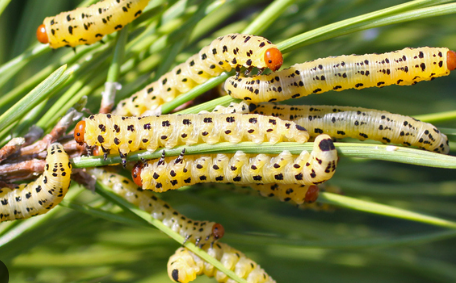
Redheaded Pine Sawflies
Redheaded Pine Sawflies (Neodiprion lecontei) are destructive defoliators of pine trees found throughout much of North America. Despite their caterpillar-like appearance, these insects are actually the larvae of sawflies, a group of non-stinging wasps in the order Hymenoptera. Redheaded pine sawflies primarily attack ornamental and forest pines, feeding in large groups that can rapidly strip needles from branches. Severe infestations may weaken or kill young trees and significantly reduce the aesthetic value of landscape plantings.
Taxonomy and Classification
Redheaded pine sawflies belong to the family Diprionidae, a group commonly known as conifer sawflies.
- Order: Hymenoptera
- Suborder: Symphyta
- Family: Diprionidae
- Genus: Neodiprion
- Species: Neodiprion lecontei
Unlike moth and butterfly caterpillars, sawfly larvae possess more abdominal prolegs and are more closely related to ants, bees, and wasps.
Physical Description
Larvae are among the most colorful and easily recognized sawflies in North America.
- Larva (Key ID): Yellowish-white to pale yellow body marked with six rows of irregular black spots and a bright reddish-orange head.
- Length: Mature larvae reach approximately 20–25 mm long.
- Prolegs: Possess seven or more pairs of abdominal prolegs, distinguishing them from true caterpillars.
- Adult (Key ID): Small, robust, non-stinging wasp-like insect. Females are larger and darker, while males are smaller and often black with feathery antennae.
- Eggs: Inserted individually into pine needles, creating rows of tiny yellow or tan scars along the needle margins.
- Conflict: Forest Pest, Ornamental Pest.
Distribution and Habitat
Redheaded pine sawflies occur throughout the eastern and southern United States and parts of Canada. Their range extends westward into portions of the Great Plains and southwestern states.
Common habitats include:
- Ornamental landscapes
- Pine plantations
- Forest edges
- Christmas tree farms
- Parks and golf courses
- Residential yards containing pine trees
Preferred hosts include:
- Shortleaf pine (Pinus echinata)
- Loblolly pine (Pinus taeda)
- Virginia pine (Pinus virginiana)
- Slash pine (Pinus elliottii)
- Scots pine (Pinus sylvestris)
- Mugo pine (Pinus mugo)
Life Cycle
Redheaded pine sawflies undergo complete metamorphosis consisting of egg, larval, pupal, and adult stages.
Egg Stage
Females use a specialized saw-like ovipositor to cut slits into pine needles and deposit eggs. Egg-laying scars often appear as rows of small yellow spots along the needle.
Larval Stage
Larvae hatch and immediately begin feeding in groups. Early instars feed on needle surfaces, while older larvae consume entire needles.
Pupal Stage
Mature larvae drop to the ground and spin tough, brown cocoons within leaf litter or upper soil layers.
Adult Stage
Adults emerge from cocoons, mate, and begin a new generation. Depending on climate, one to several generations may occur annually.
Behavior and Feeding
Redheaded pine sawflies exhibit highly social feeding behavior.
- Gregarious Feeding: Larvae feed in large colonies, often numbering dozens or hundreds of individuals.
- Defensive Display: When disturbed, larvae simultaneously raise the front and rear portions of their bodies into an “S” shape to deter predators.
- Needle Preference: Young larvae feed on older needles before moving to newer growth.
- Mass Movement: Entire colonies may move together from branch to branch as food resources are depleted.
Damage and Symptoms
Redheaded pine sawflies can cause extensive defoliation during outbreak years.
Early Feeding Damage
Young larvae consume only outer needle tissues, leaving behind straw-like remnants that turn brown and curl.
Complete Defoliation
Older larvae consume entire needles, leaving bare branches and severely weakened trees.
Branch Dieback
Heavy infestations may lead to branch death, especially when larvae feed on bark after needles are exhausted.
Reduced Growth
Repeated defoliation decreases tree growth, vigor, and resistance to secondary pests.
Tree Mortality
Young or stressed pines may die following severe or repeated infestations.
Signs of Infestation
- Groups of yellow larvae with red heads feeding on needles
- Straw-like remains of partially consumed needles
- Clusters of larvae displaying synchronized defensive postures
- Defoliated branches or entire trees
- Rows of egg scars on pine needles
- Brown cocoons in soil or leaf litter
Management and Control (IPM)
Early detection and intervention provide the best control.
Monitoring
- Inspect pine trees regularly during spring and late summer.
- Look for feeding colonies on older needles.
- Monitor for egg scars and early larval activity.
Mechanical Control
- Hand-remove or prune infested branches.
- Knock larvae into buckets containing soapy water.
- Destroy heavily infested shoots.
Biological Control
Numerous natural enemies help regulate populations, including:
- Birds
- Predatory stink bugs
- Wheel bugs
- Parasitic wasps
- Ground beetles
- Small mammals
Biological Insecticides
Bacillus thuringiensis (Bt) products are ineffective because sawflies are not true caterpillars. Products containing Spinosad provide excellent control against young larvae.
Chemical Control
Insecticidal soaps, horticultural oils, or labeled insecticides may be used when infestations are severe. Treatments are most effective when applied against young larvae.
Economic Importance
Redheaded pine sawflies are important pests in forestry, Christmas tree production, and ornamental landscapes. Severe outbreaks can result in substantial economic losses due to reduced tree growth, mortality, and replacement costs.
Research and Conservation
Research focuses on improving biological control methods, understanding outbreak dynamics, and developing sustainable integrated pest management programs for forest and ornamental settings.