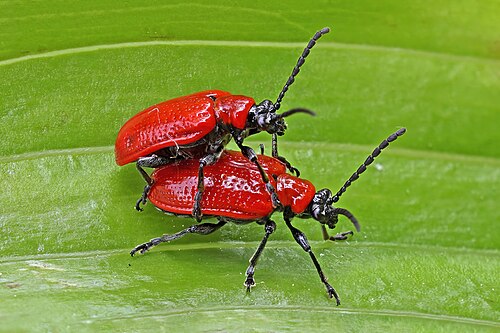
Red Lily Leaf Beetles (Lilioceris lilii) are among the most destructive pests of ornamental lilies and fritillaries. These striking scarlet-red beetles are highly specialized herbivores that feed almost exclusively on plants in the genus Lilium (true lilies) and Fritillaria. Both adults and larvae consume leaves, flower buds, stems, and blossoms, often causing severe defoliation and significant aesthetic damage.
Native to Europe and Asia, the red lily leaf beetle has become a serious invasive pest in parts of North America, particularly throughout New England, the northeastern United States, and eastern Canada. Heavy infestations can completely strip lilies of foliage, weaken bulbs, prevent flowering, and eventually kill plants if left unmanaged.
Taxonomy and Classification
Red lily leaf beetles belong to the family Chrysomelidae, commonly known as leaf beetles.
- Kingdom: Animalia
- Phylum: Arthropoda
- Class: Insecta
- Order: Coleoptera
- Family: Chrysomelidae
- Genus: Lilioceris
- Species: Lilioceris lilii
Like all beetles, red lily leaf beetles undergo complete metamorphosis, progressing through egg, larval, pupal, and adult stages.
Physical Description
Adult red lily leaf beetles measure approximately 6 to 8 millimeters long and are among the easiest ornamental pests to identify due to their distinctive coloration.
- Adult (Key ID): Brilliant scarlet-red wing covers (elytra) with a shiny appearance, contrasting sharply with the black head, legs, antennae, and underside.
- Larva (Key ID): Soft-bodied, orange to yellowish-brown grubs that typically cover themselves with a thick coating of dark, moist fecal material (frass), giving them a slimy black appearance.
- Egg (Key ID): Tiny, elongated orange-red eggs laid in neat rows on the undersides of leaves.
- Behavior (Key ID): Adults often drop to the ground and remain motionless on their black undersides when disturbed, making them difficult to locate.
- Conflict: Ornamental.
The bright coloration of adults serves as an important identification feature and distinguishes them from most other garden beetles.
Distribution and Habitat
Red lily leaf beetles are native to Europe and Asia but have expanded their range significantly through accidental introductions.
In North America, they are now established in:
- New England
- The northeastern United States
- Eastern Canada
- Parts of the Mid-Atlantic region
- Upper Midwest states
The beetles inhabit gardens, landscapes, nurseries, parks, and naturalized plantings wherever susceptible host plants occur.
Host Plants
Red lily leaf beetles are highly host-specific and primarily attack plants in the lily family.
Preferred hosts include:
- True lilies (Lilium species)
- Asiatic lilies
- Oriental lilies
- Tiger lilies
- Trumpet lilies
- Fritillaries (Fritillaria species)
Daylilies (Hemerocallis) are generally not considered suitable hosts and are rarely damaged.
Life Cycle
Red lily leaf beetles complete one generation per year in most regions.
Overwintering Adults
Adults spend the winter hidden in soil, leaf litter, garden debris, and other sheltered locations. They emerge very early in spring, often shortly after lily shoots begin to appear.
Egg Stage
Females lay rows of bright orange-red eggs on the undersides of lily leaves. A single female may produce hundreds of eggs during the growing season.
Larval Stage
Eggs hatch within approximately one week. Larvae feed aggressively on leaves, stems, flower buds, and blossoms for several weeks.
The larvae’s habit of covering themselves with fecal material provides protection against predators and environmental conditions.
Pupal Stage
Mature larvae drop to the soil and pupate underground.
Adult Stage
New adults emerge during summer and continue feeding before seeking overwintering sites in late summer and fall.
Damage and Symptoms
Both adults and larvae are highly destructive feeders.
Common signs of infestation include:
- Irregular holes in leaves
- Skeletonized foliage
- Chewed flower buds
- Destroyed blossoms
- Defoliated stems
- Presence of slimy black larvae
- Reduced flowering
- Plant decline or death
Heavy infestations can completely defoliate plants within a short period, severely weakening bulbs and reducing flowering in subsequent years.
Behavior and Conflict
The severe impact of red lily leaf beetles results from their specialized feeding habits and rapid population growth.
- Host Specificity: Nearly all feeding occurs on lilies and fritillaries.
- Voracious Feeding: Adults and larvae feed simultaneously during much of the growing season.
- Early Emergence: Overwintered adults emerge early in spring and begin feeding immediately.
- Defensive Behavior: Adults readily drop from plants when disturbed, complicating hand removal efforts.
Because lilies are highly valued ornamental plants, even moderate infestations are often considered unacceptable by gardeners.
Management and Prevention
Successful management depends on early detection and consistent monitoring.
Physical Control (Key Strategy)
- Inspect lilies frequently beginning in early spring.
- Hand-pick adults, larvae, and eggs regularly.
- Drop collected beetles into soapy water.
- Remove and destroy egg masses before hatching.
Daily monitoring during spring often provides excellent control in home gardens.
Biological Control
Several specialist parasitic wasps have been introduced in North America as biological control agents.
These include:
- Tetrastichus setifer
- Lemophagus errabundus
- Diaparsis jucunda
These tiny parasitoids lay eggs inside beetle larvae, eventually killing them.
Chemical Control
When infestations become severe, insecticides may be necessary.
- Neem oil can suppress small populations.
- Insecticidal soaps may provide limited control of young larvae.
- Systemic insecticides can offer longer-term protection.
- Always follow label instructions and avoid applications during bloom when pollinators are active.
Cultural Practices
- Remove plant debris in autumn.
- Inspect newly purchased lilies before planting.
- Monitor susceptible plants throughout the growing season.
Research and Conservation
Current research focuses primarily on establishing long-term biological control programs through the release and conservation of specialist parasitic wasps. Scientists continue to evaluate the effectiveness of parasitoids in reducing beetle populations across invaded regions.
Additional research areas include host plant resistance, improved monitoring methods, and environmentally friendly management options.
Conclusion
Red Lily Leaf Beetles are highly destructive invasive pests capable of causing complete defoliation of ornamental lilies and fritillaries. Early detection, vigilant monitoring, hand removal, and biological control remain the most effective strategies for protecting valuable landscape plantings and maintaining healthy lily displays.