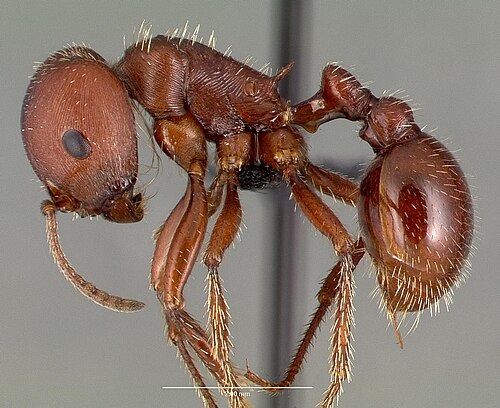
Red Harvester Ants (Pogonomyrmex spp.) are large, seed-collecting ants native to arid and semi-arid regions of North America. These conspicuous ants are especially common throughout the western and southern United States, where they construct large soil mounds surrounded by broad, vegetation-free areas. Red harvester ants are well known for their habit of gathering seeds and storing them underground as a food source for the colony.
Although these ants play an important ecological role as seed dispersers and soil aerators, they are also considered significant nuisance pests. Their painful sting is regarded as one of the most intense among North American insects, and their extensive nesting activity can interfere with lawns, landscapes, recreational areas, and agricultural operations.
Taxonomy and Classification
Red harvester ants belong to the family Formicidae and are highly specialized seed-harvesting ants.
- Kingdom: Animalia
- Phylum: Arthropoda
- Class: Insecta
- Order: Hymenoptera
- Family: Formicidae
- Subfamily: Myrmicinae
- Genus: Pogonomyrmex
Several species occur throughout North America, including the Western Harvester Ant (Pogonomyrmex occidentalis) and the Red Harvester Ant (Pogonomyrmex barbatus).
Physical Description
Worker red harvester ants typically range from 5 to 10 millimeters in length, although queens are substantially larger.
- Worker (Key ID): Large reddish-brown to dark red ants with robust bodies and powerful mandibles.
- Beard of Hairs: Many species possess a distinctive “beard” or psammophore beneath the head, consisting of long hairs used for carrying seeds and soil particles.
- Stinger: Workers possess a prominent stinger capable of delivering extremely painful venom.
- Mound (Key ID): Large, circular mounds often surrounded by broad areas cleared of vegetation.
- Conflict: Public Health, Nuisance, Agricultural, Landscape.
The cleared area surrounding nests may extend several feet beyond the mound and serves as a foraging zone and defensive perimeter.
Distribution and Habitat
Red harvester ants occur primarily in the western and southern United States, northern Mexico, and portions of the Great Plains.
They are especially abundant in:
- Deserts
- Grasslands
- Prairies
- Pastures
- Rangelands
- Roadsides
- Open woodlands
- Agricultural fields
These ants prefer open, sunny habitats with well-drained, sandy, or gravelly soils. They generally avoid heavily shaded environments.
Life Cycle and Colony Structure
Like all ants, red harvester ants undergo complete metamorphosis consisting of egg, larval, pupal, and adult stages.
Queen and Colony Formation
New colonies begin when winged reproductive ants participate in mating flights, usually following seasonal rains. After mating, queens shed their wings and establish underground nests.
Colony Growth
Colonies grow slowly and may persist for many years. Mature colonies can contain several thousand workers and a single queen, although some species may support multiple queens.
Worker Castes
Workers perform a variety of duties including:
- Foraging for seeds
- Nest construction
- Brood care
- Colony defense
- Nest maintenance
Most foraging activity occurs during cooler portions of the day, particularly in desert environments.
Behavior and Ecology
Red harvester ants are among the most ecologically important insects in arid ecosystems.
- Seed Harvesting: Workers collect seeds from numerous plant species and transport them back to underground storage chambers.
- Vegetation Clearing: Colonies remove vegetation around nest entrances to improve visibility and reduce competition.
- Soil Modification: Nest excavation improves soil aeration and nutrient cycling.
- Aggressive Defense: Workers rapidly defend their nests when disturbed.
- Foraging Trails: Ants establish well-defined trails radiating from the nest.
Because they collect and disperse seeds, red harvester ants play a major role in shaping plant communities in desert ecosystems.
Medical Importance
Red harvester ants possess one of the most potent and painful stings among North American insects.
When threatened, workers grasp the skin with their mandibles and inject venom through a stinger located at the end of the abdomen.
- Immediate Pain: The sting produces intense, burning pain that may persist for several hours.
- Localized Reactions: Swelling, redness, itching, and tenderness commonly occur.
- Allergic Reactions: Sensitive individuals may experience severe allergic responses, including anaphylaxis.
- Multiple Stings: Disturbing a nest can result in numerous stings delivered simultaneously.
Anyone experiencing difficulty breathing, dizziness, or severe swelling after a sting should seek immediate medical attention.
Damage and Conflict
Although beneficial in natural ecosystems, red harvester ants can create conflicts in developed landscapes.
- Painful Stings: Nests located near homes, playgrounds, parks, or trails pose risks to people and pets.
- Landscape Damage: Mounds disrupt lawns and ornamental landscapes.
- Equipment Interference: Large mounds may interfere with lawnmowers, farm machinery, and irrigation equipment.
- Seed Consumption: Colonies may remove newly planted seeds in agricultural settings.
- Livestock Concerns: Animals may avoid heavily infested grazing areas.
Despite these conflicts, economic damage is generally considered minor compared to that caused by invasive ant species.
Management and Prevention
Management should focus on reducing risks while preserving beneficial ecological functions whenever possible.
Avoidance and Exclusion
- Avoid disturbing nests in natural areas.
- Teach children to recognize and avoid ant mounds.
- Use barriers or fencing around high-risk colonies.
- Relocate recreational activities away from active nests.
Physical Management
- Mark mound locations to prevent accidental disturbance.
- Maintain vegetation around frequently used areas.
- Remove colonies only when they pose a significant hazard.
Chemical Control
When colonies occur in high-traffic areas, targeted treatments may be necessary.
- Apply insecticidal baits around active foraging zones.
- Use mound drenches or granular insecticides directly on individual colonies.
- Treat during periods of peak foraging activity for maximum effectiveness.
Because colonies may extend deep underground, treatments should always follow product label directions carefully.
Ecological Importance
Red harvester ants provide numerous ecological benefits.
- Disperse and store seeds
- Improve soil structure through excavation
- Enhance nutrient cycling
- Serve as prey for wildlife
- Support biodiversity in arid ecosystems
Several animals, including horned lizards, rely heavily on harvester ants as a food source.
Research and Conservation
Scientific research on red harvester ants focuses on:
- Foraging ecology
- Seed dispersal behavior
- Social organization
- Venom composition and medical applications
- Climate change impacts on desert ecosystems
Researchers continue to study harvester ant venom because some compounds may possess therapeutic potential.
Conclusion
Red Harvester Ants are fascinating and ecologically important insects that dominate many arid landscapes throughout the American Southwest. While their painful sting and large mounds can create conflicts in residential and recreational settings, these ants also provide valuable ecological services through seed dispersal and soil improvement. Proper identification and targeted management can help minimize human conflicts while preserving their beneficial role in natural ecosystems.