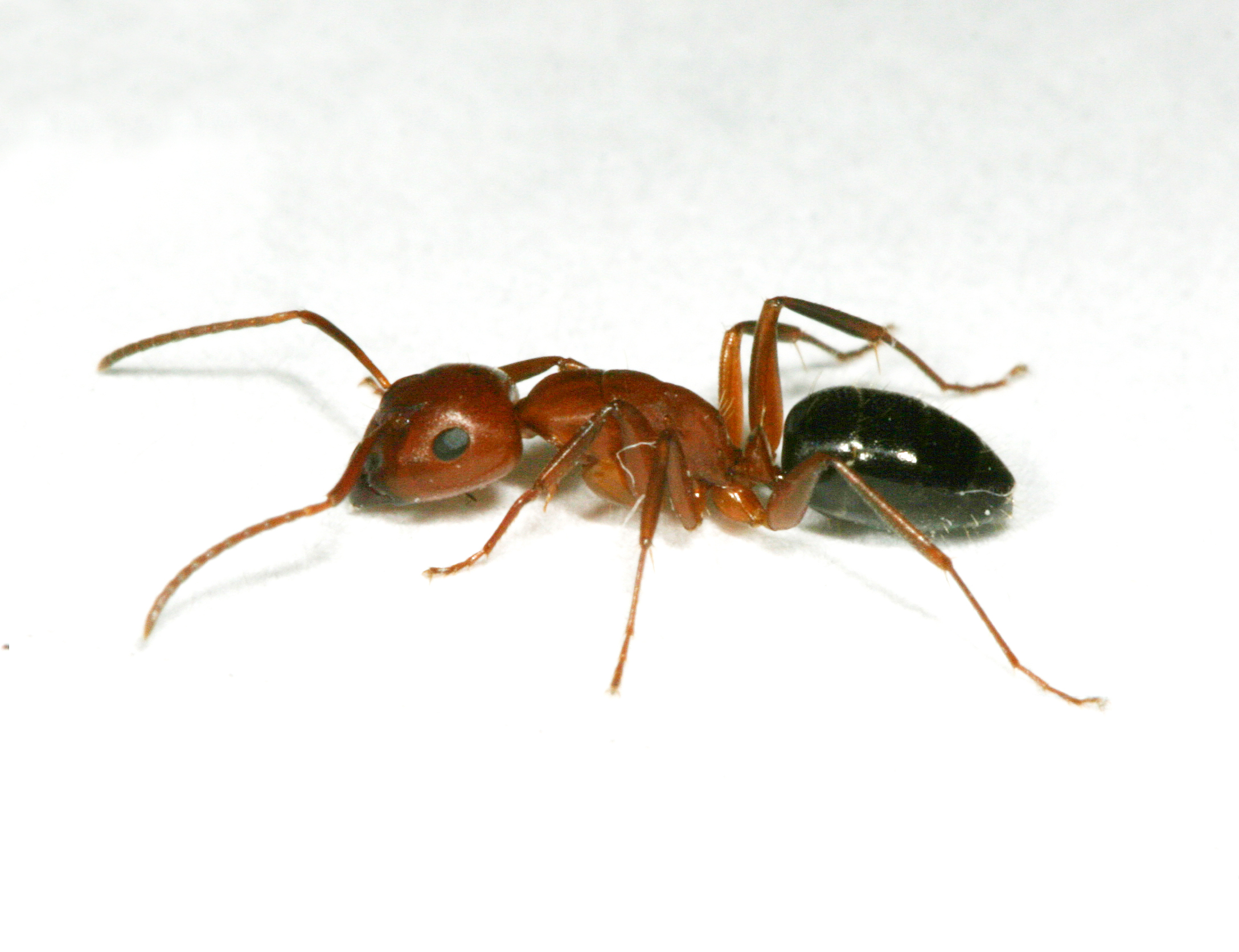
Red Carpenter Ants (Camponotus spp.) are among the largest ant species found in North America and are important structural pests in homes and buildings. These ants are commonly black, reddish-black, or reddish-brown in color and are frequently associated with moisture-damaged wood. Unlike termites, carpenter ants do not consume wood for nutrition. Instead, they excavate smooth galleries inside wood to create nests, which can eventually weaken structural components if infestations are left untreated.
Red carpenter ants are widely distributed throughout forested, suburban, and urban environments. Their ability to establish extensive colonies, including satellite nests inside structures, makes them one of the most significant wood-damaging insect pests encountered by homeowners.
Taxonomy and Classification
Red carpenter ants belong to the family Formicidae, which includes all ant species. They are members of the genus Camponotus, one of the largest ant genera in the world.
- Kingdom: Animalia
- Phylum: Arthropoda
- Class: Insecta
- Order: Hymenoptera
- Family: Formicidae
- Genus: Camponotus
Carpenter ant colonies are polymorphic, meaning workers occur in different sizes. Colonies typically contain minor workers, major workers (soldiers), winged reproductives, brood, and one or more queens.
Physical Description
Worker red carpenter ants generally range from 6 to 13 millimeters in length, although queens may exceed 18 millimeters.
- Worker (Key ID): Large reddish-brown, black, or reddish-black ant with a single node (petiole) between the thorax and abdomen.
- Thorax Shape: The upper surface of the thorax is evenly rounded when viewed from the side, lacking the distinct humps seen in some other ant species.
- Major Workers: Larger workers possess disproportionately large heads and strong mandibles.
- Winged Reproductives: Mature colonies produce winged males and females during spring or early summer swarming events.
- Damage ID: Presence of sawdust-like frass, rustling sounds inside walls, and smooth galleries excavated within wood.
- Conflict: Structural.
Unlike termites, carpenter ants have elbowed antennae, narrow waists, and unequal wing sizes on reproductive individuals.
Distribution and Habitat
Red carpenter ants are found throughout much of North America and many other parts of the world. They are particularly abundant in forested regions where dead and decaying wood is readily available.
Common nesting sites include:
- Dead trees and stumps
- Logs and fallen branches
- Woodpiles
- Fence posts
- Landscape timbers
- Wall voids
- Roof eaves
- Window and door frames
- Attics and crawl spaces
Although carpenter ants prefer moist, decaying wood for establishing initial nests, satellite colonies may later expand into sound, dry wood inside structures.
Life Cycle
Red carpenter ants undergo complete metamorphosis consisting of egg, larval, pupal, and adult stages.
Egg Stage
The queen lays small, white eggs that hatch into larvae within several weeks.
Larval Stage
Larvae are soft, legless, and entirely dependent on workers for feeding and care.
Pupal Stage
Larvae pupate within protective silk cocoons. Depending on temperature and food availability, development may require several weeks to several months.
Adult Stage
New adults emerge and assume colony duties such as brood care, nest expansion, or foraging. Colonies may survive for many years and can eventually contain thousands of workers.
Behavior and Conflict
The primary conflict associated with red carpenter ants involves their wood excavation activities.
- Wood Excavation: Ants chew wood fibers and remove them from the nest, creating smooth galleries for brood development.
- Satellite Colonies: Large colonies often maintain multiple nests connected by foraging trails.
- Nocturnal Activity: Most foraging occurs during evening and nighttime hours.
- Wide Foraging Range: Workers may travel hundreds of feet from the nest in search of food.
- Moisture Preference: Water-damaged wood strongly attracts nesting colonies.
Carpenter ants feed primarily on sugars, honeydew produced by aphids, dead insects, and various household food sources.
Signs of Infestation
Common indicators of a red carpenter ant infestation include:
- Frass: Piles of coarse, sawdust-like material mixed with insect parts beneath nesting sites.
- Rustling Sounds: Faint noises within walls or ceilings caused by worker activity.
- Worker Trails: Large ants traveling along walls, utility lines, or tree branches.
- Winged Ants: Swarming reproductives emerging indoors during spring.
- Moisture Damage: Ant activity often occurs near roof leaks, plumbing leaks, or poorly ventilated areas.
Structural Damage
Unlike termites, carpenter ants do not consume cellulose. Nevertheless, their excavation activities can result in substantial structural damage over time.
Frequently affected areas include:
- Wall studs
- Window frames
- Roof sheathing
- Floor joists
- Deck supports
- Porches
- Door frames
Severe infestations can compromise the integrity of load-bearing structural components.
Management and Prevention
Successful carpenter ant management depends on locating and eliminating both parent and satellite nests.
Source Identification (Key Strategy)
- Locate active nests whenever possible.
- Follow worker trails to determine nest locations.
- Inspect nearby trees, stumps, and woodpiles.
- Identify and eliminate moisture problems.
Moisture Management
- Repair leaking roofs and plumbing.
- Improve attic and crawl space ventilation.
- Replace water-damaged wood.
- Maintain proper drainage around foundations.
Exclusion
- Seal cracks and openings around utility penetrations.
- Trim tree branches away from structures.
- Store firewood away from buildings.
- Remove dead trees and stumps near structures.
Chemical Control
When nests are located, direct treatment is often effective.
- Apply insecticidal dusts into wall voids and galleries.
- Use non-repellent insecticides in active nesting areas.
- Employ bait formulations where appropriate.
- Treat outdoor parent colonies when discovered.
Professional pest management services are often recommended for large or difficult-to-access infestations.
Ecological Importance
Despite their pest status in buildings, carpenter ants perform important ecological functions.
- Accelerate decomposition of dead wood.
- Recycle nutrients within forest ecosystems.
- Serve as prey for birds, mammals, and other insects.
- Create nesting sites later used by other wildlife species.
Research and Future Management
Current research focuses on improving bait technologies, understanding colony structure, and developing environmentally sustainable management methods. Scientists are also investigating how moisture management and building design influence carpenter ant infestations.
Conclusion
Red Carpenter Ants are significant structural pests capable of causing extensive damage through wood excavation. Early detection, moisture control, nest elimination, and exclusion measures are essential for preventing costly structural repairs. Although these ants do not consume wood like termites, their ability to establish large, long-lived colonies makes them an important pest requiring prompt management.