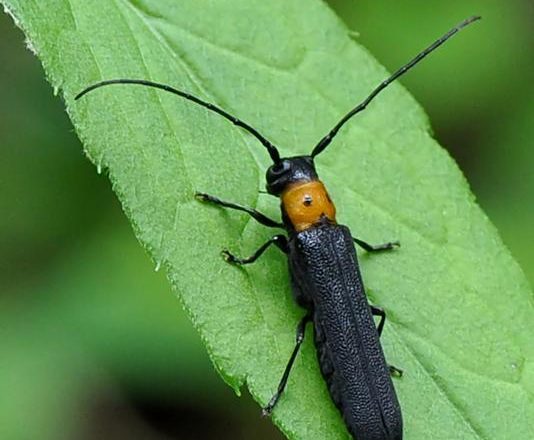
Raspberry Cane Borers (Oberea bimaculata) are destructive longhorned beetles that specialize in attacking raspberries, blackberries, and other bramble plants belonging to the genus Rubus. Although relatively small and often overlooked, these insects can cause significant damage to berry crops by tunneling inside canes, disrupting water and nutrient movement, and ultimately reducing fruit production.
The raspberry cane borer is particularly notable for the unique behavior of adult females, which create two distinct rows of punctures around the tips of young canes before laying eggs. This characteristic “double girdle” causes the cane tip to wilt and serves as one of the most reliable signs of infestation. If left unmanaged, larval feeding within the cane can weaken or kill entire canes over a two-year developmental period.
Taxonomy and Classification
Raspberry cane borers belong to the family Cerambycidae, commonly known as longhorned beetles because of their elongated antennae.
- Kingdom: Animalia
- Phylum: Arthropoda
- Class: Insecta
- Order: Coleoptera
- Family: Cerambycidae
- Genus: Oberea
- Species: Oberea bimaculata
Like all beetles, raspberry cane borers undergo complete metamorphosis, progressing through egg, larval, pupal, and adult stages.
Physical Description
Adult raspberry cane borers typically measure between 12 and 15 millimeters in length and possess a slender, elongated body.
- Adult (Key ID): Narrow black body with a distinctive yellow or orange thorax marked by two or three black spots.
- Antennae: Long, threadlike antennae typical of longhorned beetles.
- Larva (Key ID): Creamy-white, legless grub that tunnels through the pith of raspberry and blackberry canes.
- Damage ID: Characteristic double girdle near the cane tip followed by wilting and dieback.
- Conflict: Agricultural, Fruit Crop.
The adult beetles are active during late spring and early summer, when they seek suitable host plants for reproduction.
Distribution and Habitat
Raspberry cane borers are native to eastern North America and occur throughout much of the United States and southern Canada.
They are commonly found wherever raspberries and blackberries are grown, including:
- Home berry gardens
- Commercial raspberry farms
- Blackberry plantings
- Wild bramble patches
- Woodland edges
- Hedgerows
Wild brambles often serve as reservoirs for beetle populations that may later infest cultivated berry crops.
Life Cycle
The raspberry cane borer has a relatively long life cycle, often requiring two years to complete development.
Egg Stage
During late spring and early summer, females select young, actively growing canes for egg laying. Before depositing an egg, the female chews two complete rings of punctures around the cane tip, usually several inches apart.
An egg is laid between these two girdled areas.
Larval Stage
After hatching, the larva tunnels downward through the soft pith in the center of the cane.
As it feeds, the larva enlarges its tunnel and gradually moves farther down the stem. Feeding may continue for many months, with larvae overwintering inside the cane.
Pupal Stage
After completing development, the mature larva pupates within the cane, typically near the lower portion of the stem.
Adult Stage
New adults emerge during late spring or early summer and begin feeding on foliage before mating and initiating another generation.
Damage and Symptoms
The most recognizable symptom of raspberry cane borer activity is the distinctive double girdle created by egg-laying females.
- Double Girdling: Two parallel rings of punctures encircle the cane near the tip.
- Wilting Tips: The portion of the cane above the girdles wilts, droops, and eventually dies.
- Cane Dieback: Larval tunneling weakens and kills canes over time.
- Reduced Fruit Production: Damaged canes produce fewer berries or fail to fruit entirely.
- Plant Weakening: Repeated infestations can reduce overall plant vigor.
Because larvae feed internally, damage often progresses unnoticed until visible wilting occurs.
Behavior and Conflict
The conflict associated with raspberry cane borers results primarily from their unusual reproductive behavior and concealed feeding habits.
- Girdling Behavior: Females intentionally girdle canes before egg laying, causing immediate injury.
- Protected Feeding: Larvae remain safely hidden within stems, protected from predators and insecticides.
- Long Development: The extended life cycle allows damage to accumulate over multiple seasons.
- Hidden Infestations: Internal feeding often escapes detection until canes begin dying.
Even low populations can significantly impact berry production if infestations are not managed promptly.
Host Plants
Raspberry cane borers primarily attack plants in the genus Rubus.
Common hosts include:
- Red raspberries
- Black raspberries
- Blackberries
- Purple raspberries
- Wild brambles
- Dewberries
Young, vigorously growing canes are especially attractive for egg laying.
Management and Prevention
Integrated pest management (IPM) practices emphasize early detection and cultural controls.
Pruning and Sanitation (Key Strategy)
The most effective management practice is prompt removal of infested cane tips.
- Inspect canes regularly during late spring and summer.
- Look for wilting tips and double girdling.
- Prune infested canes at least 6 to 8 inches below the lower girdle.
- Destroy removed canes immediately by burning, chipping, or disposing of them.
Early pruning prevents larvae from moving farther down the cane.
Removal of Old Canes
- Remove dead or weakened canes after harvest.
- Eliminate wild brambles near cultivated plantings when practical.
- Maintain good sanitation throughout berry patches.
Monitoring
Frequent inspection is essential for successful control.
- Check young canes weekly during the growing season.
- Monitor for wilted tips and feeding damage.
- Record infestation levels to guide management decisions.
Chemical Control
Chemical management is generally less effective because larvae remain protected inside canes.
- Insecticides may be used against adults during their brief emergence period.
- Treatments must be precisely timed before egg laying occurs.
- Chemical control is usually supplemental to pruning and sanitation.
Natural Enemies
Several natural enemies help suppress raspberry cane borer populations.
- Parasitic wasps
- Predatory insects
- Birds that feed on larvae within canes
- Generalist predators
Conserving beneficial organisms can contribute to long-term population management.
Research and Future Management
Current research focuses on improving monitoring and management strategies for raspberry cane borers.
- Development of adult monitoring traps
- Improved understanding of adult emergence timing
- Evaluation of biological control agents
- Integrated pest management programs for berry production
Researchers continue to investigate sustainable approaches that minimize pesticide use while maintaining effective control.
Conclusion
Raspberry Cane Borers are specialized pests capable of causing serious losses in raspberry and blackberry production. Their distinctive double girdling behavior and concealed larval feeding can weaken or kill fruiting canes if left unmanaged. Regular monitoring, prompt pruning of infested canes, and good sanitation practices remain the most effective methods for protecting berry crops from this destructive pest.