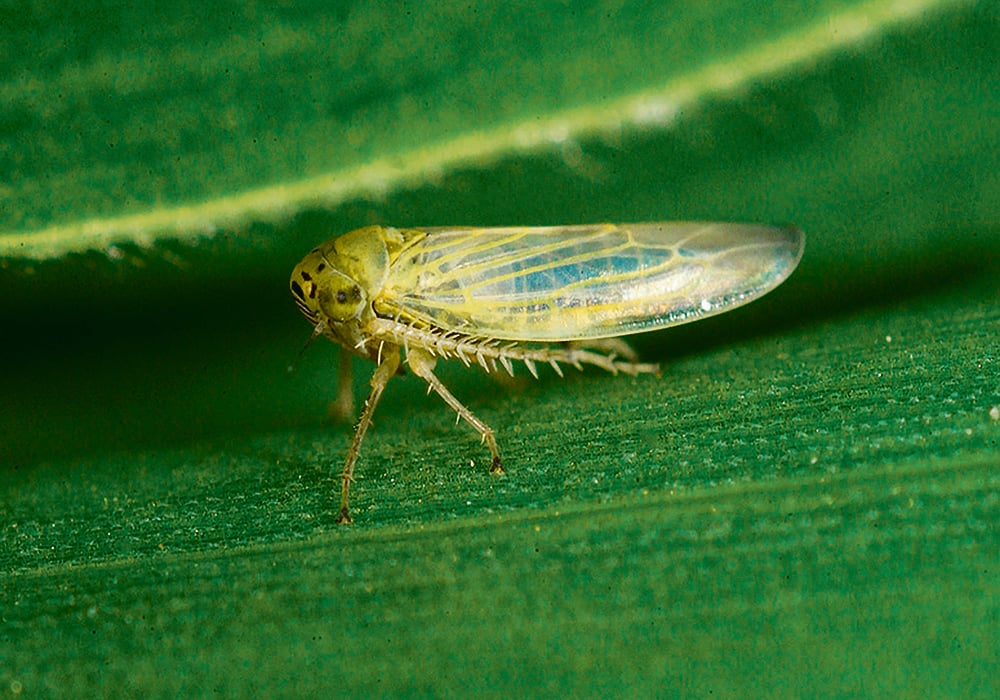
Ragweed Leafhoppers are small, wedge-shaped sap-feeding insects belonging to the family Cicadellidae. These highly mobile insects primarily feed on ragweed plants (Ambrosia spp.), although they may occasionally move onto nearby crops and ornamental plants when populations become abundant. Their rapid reproduction, exceptional jumping ability, and piercing-sucking feeding habits allow infestations to develop quickly under favorable conditions.
Taxonomy and Classification
Ragweed leafhoppers belong to the order Hemiptera, a group commonly known as the true bugs. They are members of the family Cicadellidae, which contains thousands of species worldwide.
- Order: Hemiptera
- Suborder: Auchenorrhyncha
- Family: Cicadellidae
- Representative Species: Protalebrella brasiliensis
Leafhoppers are closely related to treehoppers, spittlebugs, and planthoppers. Many species are important agricultural pests because of their ability to transmit plant diseases.
Physical Description
Adult ragweed leafhoppers are extremely small insects, typically measuring approximately 3 to 4 mm in length.
- Adult (Key ID): Small, slender, wedge-shaped body that tapers toward the rear.
- Coloration: Usually pale green, yellowish-green, cream-colored, or light brown, allowing them to blend with ragweed foliage.
- Nymph (Key ID): Wingless, translucent, and smaller than adults; resembles miniature adults.
- Movement: Extremely agile and capable of rapid jumping, short flights, and sideways movement around stems and leaves.
- Conflict: Agricultural, Ornamental, Beneficial Weed Suppression.
Distribution and Habitat
Ragweed leafhoppers occur throughout much of North America, especially in regions where ragweed grows abundantly.
Common habitats include:
- Roadsides and vacant lots
- Agricultural field edges
- Prairies and grasslands
- Disturbed landscapes
- Urban and suburban properties
- Weedy areas dominated by ragweed species
These insects are particularly common in warm regions of the southern United States, including Arizona, Texas, and Gulf Coast states.
Life Cycle
Ragweed leafhoppers undergo incomplete metamorphosis consisting of egg, nymph, and adult stages.
Egg Stage
Females insert eggs directly into leaf tissue or stems, where they remain protected from predators and environmental extremes.
Nymph Stage
After hatching, nymphs begin feeding immediately on plant sap. They pass through several developmental stages, known as instars, while gradually increasing in size.
Adult Stage
Adults emerge fully winged and capable of dispersal. Multiple generations may occur each year in warm climates, allowing populations to build rapidly during summer.
Damage and Symptoms
Ragweed leafhoppers damage plants by piercing leaf tissue and extracting sap.
Leaf Stippling
Feeding produces numerous tiny white, yellow, or pale spots on leaves, commonly referred to as stippling.
Yellowing and Bronzing
Heavy infestations can cause extensive yellowing, bronzing, and premature leaf drop.
Plant Stunting
Continuous sap removal reduces plant vigor and may stunt growth, particularly in young plants.
Reduced Pollen Production
Because ragweed leafhoppers primarily attack ragweed, feeding may reduce flower development and suppress allergenic pollen production.
Behavior and Ecological Role
Ragweed leafhoppers display several behaviors typical of leafhoppers.
- Rapid Escape: Adults readily jump or fly when disturbed.
- Sideways Movement: Individuals often move laterally around stems to avoid predators.
- Host Preference: Most populations show a strong preference for common and giant ragweed.
- Weed Suppression: Heavy feeding may naturally weaken ragweed populations, making these insects beneficial in some situations.
Management and Control
Management is rarely necessary when leafhoppers remain on ragweed. However, intervention may be warranted if they move onto economically important crops.
Monitoring
- Inspect host plants regularly.
- Check the undersides of leaves for nymphs and adults.
- Use sweep nets for population assessments.
Cultural Control
- Remove excessive ragweed growth near susceptible crops.
- Maintain weed-free field borders when crop protection is necessary.
- Promote plant health through proper irrigation and fertilization.
Biological Control
Numerous natural enemies help regulate leafhopper populations, including:
- Spiders
- Minute pirate bugs
- Damsel bugs
- Lacewings
- Parasitic wasps
Chemical Control
Insecticidal soaps, horticultural oils, and selective insecticides may be used when populations become problematic on valuable plants. Broad-spectrum insecticides should be avoided whenever possible to preserve beneficial insects.
Economic Importance
Ragweed leafhoppers are generally considered minor pests. Their economic impact is usually limited because they preferentially feed on ragweed rather than cultivated plants. In some regions, they may actually provide ecosystem services by naturally suppressing ragweed growth and reducing pollen production.
Research and Conservation
Researchers continue to study ragweed leafhoppers to better understand their potential role in biological control programs aimed at reducing invasive ragweed populations. Their interactions with native predators and plant pathogens remain areas of ongoing scientific interest.