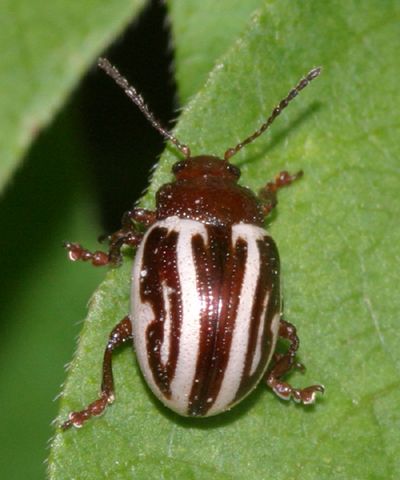
Ragweed Beetles (Zygogramma suturalis and related species) are specialized leaf-feeding beetles that primarily attack common ragweed (Ambrosia artemisiifolia) and giant ragweed (Ambrosia trifida). Unlike many agricultural pests, ragweed beetles are considered highly beneficial because they suppress ragweed populations, reducing the production of allergenic pollen and limiting the spread of these invasive weeds.
Taxonomy and Classification
Ragweed beetles belong to the family Chrysomelidae, commonly known as leaf beetles.
- Order: Coleoptera
- Family: Chrysomelidae
- Genus: Zygogramma
- Species: Zygogramma suturalis
These beetles are closely related to other leaf beetles, including the Colorado potato beetle, but exhibit an extremely narrow host range focused almost exclusively on ragweed species.
Physical Description
Adult ragweed beetles are small but easily recognized by their distinctive coloration and markings.
- Adult (Key ID): Small, oval beetles measuring approximately 4 to 6 mm long with cream to yellowish wing covers marked by dark longitudinal stripes.
- Thorax: Usually dark brown to black with lighter margins.
- Larva (Key ID): Plump, hump-backed larvae that are pale yellow, cream-colored, or grayish with darker heads.
- Behavior ID: Adults and larvae commonly drop from plants and feign death when disturbed.
- Conflict: Beneficial Biological Control Agent; Minor Agricultural Concern.
Distribution and Habitat
Ragweed beetles are native to North America and occur throughout much of the United States and southern Canada wherever ragweed grows.
They inhabit:
- Roadsides
- Vacant lots
- Agricultural field margins
- Prairies and grasslands
- Disturbed landscapes
- Urban and suburban areas containing ragweed populations
Due to their effectiveness against ragweed, these beetles have been intentionally introduced into parts of Europe and Asia as biological control agents.
Life Cycle
Ragweed beetles undergo complete metamorphosis consisting of egg, larva, pupa, and adult stages.
Egg Stage
Females deposit clusters of yellow to orange eggs on the undersides of ragweed leaves.
Larval Stage
Larvae hatch within several days and immediately begin feeding on foliage. Multiple larval stages occur over two to three weeks.
Pupal Stage
Mature larvae enter the soil to pupate. Pupation typically lasts one to two weeks depending on temperature.
Adult Stage
Adults emerge during summer and continue feeding on ragweed foliage, flowers, and developing seed heads. In many regions, one or two generations occur annually.
Damage and Ecological Benefits
Unlike most insects featured on Pestipedia, ragweed beetles are generally beneficial because they damage an undesirable weed.
Leaf Feeding
Adults and larvae consume leaf tissue, creating holes and irregular feeding patterns.
Defoliation
Heavy infestations may completely strip ragweed plants of foliage, significantly weakening or killing the host.
Reduced Pollen Production
Feeding on flower buds and terminal growth reduces pollen production, potentially lowering seasonal allergy symptoms for humans.
Reduced Seed Production
Late-season feeding suppresses seed formation, limiting future ragweed populations.
Behavior and Ecological Role
Ragweed beetles are highly specialized insects with a strong ecological relationship to their host plants.
- Host Specificity: These beetles feed almost exclusively on ragweed species and rarely attack crops or ornamental plants.
- Biological Control: They serve as important natural enemies of ragweed and have been widely studied for weed management.
- Seasonal Synchronization: Beetle development is closely synchronized with ragweed growth, ensuring food availability throughout the growing season.
- Defense Behavior: Adults commonly drop from plants and remain motionless when threatened.
Management and Conservation
Because ragweed beetles provide valuable biological control, management generally focuses on conservation rather than elimination.
Conservation Practices
- Avoid unnecessary insecticide applications in areas where ragweed suppression is desired.
- Maintain diverse habitats that support natural insect populations.
- Preserve overwintering sites such as leaf litter and undisturbed vegetation.
Agricultural Considerations
Although primarily beneficial, beetles occasionally move onto closely related plants under extreme conditions. Significant crop damage is rare.
Economic Importance
Ragweed beetles provide substantial economic and public health benefits by naturally reducing ragweed abundance. Lower ragweed densities can decrease management costs, reduce herbicide use, and potentially lessen allergy-related healthcare expenses.
Research and Biological Control
Researchers continue studying ragweed beetles as classical biological control agents against invasive ragweed populations worldwide. Their strict host specificity makes them particularly attractive for environmentally sustainable weed management programs.