Ragweed Aphids are sap-feeding insects that primarily infest ragweed plants (Ambrosia spp.), although they may occasionally disperse to nearby vegetation when populations become exceptionally high. The most common species associated with ragweed in North America is the Brown Ambrosia Aphid (Uroleucon ambrosiae). These aphids are highly specialized feeders and are often considered beneficial because they naturally suppress ragweed growth and reduce pollen production.
Taxonomy and Classification
Ragweed aphids belong to the order Hemiptera and the family Aphididae. They are true bugs that possess specialized piercing-sucking mouthparts designed to extract nutrient-rich sap from plants.
- Order: Hemiptera
- Suborder: Sternorrhyncha
- Family: Aphididae
- Genus: Uroleucon
- Representative Species: Uroleucon ambrosiae
Many aphid species are serious agricultural pests, but ragweed aphids primarily affect wild plants and weeds.
Physical Description
Adult ragweed aphids are relatively large compared to many other aphid species, typically measuring between 2.5 and 3.5 mm in length.
- Adult (Key ID): Elongated, soft-bodied insect with a shiny dark reddish-brown to nearly black body.
- Legs: Long, pale-colored legs with dark joints.
- Cornicles (Key ID): Two prominent, elongated black tubes protruding from the rear of the abdomen.
- Nymphs: Smaller, wingless versions of adults that cluster together on stems and flower spikes.
- Conflict: Minor Agricultural Pest; Beneficial Weed Suppression.
Distribution and Habitat
Ragweed aphids are widely distributed throughout North America and occur wherever ragweed and related host plants are abundant.
Typical habitats include:
- Roadsides
- Agricultural field margins
- Vacant lots
- Prairies and grasslands
- Disturbed landscapes
- Urban and suburban weed patches
They are particularly common in warm regions of the southern and southwestern United States.
Life Cycle
Like most aphids, ragweed aphids reproduce rapidly and may produce multiple generations each year.
Asexual Reproduction
During favorable conditions, females reproduce without mating through a process known as parthenogenesis. This allows colonies to expand very quickly.
Colony Development
Newly born nymphs immediately begin feeding on plant sap. Nymphs pass through several molts before becoming reproductive adults.
Winged Forms
When colonies become overcrowded or host quality declines, winged adults are produced. These dispersing forms migrate to new host plants and establish additional colonies.
Damage and Symptoms
Ragweed aphids feed by inserting their needle-like mouthparts into plant tissues and removing sap from the phloem.
Reduced Plant Vigor
Heavy infestations weaken ragweed plants by diverting nutrients and reducing energy available for growth and reproduction.
Yellowing and Stunting
Infested plants may exhibit yellowing leaves, slowed growth, and reduced flowering.
Honeydew Production
Large colonies excrete sticky honeydew, which coats leaves and stems.
Sooty Mold Development
Honeydew supports the growth of black sooty mold fungi that further reduce photosynthesis.
Pollen Suppression
By heavily feeding on flowering stems and buds, ragweed aphids may significantly reduce pollen production, potentially lowering allergen levels in surrounding areas.
Behavior and Ecology
Ragweed aphids display several interesting ecological relationships.
- Colony Formation: Individuals aggregate in dense clusters on stems, leaves, and flower spikes.
- Defensive Kicking: Colonies may perform synchronized kicking motions when predators approach.
- Ant Mutualism: Ants frequently protect aphid colonies from predators in exchange for honeydew.
- Specialist Feeding: Most populations feed almost exclusively on ragweed and closely related plants.
Natural Enemies
Ragweed aphids serve as an important food source for numerous beneficial insects.
- Lady beetles (Ladybugs)
- Hoverfly larvae
- Green lacewing larvae
- Minute pirate bugs
- Parasitic wasps such as Aphidius species
- Spiders
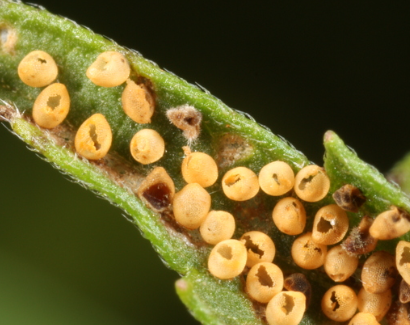
Parasitized aphids often become swollen, tan-colored “aphid mummies,” indicating that beneficial parasitoid wasps are active.
Management and Control
Management is rarely necessary because ragweed aphids primarily attack weeds rather than cultivated plants.
Conservation Biological Control
In many situations, ragweed aphids should be conserved because they naturally suppress ragweed populations and support beneficial insect communities.
Cultural Control
- Remove ragweed plants near sensitive crops if aphids begin dispersing.
- Maintain healthy crop plants to minimize stress.
Biological Control
Encouraging populations of natural predators often provides complete control.
Chemical Control
If aphids spread onto valuable ornamental or crop plants, insecticidal soaps, horticultural oils, or selective aphid insecticides may be used. Broad-spectrum insecticides should be avoided whenever possible to preserve beneficial species.
Economic Importance
Ragweed aphids rarely cause direct economic losses. In fact, they often provide ecological benefits by reducing ragweed growth, suppressing pollen production, and supporting populations of beneficial predators that later move into agricultural systems.
Research and Conservation
Researchers continue to investigate the role of ragweed aphids in integrated weed management programs and their potential contribution to reducing airborne allergen production in heavily infested landscapes.