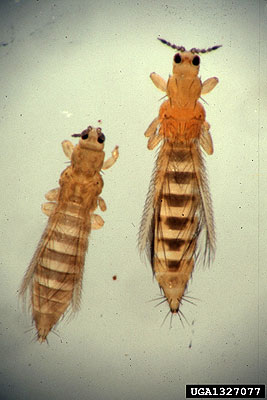
Quinoa thrips are tiny insects that feed on plant tissues, causing damage to leaves, stems, and developing grains. These pests are particularly problematic in warm, dry environments where populations can increase rapidly.
Thrips are also known vectors of plant viruses, making them a significant concern in agricultural systems.
The Silver Scar: Quinoa Thrips
The Quinoa Thrips (primarily Frankliniella occidentalis, the Western Flower Thrips, and Thrips tabaci) is a microscopic but high-impact “noxious” pest for quinoa growers in the United States. These insects are particularly troublesome in the arid climates of Arizona, Colorado, and California. Because they are “rasping-sucking” feeders, they destroy the surface cells of the quinoa plant, leading to stunted growth and, most critically, the failure of the nutrient-dense seed heads to develop properly.
Identification: The “Thunder Bug”
Thrips are notoriously difficult to see with the naked eye. To identify them users should use a “tap test” (shaking a flower head over a white sheet of paper). Key physical markers include:
- Size and Shape: They are tiny, slender insects, roughly 1mm to 2mm long (about the thickness of a credit card). They look like minute dark “slivers” or threads.
- Fringed Wings: Under a microscope, their wings are not solid but consist of a central leaf with long, hair-like fringes, resembling tiny feathers.
- Coloration: Depending on the species and temperature, they range from translucent yellow to dark brown or black.
- The “Storm” Behavior: They are often called “Thunder Bugs” in the U.S. because they take flight in massive numbers just before a thunderstorm when the humidity rises.
The “Silvery” Damage Pattern
The damage caused by Quinoa Thrips is unique and serves as a diagnostic “fingerprint” on the plant:
- Silvering: As thrips rasp away the surface of the leaf and suck out the contents, air enters the empty cells, giving the leaf a distinct silvery or metallic sheen.
- Black Specks: Small, “varnish-like” black dots of excrement (frass) are always present on the silvery patches, which distinguishes thrips damage from spider mite webbing.
- “Blast” in the Panicle: When thrips feed on the developing seed head (panicle), they cause “blasting”—the flowers dry up and fall off, or the seeds become distorted and sterile.
- Vectoring Viruses: Most dangerously, thrips in the U.S. are the primary vectors for Tomato Spotted Wilt Virus (TSWV), which can jump from weeds to quinoa and cause the plant to wilt and die rapidly.
U.S. Integrated Pest Management (IPM)
Managing thrips in quinoa is a challenge because they quickly develop resistance to chemical pesticides. Management focus is on Biological Control and Moisture:
- The “Overhead” Solution: Thrips hate moisture. In small gardens, regular overhead irrigation or a strong spray of water can physically wash them off the plants and disrupt their breeding cycle.
- Predatory Mites: In the U.S., commercial growers release Amblyseius cucumeris, tiny predatory mites that hunt thrips larvae. These are highly effective in the humid microclimate of a dense quinoa canopy.
- Blue Sticky Traps: Unlike many other insects that are attracted to yellow, many thrips species are specifically attracted to bright blue. Placing blue sticky cards at the level of the seed heads is the standard U.S. way to monitor their arrival.
- Reflective Mulch: Using UV-reflective plastic mulch (silver) at planting can disorient flying thrips, preventing them from “seeing” the quinoa plants as they migrate into the area.
Identification
Small, slender insects with fringed wings.
Life Cycle
Rapid lifecycle with multiple generations per season.
Damage
Silvery streaks, distorted leaves, and reduced yield.
Control
Sticky traps, biological controls, and targeted insecticides.