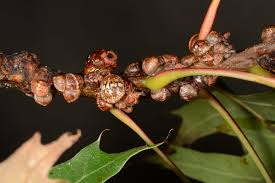
Quercus scale insects are sap-feeding pests that infest oak trees and can lead to reduced vigor and decline over time. These insects are often overlooked due to their small size and immobile nature, but their impact can be significant in heavy infestations.
The High-Latitude Hitchhiker: Quesnel Scale Insects
The Quesnel Scale Insect (Physokermes quesnelii), also known as a type of Spruce Bud Scale, is a specialized hemipteran primarily found in the cool, coniferous forests of Western North America, from British Columbia (Quesnel) down through the Pacific Northwest and into the high-elevation forests of the Southwest. These insects are “noxious” because they mimic the tree’s own reproductive buds, allowing them to suck the life out of spruce and fir trees while remaining virtually invisible to the untrained eye.
Identification: The “False Bud”
The genius of the Quesnel Scale is its camouflage. Unlike the white, cottony scales seen on some ornamental plants, these scales are designed to look like a part of the tree. Identification requires feeling the twigs rather than just looking at them:
- Appearance: Mature females are globular, leathery, and dark reddish-brown. They are almost always located in clusters at the base of new twig growth or tucked into the junctions of needles.
- The Mimicry: They are almost exactly the same size and color as a spruce bud. If you try to “pick” a bud and it squishes or feels soft, it is likely a scale insect.
- The “Sooty” Indicator: Because they are soft scales, they excrete massive amounts of honeydew. In the dense canopy of a spruce, this leads to a heavy coating of Black Sooty Mold. If the interior of your evergreen looks “charred” or black, look for the scale “buds” nearby.
The “Lower Branch” Decline
The damage caused by Quesnel Scale is slow and cumulative. It rarely kills a mature tree overnight, but it can permanently disfigure high-value landscape evergreens:
- Lower Branch Dieback: Infestations typically start on the lower branches where humidity is higher and airflow is lower. Over several seasons, these branches will lose their needles and eventually die.
- Stunted New Growth: Because the scales cluster at the base of the new year’s growth, they intercept the nutrients intended for the expanding needles, resulting in short, yellowed, or “hooked” new tips.
- The “Ant Highway”: Like many scales in the U.S. West, they are often attended by ants that protect them from predatory ladybeetles in exchange for sugar.
U.S. Forestry and Landscape Management
In the United States, managing Quesnel Scale in a forest setting is rarely feasible, but for ornamental Spruce (like Colorado Blue Spruce) or Fir, several strategies apply:
- Dormant Oil (The Winter Strike): In the late winter or very early spring, before the tree begins to “push” new growth, applying a Horticultural Superior Oil can smother the overwintering nymphs. This is the most effective organic-compatible control.
- The Crawler Window: In the Pacific Northwest and mountain regions, the tiny, mobile “crawlers” emerge in June or July. This is the only time the insects are not protected by their leathery shells. Using yellow sticky cards or a magnifying glass to spot these yellow specks is the key to timing a soap or neem oil spray.
- Improving Airflow: Pruning out the heavily infested (and often already dead) lower branches can increase sunlight and airflow, creating a less hospitable environment for the scales and the sooty mold.
- Systemic Soil Drench: For large, inaccessible trees, a soil drench of Imidacloprid in the autumn can be effective. The tree absorbs the chemical, which then kills the scale as they begin feeding the following spring.
Identification
Small, waxy bumps on bark or leaves.
Life Cycle
Includes crawler stage followed by immobile adult stage.
Damage
Yellowing leaves and branch dieback.
Control
Horticultural oils and systemic treatments.