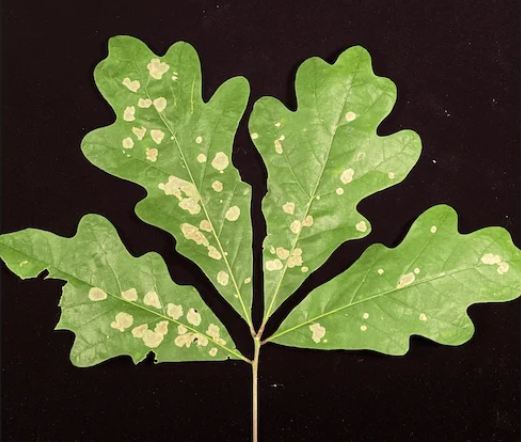
Quercus Leaf Miners is a general name for several small insects whose larvae live and feed inside the leaves of oak trees in the genus Quercus. Most are tiny moths, sawflies, or beetles whose immature stages tunnel between the upper and lower surfaces of an oak leaf. Their feeding creates distinctive blotches, winding trails, translucent patches, or brown mines that remain visible after the larvae have moved or completed development.
The conflict caused by Quercus Leaf Miners is primarily aesthetic damage and tree stress. A few mined leaves have almost no effect on a healthy oak, and these insects are a normal part of forest ecosystems. Heavy or repeated infestations, however, may reduce the amount of healthy leaf tissue available for photosynthesis. Young trees, recently transplanted oaks, drought-stressed trees, and ornamental specimens may be more affected than mature trees growing under favorable conditions.
Taxonomy and Classification
Quercus Leaf Miners do not belong to a single species or even a single insect order. The name describes insects that share the same feeding strategy: their larvae develop inside oak leaves.
- Primary Host Genus: Quercus (Oaks)
- Common Insect Orders: Lepidoptera, Hymenoptera, and Coleoptera
- Feeding Stage: Larva
- Damage Type: Internal leaf mining
- Life Cycle: Complete metamorphosis
Many oak leaf miners are tiny moths whose caterpillars live between the epidermal layers of the leaf. Other species are sawflies with larvae adapted to internal feeding, while some small beetles also create mines. Because several unrelated insects can produce similar symptoms, the shape of the mine, the host oak species, the season, and the appearance of the larva are important for accurate identification.
Physical Description
Adult Quercus Leaf Miners are usually small and rarely noticed. Depending on the species, the adult may be a tiny moth, sawfly, or beetle. The larval stage is responsible for the visible leaf damage.
- Adult Size: Usually very small and often less than 1/4 inch long
- Adult Appearance: Varies from narrow-winged moths to tiny dark sawflies or beetles
- Larva: Small, flattened, cream, yellowish, greenish, or translucent
- Location: Hidden between the upper and lower surfaces of the leaf
- Key Identification Feature: A visible tunnel or blotch containing a larva or dark frass
The larva is often flattened because it must live in the narrow space between the two surfaces of the leaf. In some species, the larva changes shape as it develops, beginning as a specialized sap-feeding stage and later becoming a more typical tissue-feeding larva.
Identifying Leaf Mine Damage
The most important sign of Quercus Leaf Miners is the mine itself. A mine forms when a larva feeds internally while leaving at least part of the outer leaf surface intact.
- Serpentine Mines: Narrow, winding trails that become wider as the larva grows
- Blotch Mines: Large, irregular, pale, tan, or brown patches
- Tentiform Mines: Raised or folded areas caused by silk contracting inside the leaf
- Linear-Blotch Mines: Narrow tunnels that eventually expand into larger patches
- Frass Trails: Dark waste material visible inside the mine
- Premature Browning: Mined tissue may dry, turn brown, and die
Leaf miner damage is sometimes mistaken for fungal leaf spots, drought scorch, or chemical injury. A useful identification method is to hold the damaged leaf up to the light. An active mine may reveal a larva, shed skin, or line of dark frass between the leaf surfaces.
Distribution and Habitat
Quercus Leaf Miners occur wherever oak trees grow. Oaks support an exceptionally diverse community of insects, and leaf-mining species are found in forests, parks, residential landscapes, urban streets, nurseries, and natural oak woodlands.
Common habitats include:
- Oak forests
- Woodland edges
- Residential landscapes
- Public parks
- Street tree plantings
- Tree nurseries
- University and commercial campuses
- Areas with young or stressed oak trees
Some species are highly specific and feed on only one oak species or a small group of closely related oaks. Others can develop on several members of the genus Quercus. The exact host can therefore provide an important clue when identifying the responsible leaf miner.
Life Cycle
Quercus Leaf Miners undergo complete metamorphosis with egg, larval, pupal, and adult stages. The adult female typically lays eggs directly on or inside an oak leaf. After hatching, the young larva immediately enters the leaf tissue and begins feeding between the surfaces.
The mine expands as the larva grows. A narrow trail may become wider, or a small pale spot may develop into a large blotch. The larva remains protected from many predators, weather conditions, and contact insecticides while inside the leaf.
Depending on the species, pupation may occur inside the mine, in a folded section of the leaf, in a cocoon attached to the foliage, or in leaf litter beneath the tree. Some Quercus Leaf Miners have one generation per year, while others may produce multiple generations during a long growing season.
Damage and Tree Impact
Most Quercus Leaf Miner damage is cosmetic. A mature, healthy oak has thousands of leaves and can usually tolerate moderate mining without significant decline. Problems are more likely when infestations are unusually heavy or when the tree is already under stress.
- Leaf Discoloration: Mines create pale, tan, yellow, or brown patches.
- Reduced Photosynthesis: Heavily mined tissue can no longer function normally.
- Premature Leaf Drop: Severely damaged leaves may fall early.
- Aesthetic Loss: Ornamental trees may appear unhealthy or scorched.
- Young Tree Stress: Repeated heavy infestations may slow growth.
- Cumulative Decline: Leaf mining combined with drought, root damage, or other pests may increase tree stress.
Leaf miners rarely kill established oaks by themselves. Their importance increases when they occur alongside other Quercus Pests, including defoliating caterpillars, scale insects, aphids, wood borers, Oak Wilt, or other diseases. A tree already weakened by drought or root disturbance may have less ability to tolerate additional leaf loss.
Behavior and Ecological Importance
Leaf mining is a highly specialized feeding strategy. By living inside the leaf, larvae gain protection from rain and some predators. However, they are still attacked by many specialized natural enemies.
Parasitic wasps are among the most important natural controls of Quercus Leaf Miners. These tiny wasps locate larvae inside leaves and lay eggs on or inside them. The developing parasitoid eventually kills the leaf miner. Birds, predatory insects, spiders, and pathogens may also contribute to population control.
In natural forests, Quercus Leaf Miners are part of the oak food web. They provide food for predators and parasitoids and contribute to the enormous biodiversity supported by oak trees.
Management and Prevention
Management of Quercus Leaf Miners should follow integrated pest management (IPM). In most cases, treatment is unnecessary because healthy oaks tolerate the damage and natural enemies suppress populations.
| Management Strategy | Description | Purpose |
|---|---|---|
| Monitoring | Inspect leaves for fresh mines during the growing season. | Determines whether damage is increasing or only cosmetic. |
| Leaf Removal | Remove a limited number of heavily mined leaves from small trees. | Can eliminate larvae before they complete development. |
| Tree Health | Provide appropriate watering and protect the root zone. | Helps the tree tolerate leaf damage. |
| Natural Enemy Protection | Avoid unnecessary broad-spectrum insecticides. | Conserves parasitic wasps and predators. |
| Leaf Litter Management | Remove fallen leaves when the responsible species overwinters in leaf litter. | May reduce the following generation. |
For young ornamental oaks, individual mined leaves may be removed and destroyed if the infestation is detected early. However, excessive leaf removal can cause more damage than the insects themselves, so only heavily infested leaves should be considered.
Broad-spectrum insecticides are rarely recommended for established trees. Larvae are protected inside the leaf, making many contact sprays ineffective. These treatments may also kill parasitic wasps and other beneficial insects that naturally regulate leaf miner populations.
When Professional Treatment May Be Needed
Professional evaluation may be appropriate when a young, recently transplanted, or high-value oak experiences repeated heavy infestations. Accurate identification is essential before treatment because different leaf-mining species have different life cycles.
An arborist or pest management professional may recommend:
- Species identification
- Seasonal monitoring
- Improved irrigation and tree care
- Protection of the root zone
- Removal of specific overwintering material
- Precisely timed treatment when economically or aesthetically justified
Timing is critical because treatments applied after larvae are fully protected inside mature mines may provide little benefit.
Conservation and Research
Quercus Leaf Miners are studied for their specialized relationships with oak trees, their interactions with parasitic wasps, and their responses to climate and environmental change. Because many species are closely associated with particular oak hosts, they can provide information about forest biodiversity and insect-plant evolution.
Research also examines how warmer temperatures, drought, urban stress, and changing oak distributions may affect leaf miner populations. Scientists continue to study natural enemy communities as a way to understand how these insects are regulated without widespread pesticide use.
Conclusion
Quercus Leaf Miners are small insects whose larvae feed inside oak leaves, creating winding trails, blotches, translucent patches, and brown mines. Although the damage can be visually dramatic, most infestations are cosmetic and do not threaten healthy, mature oak trees. Young or stressed trees may be more vulnerable when infestations are severe or repeated. Monitoring, proper tree care, selective sanitation, and conservation of natural enemies are the best management strategies. In most landscapes, Quercus Leaf Miners should be viewed as a normal part of the diverse insect community supported by oak trees rather than as a major threat requiring aggressive control.