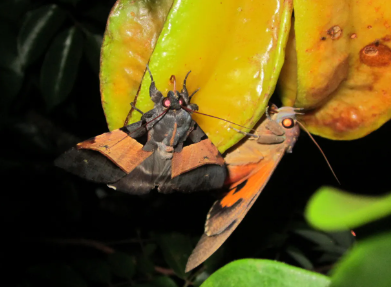
Queensland fruit piercing moths are nocturnal pests that feed on fruit by piercing the skin and extracting juices. This feeding behavior causes significant crop losses and opens pathways for secondary infections.
The Midnight Driller: Queensland Fruit Piercing Moths
The Queensland Fruit Piercing Moth (Eudocima fullonia) is a large, powerful tropical moth that presents a unique challenge to fruit growers. Unlike most moths whose larvae (caterpillars) are the primary pests, in this species, the adult moth is the destructive stage. While native to the Indo-Pacific and Australia, they are a high-alert “quarantine pest” for the United States, particularly for the citrus and tropical fruit industries in Florida, Hawaii, and Southern Arizona.
Identification: The “Leaf-Mimic” Specialist
These moths are masters of camouflage when their wings are closed, but they reveal a startling “warning” color when they take flight. Identifying them in a U.S. orchard or garden context is a matter of spotting their large size and specific underwing patterns:
- Forewings: The top wings are typically a mottled brown or olive green, shaped exactly like a dried or living leaf, complete with a “midrib” line that runs across the wing.
- Hindwings: When the moth opens its wings, it reveals brilliant orange or yellow hindwings marked with a distinct black, comma-shaped or “C-shaped” blotch near the center and a black border.
- The Proboscis: The most “noxious” feature is the mouthparts. Unlike most moths that have a soft, straw-like tube, this moth has a stiff, barbed, and heavily sclerotized proboscis capable of drilling through the tough rinds of citrus and even green pineapples.
The “Invisible” Primary Damage
Because these moths feed under the cover of darkness and leave behind very small entry points, the damage is often missed until the fruit begins to rot on the tree. The diagnostic signs are quite specific:
- The Pinprick: The moth drills a tiny, circular hole into the fruit to reach the juice. At first, this looks like a minor sting or a mechanical scratch.
- Premature Ripening: The fruit around the puncture site often turns yellow or orange prematurely, while the rest of the fruit remains green.
- Internal Fermentation: As the moth feeds, it introduces yeasts and bacteria. Within 48 hours, the area around the hole becomes soft and “water-soaked,” eventually leading to a complete collapse and a strong smell of fermentation.
The “Host-Switching” Lifecycle
One of the reasons these moths are so difficult to manage is their “migratory” lifecycle. The larvae do not eat fruit; they feed exclusively on the leaves of Menispermaceae (Moonseed) vines. The adults may travel many miles from these wild vines to find an orchard to feed in, making the “source” of the infestation hard to pin down.
U.S. Management: Lights and Netting
In the United States, traditional insecticides are largely ineffective because the moths do not stay on the fruit long enough to ingest a lethal dose. Management is focused on physical and visual disruption:
- Exclusion Netting: In high-value tropical fruit operations, fine-mesh netting is the only 100% effective way to keep these large moths from reaching the crop.
- Fruit Bagging: In home gardens, placing individual mesh or paper bags over developing fruit can prevent the moths from drilling into them.
- Yellow Light Distraction: In their native range, bright yellow lights are often used in orchards at night. These lights can disorient the moths and suppress their feeding activity, though it is not a perfect solution.
- Habitat Removal: Identifying and removing wild Menispermaceae vines near orchards can reduce the local breeding population, as the larvae have no other food source.
Identification
Large moths with strong proboscises adapted for piercing fruit.
Damage
Fruit damage, rot, and reduced marketability.
Control
Netting, trapping, and orchard sanitation.