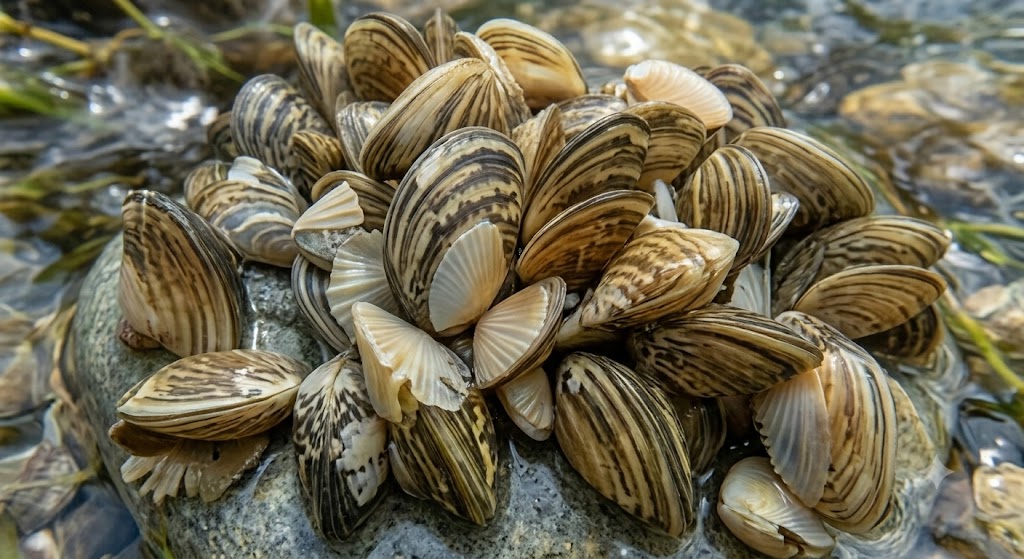
Quagga Mussels (Dreissena rostriformis bugensis) are highly invasive freshwater bivalves that have caused major ecological and economic damage across North America and parts of Europe. Native to the Dnieper River drainage region of Ukraine, Quagga Mussels spread through shipping, ballast water, canals, rivers, reservoirs, and contaminated recreational equipment. Along with the closely related Zebra Mussel, they are considered among the most damaging aquatic invasive species because they reproduce rapidly, attach densely to submerged surfaces, and filter enormous quantities of plankton from the water.
The conflict caused by Quagga Mussels is both environmental and industrial. In lakes and reservoirs, they alter food webs by removing phytoplankton that native zooplankton and young fish depend on. In water systems, they cause severe biofouling by clogging intake pipes, screens, pumps, dams, cooling systems, irrigation equipment, docks, boat hulls, and marina infrastructure. Their sharp shells also create hazards on beaches and shorelines.
Taxonomy and Classification
Quagga Mussels belong to the class Bivalvia, a group that includes clams, oysters, scallops, and other two-shelled mollusks. They are members of the family Dreissenidae, which includes several invasive mussels known for attaching to hard surfaces with strong byssal threads.
- Phylum: Mollusca
- Class: Bivalvia
- Order: Myida
- Family: Dreissenidae
- Genus: Dreissena
- Species: Dreissena rostriformis bugensis
- Common Name: Quagga Mussel
Adult Quagga Mussels are mostly sessile, meaning they remain attached to surfaces after settling. Unlike many native freshwater mussels that live partly buried in sediment, Quagga Mussels can form dense colonies on rocks, docks, pipes, boat surfaces, and even softer lake-bottom substrates.
Physical Description
Adult Quagga Mussels are small, usually measuring about 1/2 inch to 1.5 inches long. Their shells are variable in color, shape, and pattern, which can make them difficult to distinguish from Zebra Mussels without close inspection.
- Length: Approximately 1/2 to 1.5 inches
- Shell Shape: D-shaped but often rounded or asymmetrical
- Color: Light brown, dark brown, cream, white, or banded
- Attachment: Strong byssal threads attach adults to surfaces
- Key ID Feature: Often unstable when placed on a flat surface because the underside is less flattened than that of Zebra Mussels
The larval stage is microscopic and free-swimming. These larvae, called veligers, drift in the water column before settling and attaching to a suitable surface. Because veligers are invisible to the naked eye, contaminated water in boats, bait buckets, ballast tanks, live wells, bilges, and equipment can spread Quagga Mussels even when no adult mussels are visible.
Distribution and Habitat
Quagga Mussels are now established in many major freshwater systems, including the Great Lakes, connecting waterways, and numerous western reservoirs in North America. Their ability to tolerate deeper, colder water gives them an advantage over some related invasive mussels and allows them to colonize large areas of lake bottoms.
Common habitats include:
- Freshwater lakes
- Reservoirs
- Rivers
- Canals
- Water intake structures
- Marinas
- Docks and pilings
- Boat hulls and motors
- Irrigation systems
They are spread primarily by human activity. Trailered boats, fishing equipment, personal watercraft, construction equipment, and any object that moves contaminated water or attached mussels from one water body to another can introduce the species to new locations.
Life Cycle and Reproduction
Quagga Mussels reproduce by releasing eggs and sperm into the water. Fertilization occurs externally, producing microscopic veligers that drift with currents. A single female can produce very large numbers of eggs during a reproductive season, allowing populations to expand quickly when conditions are favorable.
After the larval stage, young mussels settle onto surfaces and attach using byssal threads. Once established, colonies may become extremely dense, with layers of mussels growing over rocks, pipes, boat surfaces, native mussels, and other submerged structures. Their ability to reproduce rapidly and colonize deep areas makes eradication extremely difficult once they become established.
Ecological Damage
The ecological impact of Quagga Mussels is severe because they filter massive quantities of water. While filter feeding may make water appear clearer, this clarity is not necessarily a sign of improved ecosystem health. By removing phytoplankton and suspended organic material, Quagga Mussels reduce food availability for native zooplankton, young fish, and other aquatic organisms.
Major ecological effects include:
- Reduced plankton availability
- Altered food webs
- Declines in native mussels
- Increased water clarity
- Shifts in nutrients toward bottom habitats
- Growth of nuisance algae such as Cladophora
- Changes in fish communities
Native mussels are especially vulnerable because Quagga Mussels can attach directly to their shells in dense clusters, interfering with movement, feeding, respiration, and reproduction.
Economic and Infrastructure Damage
Quagga Mussels are notorious for biofouling. Their colonies grow inside and around water infrastructure, reducing flow and increasing maintenance costs. Power plants, municipal water systems, irrigation districts, fish hatcheries, industrial cooling systems, and hydropower facilities may all be affected.
Common infrastructure problems include:
- Clogged intake pipes
- Reduced water flow
- Blocked screens and filters
- Damaged boat motors
- Fouled hulls and docks
- Increased corrosion
- Higher maintenance and treatment costs
For boaters and anglers, Quagga Mussels create practical and regulatory problems. Boats leaving infested waters may require inspection, decontamination, or drying periods before entering another water body.
Management and Prevention
Once Quagga Mussels establish in a large water body, complete eradication is rarely practical. Prevention is the most important management strategy. Public education, boat inspections, watercraft decontamination, and rapid detection programs are essential for slowing spread.
| Management Strategy | Description | Purpose |
|---|---|---|
| Clean, Drain, Dry | Clean boats and gear, drain all water, and dry equipment before moving between water bodies. | Prevents transport of adults and microscopic veligers. |
| Hot Water Decontamination | Use hot, high-pressure water on boats, trailers, motors, and equipment. | Kills attached mussels and removes hidden contamination. |
| Infrastructure Treatment | Apply approved molluscicides, chlorine, copper-based treatments, or other system-specific methods. | Controls mussels inside pipes and water systems. |
| Mechanical Removal | Scrape, pressure wash, or physically remove mussel colonies. | Reduces buildup on accessible surfaces. |
| Early Detection | Use plankton sampling, settlement plates, and environmental DNA testing. | Helps detect new invasions before populations explode. |
The most important prevention message is simple: Clean, Drain, Dry. Boats, trailers, anchors, fishing gear, waders, bait buckets, and any equipment exposed to infested water should be cleaned thoroughly, drained completely, and allowed to dry before reuse elsewhere.
Conservation and Research
Quagga Mussels are a major focus of invasive species research. Scientists are developing faster detection tools, improved anti-fouling coatings, species-specific control methods, and better models for predicting spread. Environmental DNA testing is especially useful because it can detect traces of Quagga Mussels in water samples before adults are easily found.
Research also examines biological controls and targeted treatments that could reduce mussel populations without harming native aquatic organisms. Because freshwater systems are sensitive and interconnected, any control method must be carefully evaluated before large-scale use.
Conclusion
Quagga Mussels are among the most damaging invasive freshwater species in North America and Europe. Their rapid reproduction, microscopic larval stage, dense attachment behavior, and massive filter-feeding capacity allow them to transform aquatic ecosystems and impose heavy costs on water infrastructure. Once established, they are extremely difficult to remove, making prevention the strongest defense. Consistent use of Clean, Drain, Dry practices, careful boat inspection, early detection, and targeted infrastructure treatment are essential for reducing the spread and impact of this invasive mussel.