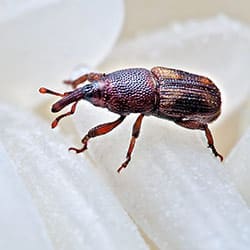
Quadrispine weevils are a group of plant-feeding beetles characterized by their distinctive snouts and often spined body structures. Like many weevils, they are known for causing damage at both larval and adult stages. Larvae typically feed on roots, while adults consume foliage, making them a dual-threat pest in agricultural and ornamental settings.
These pests are particularly problematic in nursery environments and crop systems where plants are grown in high density. Because larvae develop underground, infestations may go unnoticed until plants begin to show signs of stress or decline.
The Spiny Specialist: Quadrispine Weevils
The Quadrispine Weevil (Chelotrupes quadrispinosus or related species in the Baridinae subfamily) is a specialized “snout beetle” characterized by four distinct spines or projections on its thorax or wing covers. In the United States, these weevils are primarily associated with native grasses and herbaceous perennials. While they are not as globally infamous as the Boll Weevil, they are considered “noxious” in specific agricultural contexts—particularly in seed production and rangeland management—where their internal feeding can decimate a plant’s reproductive potential.
Identification: The “Four-Spine” Fortress
Like all weevils, the Quadrispine possesses a elongated rostrum (snout) with chewing mouthparts at the tip. However, its “armored” appearance sets it apart from the smoother-bodied grain weevils often found in American pantries:
- Thoracic Spines: The hallmark of the genus is the presence of four sharp, chitinous spines (two on each side) located on the prothorax. These likely serve as a defense against small predatory insects and birds.
- Hardened Elytra: Their wing covers are deeply pitted and extremely hard, often sporting a metallic or dull “pebbled” texture that mimics the seeds or soil of their habitat.
- Leg Structure: They have “fossorial” (digging) tendencies, with stout legs and hooked tarsi that allow them to cling tightly to wind-blown stalks or burrow into the crown of a plant.
The “Inner-Stem” Feeding Strategy
The Quadrispine Weevil is an endophytic feeder, meaning the most destructive part of its life cycle happens entirely inside the plant tissue. This makes them a “hidden” pest for Pestipedia.com users:
- Oviposition Scars: The female uses her snout to drill a tiny hole into the stem or seed head of a host plant. She deposits a single egg and then seals the hole with a “plug” of plant fibers and frass.
- Internal Tunneling: Upon hatching, the larva (a legless, white, C-shaped grub) tunnels through the pith of the stem. This disrupts the flow of water and often causes the seed head to “lodge” (bend over or break) before harvest.
- Nutrient Theft: Because they target the reproductive parts of the plant, an infestation can result in “blank” seed heads, where the seeds appear formed but are actually hollow husks.
U.S. Rangeland and Seed Crop Management
In the Western and Midwestern United States, managing Quadrispine Weevils is a matter of timing and habitat disturbance. Because the larvae are protected inside the plant, surface sprays are rarely effective once the eggs are laid.
- Mowing and Grazing: In rangeland management, controlled grazing or mowing at the specific time of “bolting” (when the plant stems shoot up) can remove the egg-laying sites before the weevils can establish.
- Post-Harvest Sanitation: Since many species overwinter as larvae in the stubble of the plant, burning or deep-plowing crop residue is a standard U.S. practice to break the yearly cycle.
- Systemic Protection: In high-value seed production, systemic insecticides that move *through* the plant’s vascular system are used to target the larvae as they begin to feed on the inner pith.
Identification
Quadrispine weevils are small to medium-sized beetles with elongated snouts. Their bodies may feature small spines or ridges, and coloration typically ranges from brown to black.
Life Cycle
Eggs are laid in soil or plant tissue. Larvae develop underground, feeding on roots before pupating. Adults emerge and feed on foliage.
Damage and Impact
Root feeding weakens plants, while adult feeding causes leaf notching. Severe infestations can lead to plant death.
Control
Control includes soil treatments, biological agents such as nematodes, and monitoring adult populations.