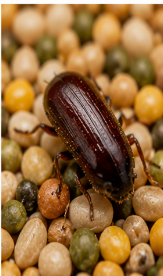
Pulse Beetles are a group of small seed-feeding beetles that attack peas, beans, chickpeas, lentils, cowpeas, mung beans, and other dried legumes known collectively as pulses. The term most commonly includes the Pea Weevil (Bruchus pisorum), the Cowpea Weevil (Callosobruchus maculatus), and related seed beetles in the subfamily Bruchinae.
Despite being commonly called weevils, Pulse Beetles are not true weevils in the family Curculionidae and do not have the long snout associated with insects such as grain weevils. They are specialized leaf beetles whose larvae develop inside legume seeds. Their concealed feeding causes weight loss, reduced nutritional value, poor germination, contamination, and rejection of stored products.
Overview
Pulse Beetles are important agricultural and stored-product pests throughout the world. Some species begin infestations in the field by laying eggs on developing pods. Others can reproduce continuously after harvested seeds have been placed in storage. Because the larvae remain hidden inside individual seeds, infestations may go unnoticed until adults emerge and leave circular holes in the seed coats.
The severity of damage depends on the beetle species, host seed, storage temperature, moisture level, and length of storage. Under warm conditions, store-infesting species can complete several generations in succession. A small number of contaminated beans or peas may therefore develop into a major infestation that affects an entire container, sack, warehouse, or processing facility.
Taxonomy and Classification
Pulse Beetles belong to the order Coleoptera, which includes all beetles, and the family Chrysomelidae, commonly called leaf beetles. They are placed in the subfamily Bruchinae, a group specialized for feeding inside seeds.
- Order: Coleoptera
- Family: Chrysomelidae
- Subfamily: Bruchinae
- Important Genera: Bruchus, Callosobruchus, Acanthoscelides, and related groups
- Common Names: Pulse Beetles, Seed Beetles, Bean Weevils, Pea Weevils, and Cowpea Weevils
Pulse Beetles undergo complete metamorphosis, passing through egg, larval, pupal, and adult stages. The larval stage causes nearly all of the direct seed damage.
Species in the genus Bruchus generally infest seeds while crops are still growing in the field. Many species in Callosobruchus can reproduce in both field and storage environments, making them especially destructive after harvest.
Identification
Adult Pulse Beetles are small, compact insects that usually measure approximately 1/8 to 1/4 inch long. Their bodies are oval or slightly wedge-shaped and often covered with gray, brown, black, cream, or reddish scales.
- Adult Body: Short, broad, and somewhat hump-backed.
- Color: Brown, gray, black, reddish, or mottled with lighter markings.
- Wing Covers: The hardened wing covers are often shortened and may leave the end of the abdomen exposed.
- Hind Legs: Many species have enlarged hind thighs, sometimes with small teeth or spines.
- Snout: Adults lack the elongated snout found on true weevils.
- Larvae: Creamy white, curved, fleshy grubs that become legless after entering the seed.
- Eggs: Small, pale, oval structures glued firmly to pods or stored seeds.
The most recognizable sign is a smooth, round adult exit hole in the seed coat. Some seeds may contain a thin circular window where an adult is about to emerge. Multiple seeds with matching holes strongly suggest an established infestation.
Distribution and Habitat
Pulse Beetles are found worldwide wherever legumes are cultivated, transported, processed, or stored. They are especially serious in warm tropical and subtropical regions, where temperatures allow rapid reproduction throughout much of the year.
In agricultural settings, adults may be found on flowers, leaves, pods, and developing crops. After harvest, infestations occur in granaries, warehouses, silos, markets, food-processing facilities, seed stores, animal-feed areas, and household pantries.
Suitable products include:
- Dried peas
- Cowpeas and black-eyed peas
- Chickpeas
- Lentils
- Mung beans
- Adzuki beans
- Common dry beans
- Pigeon peas
- Fava beans
- Other dried legume seeds
Different species favor different host seeds. Correct identification can therefore help determine where an infestation began and whether the beetles are capable of continuing to reproduce in storage.
Life Cycle
The life cycle begins when a female glues eggs to the surface of a pod or seed. Field-infesting species often place eggs on developing pods. After hatching, the tiny larva penetrates the pod and enters a seed. Store-infesting species may lay eggs directly on harvested beans, peas, or lentils.
Once inside, the larva feeds on the cotyledons and other internal tissues. The entrance wound is usually so small that it is difficult to detect. As the larva grows, it creates an expanding chamber and consumes much of the seed.
The mature larva prepares a circular exit area just beneath the seed coat and pupates inside the feeding chamber. When development is complete, the adult pushes or chews through this weakened area, leaving a clean round hole.
Development may take several weeks under warm conditions. Store-infesting species can mate and lay eggs soon after emerging, allowing many overlapping generations to develop during extended storage.
Field-Infesting and Storage-Infesting Species
Understanding the difference between field and storage species is important for control.
Field-Infesting Species
The Pea Weevil and related Bruchus species usually lay eggs on green pods before harvest. Larvae enter developing seeds and may remain inside through harvest and storage. However, the adults generally do not reinfest dry seeds repeatedly in storage.
Storage-Infesting Species
Cowpea Weevils and many Callosobruchus species can lay eggs directly on dry stored seeds. Their offspring emerge, mate, and attack additional seeds, producing repeated generations. These species can cause rapid deterioration of stored pulses if conditions remain warm.
Damage and Problems
Pulse Beetle damage is caused almost entirely by larvae feeding inside seeds. Because this feeding is concealed, the product may appear acceptable from the outside until exit holes, powder, or adult beetles become visible.
Weight Loss
Larvae consume the seed’s internal tissues, reducing its weight and usable food content. Severe infestations may leave only a hollow shell and loose fragments.
Loss of Germination
Feeding can destroy the embryo or remove nutrients needed for germination. Infested seed intended for planting may produce weak seedlings or fail to germinate entirely.
Food Contamination
Damaged products may contain live larvae, pupal skins, adults, eggs, frass, cast skins, and broken seed material. Heavy contamination makes the product unsuitable for sale or human consumption.
Reduced Nutritional and Market Value
Internal feeding reduces protein, carbohydrate, and overall food value. Visible exit holes also lower consumer confidence and may cause shipments to be rejected by buyers or regulators.
Heating and Moisture Problems
Large insect populations generate heat and moisture through respiration. In poorly managed storage, this may encourage mold, spoilage, and further deterioration.
Inspection and Monitoring
Stored pulses should be inspected before storage and at regular intervals afterward. Early detection prevents a small infestation from spreading through large quantities of product.
- Look for circular holes in peas, beans, chickpeas, or lentils.
- Check for eggs attached to the seed surface.
- Watch for small beetles crawling inside containers or sacks.
- Inspect seams, corners, spilled food, and residues around storage areas.
- Sift or sample stored products to detect adults and damaged seeds.
- Examine seed lots for thin circular emergence windows.
Pheromone or food-baited traps may be available for certain storage facilities, but direct product inspection remains essential because most immature stages are hidden inside seeds.
Management and Control
Pulse Beetle management should address both field infestation and post-harvest storage. Once larvae enter seeds, ordinary surface sprays may not reach them.
Field Management
In crops where adults lay eggs on developing pods, monitoring should begin during flowering and pod formation. Harvesting promptly after maturity may reduce the time available for infestation.
When insecticides are justified, treatments must target adults before egg laying or newly hatched larvae before they enter the pods. Products should be selected and timed according to crop labels and local agricultural guidance.
Storage Sanitation
- Remove old grain, beans, dust, and debris from storage bins.
- Clean cracks, machinery, sacks, shelves, and transport containers.
- Repair gaps where spilled seeds accumulate.
- Do not mix freshly harvested pulses with older stock.
- Use clean, dry containers with tight-fitting lids.
Even a small quantity of infested residue can introduce adults into a new seed lot.
Drying
Seeds should be dried to an appropriate moisture level before long-term storage. Dry conditions slow insect development and reduce mold risk. Moisture requirements vary by crop and storage system, so commercial producers should follow commodity-specific recommendations.
Hermetic Storage
Hermetic storage uses airtight bags, drums, or containers that restrict oxygen exchange. As insects respire, oxygen levels decline and carbon dioxide levels increase, suppressing feeding, reproduction, and survival.
This approach can be highly useful in areas where refrigeration or conventional fumigation is unavailable. Containers must remain properly sealed to be effective.
Heat and Cold Treatment
Small household quantities may be treated with controlled heat or freezing. Freezing infested dry pulses at approximately 0°F for several days can kill many life stages. Carefully managed heat may also be effective, but excessive temperatures can damage seed viability, flavor, or cooking quality.
Treated products should be allowed to return to room temperature while sealed to prevent condensation.
Discarding Infested Products
Heavily infested household products should usually be sealed in a bag and discarded. Nearby dried beans, peas, grains, and seeds should be inspected because adults may move between packages.
Fumigation
Commercial infestations may require fumigation to reach larvae and pupae hidden inside seeds. Fumigants such as phosphine are highly hazardous, regulated pesticides that must be applied only by trained and licensed professionals.
Improper fumigation can cause poisoning, fire, treatment failure, or illegal pesticide residues. It should never be attempted as a household treatment.
Biological Control
Several parasitic wasps attack Pulse Beetle eggs, larvae, or pupae. These beneficial insects may reduce populations in field and storage environments. Biological control can be especially valuable in enclosed facilities where compatible parasitoid species are released as part of an organized pest management program.
Researchers are also evaluating plant-based repellents, microbial agents, inert dusts, and other low-residue methods. Their effectiveness depends on the beetle species, seed type, temperature, and storage conditions.
Prevention
Prevention is the most reliable way to protect stored pulses. Inspect seeds before purchase or storage, maintain clean facilities, and use insect-resistant containers. Rotate stored stock so older products are used first, and avoid keeping opened bags for long periods in warm areas.
For household storage, transfer dry beans, peas, and lentils into tightly sealed glass, metal, or heavy plastic containers. Thin cardboard boxes and lightweight bags may not prevent adult beetles from escaping or entering.
Seed intended for planting should be stored separately from food products and tested for germination if infestation is suspected.
Conservation and Research
Pulse Beetles are major subjects of stored-product and food-security research. Pulses are important sources of protein, particularly in regions where animal protein is limited or expensive. Preventing storage loss can therefore have a direct effect on nutrition, farmer income, and food availability.
Current research includes breeding legume varieties with harder seed coats, natural defensive compounds, or reduced attractiveness to egg-laying females. Scientists also study hermetic storage, parasitoid releases, botanical insecticides, resistant packaging, and improved detection systems.
Another important research area is the ability of Pulse Beetles to adapt to new host seeds. Understanding host selection and resistance may help protect both commercial crops and traditional stored-food systems.
Conclusion
Pulse Beetles are destructive pests of peas, beans, chickpeas, lentils, cowpeas, and other legume seeds. Their larvae remain concealed inside the seed, where they consume the cotyledons, reduce weight, destroy germination, and contaminate the product.
Some species infest crops primarily in the field, while others reproduce continuously in stored pulses. Effective management combines field monitoring, prompt harvest, sanitation, proper drying, airtight storage, temperature treatment, and professional fumigation when necessary. Early detection and clean storage practices provide the best protection against serious losses.