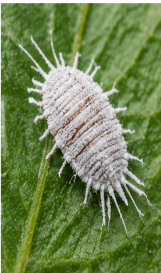
Pseudococcus Mealybugs are soft-bodied, sap-feeding insects in the genus Pseudococcus. They are important pests of greenhouse crops, houseplants, ornamentals, grapevines, citrus, fruit trees, and many other cultivated plants. Their bodies are covered with a white, waxy coating that gives them a cottony or powdery appearance and helps protect them from drying, predators, and some pesticide treatments.
These mealybugs damage plants by inserting slender, piercing-sucking mouthparts into stems, leaves, roots, flowers, and fruit. They remove sap from the plant’s vascular tissues, reducing vigor and interfering with normal growth. Heavy infestations can cause yellowing, leaf drop, distorted shoots, reduced flowering, poor fruit development, and general decline.
Pseudococcus Mealybugs also excrete large quantities of sticky honeydew. This sugary waste coats leaves, fruit, benches, floors, and nearby surfaces. Black sooty mold fungi frequently grow on the honeydew, reducing the plant’s appearance and interfering with photosynthesis when growth becomes extensive.
Overview
Mealybugs are closely related to scale insects and are among the most persistent pests of indoor plants and protected crops. The genus Pseudococcus contains several economically important species, including the Citrus Mealybug (Pseudococcus citri) and the Grape Mealybug (Pseudococcus maritimus).
Their success as pests comes from several traits. Females can produce large numbers of eggs, populations develop continuously in warm environments, and the insects hide in plant crevices where sprays may not reach them. Their waxy coating also reduces the effectiveness of many contact insecticides.
Small infestations may remain unnoticed for weeks. A grower or homeowner may first detect the problem after seeing white cottony clusters, sticky foliage, ants, black sooty mold, or declining plant growth.
Taxonomy and Classification
Pseudococcus Mealybugs belong to the order Hemiptera, which includes true bugs and other insects with piercing-sucking mouthparts. They are members of the family Pseudococcidae, the mealybugs.
- Order: Hemiptera
- Family: Pseudococcidae
- Genus: Pseudococcus
- Common Group: Mealybugs
- Feeding Type: Piercing-sucking sap feeder
Mealybugs undergo incomplete metamorphosis. Their life cycle includes egg, nymphal, and adult stages. Female nymphs gradually become larger and more heavily covered in wax. Males develop differently and pass through a nonfeeding, cocoon-like stage before becoming winged adults.
Although commonly discussed as scale insects, mealybugs remain mobile for much of their lives. Adult females can crawl, although they usually move slowly and remain in protected feeding sites.
Identification
Adult female Pseudococcus Mealybugs are oval, segmented, and usually covered with white, powdery wax. Many species have short wax filaments around the body margin and longer filaments extending from the rear.
- Adult Females: Wingless, oval, slow-moving, and covered in white wax.
- Body Size: Usually a few millimeters long, depending on species and maturity.
- Wax Filaments: Short projections may surround the body, with longer tail-like filaments at the rear.
- Nymphs: Smaller and less heavily coated than adults.
- Crawlers: Newly hatched nymphs that are highly mobile and responsible for spreading infestations.
- Adult Males: Tiny, delicate, winged insects that resemble small gnats and do not feed.
- Egg Masses: White, fluffy structures called ovisacs that protect clusters of eggs.
Mealybugs are often found in leaf axils, under leaves, around buds, along stems, beneath loose bark, around roots, and where fruit touches leaves or other fruit. Root-feeding populations may be difficult to detect without removing the plant from its pot or inspecting the root zone.
Distribution and Habitat
Pseudococcus Mealybugs occur worldwide. They are especially common in tropical and subtropical climates, where outdoor populations may remain active throughout the year. In cooler regions, they are frequent pests of greenhouses, conservatories, indoor gardens, and houseplants.
They infest a wide range of hosts, including:
- Citrus trees
- Grapevines
- Ornamental foliage plants
- Succulents and cacti
- Palms
- Fruit trees
- Vegetable transplants
- Greenhouse flowers
- Houseplants
- Herbs and specialty crops
Warm temperatures and protected conditions encourage rapid reproduction. Indoor populations may continue developing during winter when outdoor natural enemies and cold weather would otherwise reduce their numbers.
Life Cycle
The life cycle begins when a female lays eggs inside a waxy ovisac. The number of eggs varies by species, host plant, temperature, and female condition. The cottony wax protects the eggs from drying and provides some defense against predators and pesticide exposure.
After hatching, the young nymphs are called crawlers. This is the most mobile stage. Crawlers move across the plant, spread to nearby plants, or may be carried on tools, clothing, airflow, animals, or plant material.
Once a crawler finds a suitable feeding site, it inserts its mouthparts into the plant and begins removing sap. Female nymphs pass through several stages before becoming mature adults. They remain wingless and continue feeding throughout their lives.
Males are less commonly observed. They develop through additional stages and eventually emerge as tiny winged adults. Adult males do not feed and live only long enough to locate and mate with females.
In warm greenhouses or indoor environments, generations may overlap. Eggs, crawlers, older nymphs, and adult females may all be present at the same time, which is one reason repeated treatments are often necessary.
Behavior and Feeding
Pseudococcus Mealybugs feed by inserting narrow stylets into plant tissue. They primarily remove sap from the phloem, which carries sugars and nutrients through the plant.
They prefer protected feeding sites where humidity is higher and disturbance is limited. Common locations include:
- Leaf axils
- Stem joints
- Flower buds
- Fruit clusters
- Undersides of leaves
- Root collars
- Crevices beneath bark
- Pot rims and drainage holes
Mealybugs may also develop on roots, especially in potted plants. Root infestations can cause decline even when few insects are visible above ground.
Damage and Problems
Mealybug damage may be direct, caused by sap removal, or indirect, caused by honeydew, sooty mold, ant activity, and disease transmission.
Sap Removal
Large populations remove enough sap to weaken the plant. Symptoms include reduced vigor, yellowing leaves, wilting, delayed growth, and smaller flowers or fruit.
Distorted Growth
Feeding on young shoots and buds can cause curling, stunting, uneven leaf expansion, and malformed flowers. New growth may remain small or fail to open normally.
Leaf and Fruit Drop
Heavily infested plants may shed leaves, buds, flowers, or young fruit. Repeated infestations can reduce crop yield and ornamental value.
Honeydew
Mealybugs excrete excess sugar as sticky honeydew. Leaves may feel shiny or tacky, and the residue can drip onto lower foliage, floors, furniture, vehicles, greenhouse benches, or fruit.
Sooty Mold
Black sooty mold fungi grow on honeydew-covered surfaces. The fungus does not directly invade the plant, but thick growth can block light and reduce photosynthesis. It also makes fruit and ornamental plants unattractive.
Ant Activity
Ants are attracted to honeydew and may protect mealybugs from predators and parasitic wasps. Heavy ant activity on a plant can therefore be an important sign of hidden mealybug colonies.
Virus Transmission
Some mealybug species can transmit plant viruses, especially in grapevines and certain perennial crops. Disease spread can make even low pest populations economically important.
Inspection and Monitoring
Early detection greatly improves control. Plants should be inspected before purchase, propagation, repotting, or movement into a greenhouse or indoor collection.
- Inspect leaf axils, stem joints, buds, and undersides of leaves.
- Look for white wax, cottony egg masses, and crawling nymphs.
- Check for sticky honeydew and black sooty mold.
- Watch for ants moving repeatedly onto the plant.
- Examine roots and potting media when unexplained decline occurs.
- Use a hand lens to detect small crawlers and eggs.
Yellow sticky cards may capture winged males and other flying insects, but visual inspection remains the most useful monitoring method because most mealybugs are wingless and concealed.
Management and Control
Mealybug management requires persistence. Their hidden feeding sites, waxy coating, and overlapping generations make one-time treatments unreliable. An integrated approach provides the best results.
Isolation
Infested houseplants or greenhouse plants should be isolated from healthy plants. Crawlers can move between touching leaves or be spread during watering and maintenance.
New plants should be quarantined and inspected repeatedly before being added to an established collection.
Manual Removal
Small infestations can be removed by hand. A cotton swab lightly moistened with rubbing alcohol may be used to touch individual mealybugs and dissolve their waxy coating.
Test alcohol on a small area first because some plants are sensitive. Avoid soaking leaves, flowers, or stems. Dead insects and egg masses should be wiped away.
Pruning
Heavily infested shoots, leaves, or flower clusters may be pruned and discarded. Removed material should be sealed in a bag and kept away from healthy plants.
Pruning can reduce the population quickly, but the remaining plant must still be inspected for crawlers and hidden colonies.
Insecticidal Soap
Insecticidal soap can kill exposed mealybugs by disrupting their outer membranes. Thorough coverage is essential, especially in leaf axils, beneath leaves, and around stems.
Soap provides little residual control, so repeat applications are usually required as new crawlers hatch. Follow the label and avoid treating drought-stressed or heat-sensitive plants.
Horticultural Oil
Horticultural oils can smother mealybugs and help penetrate waxy deposits. Coverage must reach the pest directly. Oils may also loosen honeydew and sooty mold deposits.
Do not apply oil under extreme heat, to water-stressed plants, or in combinations prohibited by the label.
Biological Control
Biological control is especially valuable in greenhouses and enclosed growing systems. The Mealybug Destroyer (Cryptolaemus montrouzieri) is a predatory lady beetle whose larvae and adults consume mealybugs.
The larvae of the Mealybug Destroyer are covered in white wax and may resemble large mealybugs. They move more actively and feed on eggs, crawlers, and adult females.
Parasitic wasps can also provide control. Female wasps lay eggs in mealybugs, and the developing parasitoid kills the host. Biological control works best when broad-spectrum insecticides are avoided and temperatures are suitable for the beneficial species.
Ant Management
Controlling ants may improve biological control because ants often defend mealybugs in exchange for honeydew. Ant trails can be managed with exclusion, sanitation, and appropriately placed baits.
Systemic Insecticides
Systemic insecticides may be used for severe infestations on certain labeled plants. These products are absorbed by roots, stems, or leaves and move through plant tissues, allowing them to reach feeding mealybugs.
Use must be balanced with risks to pollinators and beneficial insects. Systemic products should not be applied to flowering plants visited by bees unless the label specifically permits the use and all restrictions are followed.
Root Mealybug Management
Root infestations are especially difficult because the insects remain hidden in potting media and around roots. Suspected plants may need to be removed from their containers and examined.
Management may include discarding infested potting mix, washing the roots, cleaning the container, and repotting in fresh sterile media. Severely infested plants may be easier to discard than treat, particularly when they pose a risk to a valuable collection.
Prevention
Prevention begins with careful plant selection and quarantine. Inspect new plants around leaf axils, stems, roots, pot rims, and labels before bringing them indoors or into a greenhouse.
- Quarantine new plants before introduction.
- Clean pruning tools and work surfaces.
- Avoid allowing plant canopies to touch.
- Remove dead leaves and plant debris.
- Control ants that protect mealybugs.
- Avoid excessive nitrogen fertilizer that encourages tender growth.
- Inspect plants regularly during warm weather.
Healthy plants tolerate limited feeding better than stressed plants, but excess fertilizer can promote soft growth that is especially attractive to sap-feeding insects.
Conservation and Research
Pseudococcus Mealybugs are major subjects of horticultural and agricultural research. Scientists study species identification, pheromones, virus transmission, insecticide resistance, natural enemies, and host plant relationships.
Biological control research focuses on improving the production and release of Mealybug Destroyers and parasitic wasps. Researchers are also developing more selective insecticides, microbial products, plant-derived compounds, and monitoring systems that reduce pesticide use.
Accurate identification is increasingly important because different mealybug species vary in host preference, pesticide susceptibility, virus transmission, and response to biological control agents.
Conclusion
Pseudococcus Mealybugs are persistent sap-feeding pests of houseplants, greenhouse crops, grapevines, citrus, ornamentals, and many other plants. Their waxy coating, hidden feeding sites, and overlapping generations make them difficult to control.
Damage includes yellowing, stunted growth, distorted shoots, leaf drop, honeydew, sooty mold, and reduced fruit or flower quality. Effective management combines isolation, inspection, manual removal, pruning, insecticidal soaps, horticultural oils, biological control, ant management, and carefully selected systemic treatments when necessary.
Early detection is critical. Small colonies are much easier to eliminate before crawlers spread to nearby plants and establish new feeding sites.