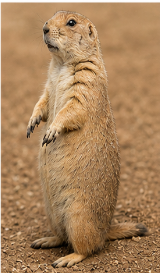
Prairie Dogs (Cynomys spp.) are highly social, burrowing rodents native to the grasslands and prairies of North America. Despite their name, they are not dogs; they are members of the squirrel family and are closely related to ground squirrels. Prairie Dogs are best known for their underground colonies, called towns, and their sharp barking alarm calls. They are ecologically important animals, but they can also become serious nuisance and agricultural pests when their colonies expand into rangeland, cropland, airports, parks, golf courses, or residential developments.
The conflict surrounding Prairie Dogs is complex. They are considered a keystone species because their burrows, grazing, and soil disturbance create habitat for many other animals. At the same time, their feeding and tunneling can reduce forage, damage fields, create livestock hazards, and interfere with urban infrastructure. Management often requires balancing landowner concerns with wildlife conservation.
Taxonomy and Classification
Prairie Dogs belong to the squirrel family, Sciuridae. They are placed in the genus Cynomys, which includes several species native to North America.
- Order: Rodentia
- Family: Sciuridae
- Genus: Cynomys
- Common Name: Prairie Dog
- Primary Habitat: Grasslands and prairies
The five recognized Prairie Dog species are the Black-tailed Prairie Dog (Cynomys ludovicianus), White-tailed Prairie Dog (Cynomys leucurus), Gunnison’s Prairie Dog (Cynomys gunnisoni), Utah Prairie Dog (Cynomys parvidens), and Mexican Prairie Dog (Cynomys mexicanus). The Black-tailed Prairie Dog is one of the most widespread and familiar species.
Physical Description
Prairie Dogs are medium-sized, stout-bodied rodents. Most adults measure about 12 to 16 inches long and weigh approximately 1.5 to 3 pounds, depending on species, age, sex, and seasonal condition.
- Length: About 12 to 16 inches
- Weight: About 1.5 to 3 pounds
- Fur: Yellowish-brown, tan, reddish, or buff-colored
- Body: Stout with short legs
- Tail: Short, often with a black or white tip depending on species
- Ears: Small and rounded
- Behavioral Sign: Upright posture and barking alarm calls
One of the easiest signs of Prairie Dog activity is the presence of large burrow mounds. These mounds often surround a central entrance hole and may be shaped like small volcanoes or raised rims of soil. The mounds help prevent flooding, improve ventilation, and serve as lookout posts.
Distribution and Habitat
Prairie Dogs are native to central and western North America. Their range includes grasslands, shortgrass prairie, mixed-grass prairie, open rangeland, and some semi-arid landscapes. They require open visibility for predator detection and soils suitable for digging.
Typical habitats include:
- Shortgrass prairies
- Mixed-grass rangelands
- Open plains
- Pastures
- Desert grasslands
- Grassland edges near agriculture
- Urban open spaces
- Airfields, parks, and golf courses
Prairie Dogs prefer areas with low vegetation because short plants allow them to see approaching predators. Their grazing helps maintain this short vegetation structure, which can further support colony expansion.
Burrows and Colony Structure
Prairie Dog colonies are called towns. A town may contain a few burrows or cover many acres. Within the town, Prairie Dogs live in smaller social groups known as coteries. A coterie typically includes one or more adult males, several adult females, and their young.
The burrow system is complex and may include:
- Entrance mounds
- Deep tunnels
- Nesting chambers
- Side passages
- Escape routes
- Ventilation openings
- Nursery areas
Burrows provide protection from predators, temperature extremes, fire, and harsh weather. They also shelter many other animals, including burrowing owls, snakes, insects, amphibians, and small mammals.
Behavior and Diet
Prairie Dogs are diurnal, meaning they are active during the day. They spend much of their time foraging, grooming, maintaining burrows, watching for predators, and communicating with colony members.
Their diet consists mainly of:
- Grasses
- Forbs
- Seeds
- Roots
- Leaves
- Flowers
- Occasional insects
- Agricultural crops near colonies
Prairie Dogs are famous for their alarm calls. When a predator approaches, one animal may stand upright and give a sharp bark or yip. Other colony members respond by retreating to burrows or becoming alert. Their vocalizations can communicate information about threats and help the colony survive.
Damage and Human Conflict
Conflict usually develops when Prairie Dog towns expand into areas used by livestock, crops, roads, lawns, sports fields, or urban development. Their grazing and burrowing can change vegetation structure and create safety hazards.
- Forage Competition: Prairie Dogs consume grasses and forbs also used by livestock.
- Crop Damage: Colonies near cultivated fields may feed on young plants or field edges.
- Burrow Hazards: Holes can injure horses, cattle, people, pets, or damage equipment.
- Erosion: Heavy soil disturbance may increase erosion on vulnerable sites.
- Infrastructure Issues: Burrows can undermine roads, levees, sidewalks, and landscaped areas.
- Urban Nuisance: Colonies in parks or open spaces may conflict with recreation or development.
While some landowners view Prairie Dogs as serious pests, ecologists often emphasize their value to grassland biodiversity. This difference in perspective is why Prairie Dog management can be controversial.
Disease Concerns
Prairie Dogs are highly susceptible to sylvatic plague, a disease caused by the bacterium Yersinia pestis. Plague can spread through flea bites and may rapidly kill large portions of a colony.
Although human plague cases are uncommon, people and pets should avoid handling Prairie Dogs or entering active colonies where sick or dead animals are present. Fleas associated with rodents can pose a disease risk. Dogs and cats should be kept away from active colonies, especially during die-offs.
Ecological Importance
Prairie Dogs are widely recognized as a keystone species in grassland ecosystems. Their burrows and grazing patterns support many other species and influence the structure of prairie habitats.
Animals associated with Prairie Dog towns may include:
- Burrowing owls
- Black-footed ferrets
- Ferruginous hawks
- Badgers
- Rattlesnakes
- Swift foxes
- Coyotes
- Ground beetles and other insects
The Black-footed Ferret, one of North America’s most endangered mammals, depends heavily on Prairie Dogs as prey and uses their burrows for shelter. This relationship makes Prairie Dog conservation important for broader grassland recovery efforts.
Management and Prevention
Prairie Dog management must consider local laws, species status, land use, disease concerns, and conservation priorities. Some species are protected or managed under special regulations, so landowners should check state and local rules before taking action.
| Management Strategy | Description | Purpose |
|---|---|---|
| Exclusion | Use buried barriers or fencing for small gardens or sensitive sites. | Prevents entry into limited areas. |
| Habitat Modification | Manage vegetation and reduce attractive open short-grass areas where appropriate. | Discourages colony expansion in selected locations. |
| Relocation | Live-trap and move animals where legal and feasible. | Reduces conflict while preserving animals. |
| Fumigation | Use regulated burrow fumigants in approved settings. | Reduces populations where serious damage occurs. |
| Plague Management | Dust burrows for fleas or use approved disease-control tools where appropriate. | Protects colonies and reduces flea-borne risk. |
Exclusion may work for small gardens, landscaped areas, or high-value sites, but it is usually impractical for large rangelands. Fences or barriers must be designed to prevent digging underneath, often requiring buried material.
Fumigation and lethal control are regulated and may not be legal or appropriate in all areas. Live trapping and relocation can also be difficult because suitable release sites, disease testing, permits, and colony compatibility must be considered.
Conservation and Research
Prairie Dogs are a major focus of grassland conservation research. Scientists study their communication, social behavior, grazing effects, burrow systems, disease ecology, and relationships with predators and dependent species.
Conservation programs often focus on maintaining viable Prairie Dog colonies while reducing conflict with agriculture and urban development. Strategies may include buffer zones, relocation, plague control, habitat planning, and public education.
Conclusion
Prairie Dogs are social burrowing rodents that play a powerful role in North American grassland ecosystems. Their towns provide habitat for many species and support predators such as the Black-footed Ferret, but their grazing and burrowing can also create conflict on farms, ranches, parks, and urban properties. Effective management requires balancing property protection, disease safety, legal requirements, and ecological value. Whether viewed as wildlife or pests, Prairie Dogs are among the most influential animals of the prairie landscape.