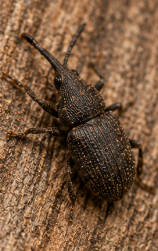
Pine Weevils is a broad term used for several snout beetles that feed on pine trees and other conifers. In the eastern United States, the name most often refers to the Pales Weevil (Hylobius pales), a serious pest of newly planted pine seedlings. Adult beetles chew the bark of young trees and may girdle the stems, interrupting the flow of nutrients and water until the seedlings weaken or die.
Pine Weevils are especially damaging in recently harvested pine stands. Freshly cut stumps, roots, and logging debris provide ideal breeding sites for the larvae. When new seedlings are planted too soon after a harvest, emerging adult weevils may move directly from the old stumps to the young trees, creating heavy losses across a reforestation site, Christmas tree plantation, or pine nursery.
Overview
The Pales Weevil is one of the most important insect pests associated with pine regeneration in the eastern United States. Its larvae usually develop inside the roots and root collars of recently cut, dying, or dead pine stumps. The larvae generally do not cause the most economically important injury. Instead, the greatest damage is caused by the adults when they feed on the bark of living seedlings and young saplings.
Seedlings less than one inch in stem diameter are particularly vulnerable. Adult feeding creates irregular patches of missing bark. When these wounds extend around most or all of the stem, the tree becomes girdled. Girdling destroys the tissues that transport sugars and other nutrients between the roots and the crown, often killing the seedling.
Damage is usually most severe where pine seedlings are planted immediately after a mature pine stand has been cut. The presence of fresh stumps supports large numbers of developing weevils, while the newly planted seedlings provide an abundant food source for emerging adults.
Taxonomy and Classification
Pine Weevils belong to the order Coleoptera, which includes all beetles, and the family Curculionidae, commonly known as the weevils or snout beetles. Members of this family are recognized by their elongated snouts, also called rostrums, and their chewing mouthparts.
- Order: Coleoptera
- Family: Curculionidae
- Genus: Hylobius
- Species: Hylobius pales
- Common Names: Pales Weevil and Pine Weevil
Pine Weevils undergo complete metamorphosis, developing through egg, larval, pupal, and adult stages. The Pales Weevil is closely related to the European Pine Weevil (Hylobius abietis), which causes similar damage to conifer seedlings in Europe.
Identification
Adult Pales Weevils are stout, hard-bodied beetles measuring approximately 1/3 to 1/2 inch long. Their dark coloration and mottled markings allow them to blend into bark, soil, and woody debris.
- Adult Color: Dark reddish-brown, brownish-black, or nearly black.
- Wing Covers: The hardened wing covers are marked with scattered patches of pale yellow, tan, or gray scales.
- Snout: Adults have a broad, curved snout that is shorter and thicker than the snout of many seed-feeding weevils.
- Antennae: The antennae are elbowed and arise from the snout.
- Larvae: The larvae are creamy white, legless, C-shaped grubs with brown head capsules.
- Pupae: Pupae are pale when first formed and develop inside protected chambers in stumps, roots, or nearby soil.
Adult Pine Weevils may remain motionless when disturbed and can be difficult to see against dark bark or forest litter. Their presence is often first recognized through feeding damage rather than direct observation of the beetles.
Distribution and Habitat
The Pales Weevil occurs throughout much of the eastern United States and into southeastern Canada. It is especially common in regions where pine forests are harvested and replanted on a regular basis.
Suitable habitat includes clear-cut pine stands, logging sites, recently thinned forests, Christmas tree plantations, pine nurseries, and reforestation areas. Freshly cut pine stumps are particularly attractive because they release odors that guide adult weevils to breeding sites.
Adults may also be found beneath bark, in soil, around stump roots, under logging debris, or near the bases of young pine trees. Although pines are the main hosts, adults may occasionally feed on other conifers when suitable pine seedlings are unavailable.
Life Cycle
Adult Pales Weevils become active during spring as temperatures rise. They are attracted to recently cut pine stumps and damaged roots by odors released from fresh resin and wood.
Females lay eggs in small cavities near the root collar, roots, or bark of recently cut or dying pine stumps. After hatching, the larvae tunnel beneath the bark and feed on the inner bark, phloem, cambium, and nearby woody tissues.
The larvae pass through several growth stages while remaining protected inside the stump or root system. When mature, they create pupal chambers in the wood or surrounding soil. Adults later emerge and begin feeding on nearby seedlings.
Depending on climate, food quality, and the time of egg laying, the life cycle may take one to two years. More than one group of adults may be active during a growing season, with activity often occurring in spring and again later in summer or fall.
Behavior and Feeding
Adult Pine Weevils feed primarily at night or during cool, damp periods. During the day, they may hide beneath litter, soil clods, bark, or vegetation near the base of seedlings.
The beetles chew irregular patches from the bark of stems, branches, and root collars. They often begin feeding close to ground level, but damage may occur higher on the stem or on lateral branches.
Fresh cutting activity strongly influences their movement. When a pine stand is harvested, resin odors attract adults from surrounding areas. The resulting concentration of weevils can create a high-risk environment for seedlings planted during the following months.
Damage and Problems
Pine Weevil damage can range from minor bark scarring to complete seedling mortality. Young trees may be attacked repeatedly by several adults, increasing the likelihood of girdling.
Bark Removal
Adult feeding produces irregular, rough-edged patches where bark has been removed. Fresh wounds may expose pale inner bark or wood and may release small amounts of resin.
Girdling
The most serious injury occurs when feeding wounds extend around the stem. Complete or nearly complete girdling interrupts nutrient movement and can kill the tree. Seedlings may wilt, turn yellow or reddish-brown, and die above the damaged area.
Seedling Mortality
Small seedlings are easily killed because they have thin bark and limited stored energy. In heavily infested plantations, large numbers of newly planted trees may die during the first growing season.
Deformation and Reduced Growth
Seedlings that survive may develop crooked stems, dead leaders, excessive branching, or reduced height growth. Such deformities can lower the quality of timber and Christmas trees.
Economic Loss
Losses include the cost of dead planting stock, labor for replanting, delayed stand establishment, uneven tree growth, and reduced future timber value. Christmas tree plantations may suffer additional losses when feeding damage affects tree shape or appearance.
Monitoring
Monitoring should begin before planting on sites where pines were recently harvested. Inspect stumps, seedlings, and nearby forest litter for adult weevils and signs of bark feeding.
- Examine the lower stems and root collars of seedlings.
- Look for irregular bark wounds, resin spots, or exposed inner wood.
- Inspect recently cut stumps for larval galleries.
- Check seedlings during spring and late summer when adults may be active.
- Visit the site at night or during cool, cloudy weather when adults are easier to find.
Small bait logs or freshly cut pine material may be used to detect adult activity in some forestry programs. Local forestry recommendations should be followed when formal monitoring thresholds are available.
Management and Control
Pine Weevil management is most effective when it reduces breeding habitat and protects seedlings during their most vulnerable stages. An integrated approach is usually more successful than relying on a single treatment.
Delayed Planting
Delaying replanting is one of the most effective cultural controls. New pine seedlings should not be planted immediately after the previous pine stand is harvested when Pales Weevils are a known problem.
Waiting at least one full growing season allows fresh stumps to dry and become less suitable for egg laying and larval development. The exact waiting period may vary with local climate, harvest timing, and pest pressure.
Site Preparation
Reducing fresh logging debris, exposed roots, and damaged pine material can make a site less attractive to adult weevils. Stump removal may reduce breeding sites, but it is often expensive and impractical over large areas.
Mechanical site preparation may also expose or damage developing larvae and pupae. However, operations should be planned carefully to avoid creating additional fresh pine material that attracts adults.
Seedling Protection
High-value seedlings may be protected with approved residual insecticides applied before or after planting. Some forestry operations treat the lower stem and root collar because these are the areas most likely to be attacked.
Only products labeled for use on conifer seedlings and Pine Weevils should be used. Applicators must follow all label directions concerning rates, protective equipment, environmental restrictions, and retreatment intervals.
Physical Barriers
Protective collars, sleeves, wax coatings, or mesh barriers may reduce feeding on individual seedlings. These methods are more practical for nurseries, small plantations, restoration projects, or valuable ornamental trees than for large commercial forests.
Barriers must fit securely without restricting stem growth. They should also be inspected regularly because soil movement, wildlife, and weather can create openings.
Biological Control
Predators, parasitic insects, entomopathogenic fungi, and beneficial nematodes may attack Pine Weevils or their immature stages. Because the larvae live inside stumps and roots, natural enemies may have difficulty reaching them.
Research continues into biological agents that can move through soil or penetrate breeding material. Maintaining a diverse forest ecosystem may also support predators that feed on adult beetles.
Prevention
Prevention begins with harvest and planting schedules. Avoid placing vulnerable seedlings into sites containing large amounts of fresh pine stump material. When planting cannot be delayed, use treated seedlings, physical protection, or increased monitoring.
Inspect nursery stock before planting and keep seedlings healthy through proper handling, planting depth, soil preparation, and moisture management. Stressed seedlings are less able to survive bark damage than healthy, actively growing trees.
Landowners should also avoid piling fresh pine logs, branches, or stumps near new plantings, as this material may attract adult weevils and provide breeding habitat.
Conservation and Research
Pine Weevils are major subjects of forestry research because of the economic damage they cause and the difficulty of controlling larvae hidden inside stumps. Researchers study insect behavior, stump attractiveness, seedling coatings, systemic insecticides, biological control organisms, and alternatives to broad insecticide applications.
Other research focuses on improving planting schedules and identifying tree varieties that tolerate or resist feeding. Scientists are also studying fungal pathogens and beneficial nematodes that may reduce larval survival in roots and stumps.
Conclusion
Pine Weevils, particularly the Pales Weevil (Hylobius pales), are destructive pests of newly planted pine seedlings. Their larvae develop in recently cut pine stumps, while the adults feed on living seedlings and may remove enough bark to girdle and kill young trees.
The risk is greatest when pine seedlings are planted immediately after a mature pine stand is harvested. Delayed planting, careful site preparation, monitoring, seedling protection, and reduction of fresh breeding material provide the best long-term management. Early recognition of bark feeding is essential because small seedlings may decline quickly once serious girdling occurs.