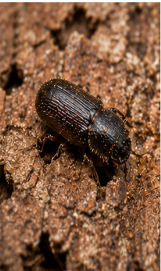
Pine Cone Beetles are small, cone-infesting bark beetles in the genus Conophthorus. Unlike destructive bark beetles that attack the trunks and branches of living pine trees, Pine Cone Beetles specialize in feeding and reproducing inside developing female pine cones. Their activity usually does not threaten the overall survival of a mature tree, but it can severely reduce the number and quality of viable seeds produced.
These beetles are especially important in pine seed orchards, nurseries, conservation plantings, and tree-breeding programs where high-quality seed production is essential. Heavy infestations can destroy a large percentage of the annual cone crop, making it more difficult and expensive to produce seedlings for commercial forestry, habitat restoration, windbreaks, and reforestation projects.
Overview
Pine Cone Beetles spend most of their life cycle concealed inside pine cones. Adult females bore through the cone scales and enter the central cone axis, where they feed and lay eggs. The resulting larvae tunnel through the cone’s internal tissues and consume or disrupt the developing seeds.
Infested cones often stop growing, turn brown, and fall from the tree prematurely. A small resin droplet or hardened pitch mass near the cone base may mark the original entry point. When damaged cones are opened, the interior may contain tunnels, frass, dead tissue, larvae, pupae, or adult beetles.
Although individual trees may survive without visible decline, repeated losses can be economically serious in seed-production areas. A seed orchard may contain selected trees with valuable genetic traits, so the destruction of even a limited number of cones can interfere with breeding and seed collection goals.
Taxonomy and Classification
Pine Cone Beetles belong to the order Coleoptera, which includes all beetles, and the family Curculionidae, the weevil family. They are placed in the subfamily Scolytinae, which includes bark beetles and ambrosia beetles.
- Order: Coleoptera
- Family: Curculionidae
- Subfamily: Scolytinae
- Genus: Conophthorus
- Common Name: Pine Cone Beetles
Members of Conophthorus are highly specialized. While many scolytine beetles tunnel beneath bark or into wood, Pine Cone Beetles are adapted to living within cones and feeding on their central tissues and developing seeds.
Different species are associated with different pine hosts. One example is the White Pine Cone Beetle (Conophthorus coniperda), which attacks the cones of eastern white pine. Other species infest cones of lodgepole pine, ponderosa pine, pinyon pine, and additional pine species.
Pine Cone Beetles undergo complete metamorphosis, developing through egg, larval, pupal, and adult stages.
Identification
Adult Pine Cone Beetles are very small, cylindrical insects that are generally less than 1/8 inch long. Their dark color and concealed habits make them difficult to find unless infested cones are opened.
- Adult Color: Dark brown, reddish-brown, or black.
- Body Shape: Cylindrical and compact, similar to other small bark beetles.
- Head: Partly hidden beneath the rounded section behind it when viewed from above.
- Larvae: Small, creamy white, legless grubs with brown head capsules.
- Pupae: Pale and soft-bodied when first formed, later darkening as the adult develops.
- Eggs: Tiny, white, and deposited inside galleries within the cone.
Because the beetles themselves are rarely seen, identification usually depends on symptoms found on the cones.
Signs of Infestation
The most useful signs of Pine Cone Beetle activity include premature cone browning, resin deposits, bore holes, and internal feeding damage.
- Entrance Hole: A small round hole may be visible near the base or side of a developing cone.
- Resin Mass: White, cream, or yellowish pitch may collect over the entrance hole.
- Premature Browning: An attacked cone may turn brown while surrounding healthy cones remain green.
- Frass: Fine boring dust and insect waste may be packed inside the cone.
- Internal Galleries: Tunnels may extend through the cone axis and seed-bearing tissues.
- Seed Destruction: Developing seeds may be eaten, crushed, dried, or rendered nonviable.
- Premature Cone Drop: Damaged cones frequently fall before normal maturity.
Infested cones may resemble cones damaged by squirrels, cone worms, seed bugs, fungal diseases, drought, or mechanical injury. Opening several affected cones is often necessary for accurate diagnosis.
Distribution and Habitat
Pine Cone Beetles occur throughout North America wherever their preferred pine hosts grow. Each species has a distribution linked closely to the natural or cultivated range of its host tree.
They may be found in natural forests, commercial seed orchards, Christmas tree plantations, nurseries, botanical collections, windbreaks, and reforestation sites. Their greatest economic importance occurs in locations where cones are collected specifically for seed.
The beetles live primarily in the tree canopy during cone attack. Larvae and pupae remain protected inside the cone, while adults may overwinter within cones, beneath cone scales, in bark crevices, in needle litter, or in the soil beneath host trees.
Host Trees
Pine Cone Beetle species attack various members of the genus Pinus. Important host groups may include:
- Eastern white pine
- Western white pine
- Ponderosa pine
- Lodgepole pine
- Red pine
- Jack pine
- Pinyon pines
- Other regional pine species
The exact host range depends on the beetle species. Accurate identification of both the pine and the beetle is important when evaluating potential seed losses.
Life Cycle
Most Pine Cone Beetles complete one generation per year, although development can vary with climate, elevation, host species, and cone availability.
Adults usually become active in spring as temperatures rise and female cones begin developing. Females locate suitable cones, often using plant odors released from actively growing cone tissue.
A female bores through the cone surface and creates a gallery in the central axis. She lays eggs along this tunnel. After hatching, the larvae feed within the cone, extending the gallery and damaging seed-bearing tissues.
Larval feeding may girdle the cone axis and interrupt the movement of water and nutrients. The cone then wilts, browns, or falls from the tree. Development often continues after the cone reaches the ground.
Mature larvae pupate within chambers in the damaged cone. New adults may remain inside for a period before emerging. Depending on the species, adults overwinter within old cones, forest litter, soil, or protected tree crevices.
Behavior and Feeding
Pine Cone Beetles are specialized internal feeders. Their life cycle is closely synchronized with the seasonal development of pine cones. Females must enter the cone while the tissues are suitable for larval development.
The female’s boring activity damages the cone even before the larvae hatch. Once larvae begin feeding, they tunnel through the central axis, scales, and seed tissues. One infested cone may support several developing beetles.
Adult flight is usually seasonal and may last only a few weeks. This narrow activity period is important for monitoring and treatment timing. Once the beetles enter the cones, they are difficult to reach with contact insecticides.
Damage and Problems
Pine Cone Beetles primarily affect seed production rather than tree health. Their economic importance depends on how much value is placed on the cone crop.
Seed Destruction
Larvae consume or damage developing seeds inside the cone. Surviving seeds may be smaller, malformed, or unable to germinate.
Premature Cone Drop
Infested cones frequently fall before they reach maturity. Fallen cones may continue to support larval and pupal development, allowing the beetles to complete their life cycle.
Reduced Seed Yield
A heavily infested orchard may produce far fewer usable seeds than expected. In severe outbreaks, losses can affect most of the available cone crop.
Reduced Genetic and Breeding Value
Seed orchards often contain trees selected for rapid growth, disease resistance, wood quality, or climate tolerance. Losing cones from these trees can delay breeding programs and reduce the supply of genetically improved planting stock.
Increased Production Costs
Growers may need to collect more cones, maintain additional seed trees, increase monitoring, or apply treatments to produce the required amount of viable seed.
Monitoring
Monitoring should begin before adult emergence and continue through early cone development. The exact timing varies among beetle species and regions.
- Inspect developing cones for resin droplets and entry holes.
- Look for cones that brown before surrounding cones.
- Collect fallen cones and open them to check for galleries or larvae.
- Record the percentage of cones showing damage.
- Use traps when species-specific attractants or monitoring systems are available.
- Compare damage among orchard blocks and individual seed trees.
Sampling should include cones from different heights and parts of the canopy when practical. Damage can be unevenly distributed among trees.
Management and Control
Management focuses on protecting valuable cones and reducing the number of beetles that survive to infest future crops. An integrated approach is more practical than relying on a single method.
Sanitation
Collecting and destroying fallen infested cones is one of the most useful cultural practices. Cones should be gathered before adult beetles emerge.
- Collect prematurely dropped cones throughout summer.
- Remove visibly browned or resin-covered cones when practical.
- Destroy infested cones by chipping, burning where permitted, or securely disposing of them.
- Do not leave collected cones in piles near seed trees.
Sanitation is most practical in seed orchards, nurseries, and small high-value plantings. It is usually impossible to collect enough cones to suppress beetles across large natural forests.
Pheromone and Attractant Trapping
Traps may be used to detect seasonal adult activity and help determine when beetles begin moving into cones. The availability and effectiveness of attractants vary by species.
Monitoring traps are generally more useful for timing management than for eliminating the population. Trap information should be combined with direct cone inspection.
Chemical Protection
In high-value seed orchards, insecticides may be used to protect developing cones during adult flight. Applications must be timed before or during the period when females enter the cones.
Once adults and larvae are concealed inside, ordinary contact sprays may provide little benefit. Complete canopy coverage can also be difficult on large pine trees.
Some systemic products may move into cone tissues after trunk injection or soil application. However, treatment suitability depends on the product label, tree species, environmental conditions, and local regulations.
Systemic insecticides must be used carefully because they may affect non-target insects or move into surrounding soil and water. Professional application is often appropriate in commercial seed orchards.
Biological Control
Natural enemies may include parasitic wasps, predatory beetles, birds, and microbial pathogens. However, the cone provides substantial protection for eggs and larvae, limiting the ability of some predators and parasitoids to reach them.
Conserving natural enemies can still contribute to population suppression. Unnecessary broad-spectrum insecticide applications should be avoided when possible.
Cone and Orchard Management
Maintaining vigorous, properly spaced trees can improve cone production and make monitoring easier. Pruning and canopy management may improve access to cones in seed orchards, although such practices must be balanced against tree health and seed yield.
Where feasible, growers may spread risk by maintaining several seed-production blocks or collecting from multiple trees rather than depending on a small number of heavily infested specimens.
Prevention
Prevention begins with routine inspection of cone crops and rapid removal of damaged cones. Seed orchard managers should keep records of adult flight, cone development, infestation levels, and seed yield.
Fallen cones from infested sites should not be transported into uninfested nurseries, seed orchards, or storage areas. Equipment and collection containers should be cleaned if they contain cone fragments or beetles.
Because adults may survive in old cones or litter, maintaining sanitation beneath valuable seed trees can reduce local breeding sites. However, prevention rarely eliminates the pest entirely where native host pines are abundant nearby.
Conservation and Research
Pine Cone Beetles are important research subjects in forestry and seed production. Scientists study their host preferences, chemical communication, seasonal flight patterns, natural enemies, and responses to changing climate conditions.
Research also focuses on improved pheromone lures, more precise treatment timing, less hazardous systemic products, and biological controls capable of reaching larvae inside cones.
Another important goal is improving seed orchard design so valuable cone crops are less vulnerable to concentrated beetle activity. Better monitoring and predictive models may allow managers to intervene only when economic damage is likely.
Conclusion
Pine Cone Beetles in the genus Conophthorus are specialized pests of developing pine cones. Adult females bore into the cone axis and lay eggs, while the larvae feed internally on cone tissue and developing seeds. Infested cones often brown and fall prematurely, leaving little or no viable seed.
Although these beetles rarely kill mature trees, they can cause serious losses in pine seed orchards, nurseries, and tree-breeding programs. Monitoring, collection and destruction of fallen cones, precise treatment timing, and protection of high-value seed trees provide the most effective management. Early detection is essential because beetles become difficult to control once they are concealed inside the cone.