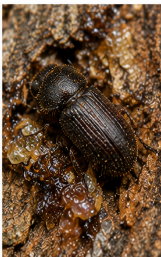
Pine Bark Beetles are a group of small, destructive beetles that attack pine trees by tunneling beneath the bark and feeding on the living inner tissues. The name commonly includes several species in the genera Dendroctonus and Ips, including the Southern Pine Beetle (Dendroctonus frontalis), the Mountain Pine Beetle (Dendroctonus ponderosae), and various Engraver Beetles (Ips spp.).
These beetles are among the most important insect threats to pine forests, plantations, windbreaks, and landscape trees. During outbreaks, they can kill large numbers of pines across extensive areas. Their feeding galleries interrupt the movement of nutrients through the phloem, while fungi carried by the beetles may block water movement within the tree. Together, these effects can girdle and kill the host within weeks or months.
Overview
Pine Bark Beetles are naturally occurring members of forest ecosystems. At low population levels, many species help remove weakened, injured, or dying trees and contribute to nutrient cycling. Problems develop when beetle populations increase enough to attack healthy or only mildly stressed trees.
Some species, particularly those in the genus Dendroctonus, are capable of launching coordinated mass attacks. A single beetle begins boring through the bark and releases chemical signals called aggregation pheromones. These pheromones attract additional beetles, which arrive in large numbers and overwhelm the tree’s defensive resin system.
Other species, such as many Ips Engraver Beetles, more commonly attack drought-stressed trees, storm-damaged pines, logging debris, recently cut material, or trees weakened by construction injury. However, when populations build in abundant breeding material, they may also attack standing trees.
Taxonomy and Classification
Pine Bark Beetles belong to the order Coleoptera, which includes all beetles, and the family Curculionidae, the weevil family. They are classified in the subfamily Scolytinae, which includes bark beetles and ambrosia beetles.
- Order: Coleoptera
- Family: Curculionidae
- Subfamily: Scolytinae
- Important Genera: Dendroctonus and Ips
- Primary Hosts: Pine trees in the genus Pinus
Pine Bark Beetles undergo complete metamorphosis, developing through egg, larval, pupal, and adult stages. Nearly all immature development takes place beneath the bark, where the insects are protected from weather, predators, and many surface treatments.
Important Species
Several Pine Bark Beetle species are especially important in North American forests and landscapes.
- Southern Pine Beetle: A highly aggressive species that attacks several southern pine species and can produce rapidly expanding infestation spots.
- Mountain Pine Beetle: A major pest of lodgepole, ponderosa, limber, whitebark, and other western pines.
- Western Pine Beetle: Primarily attacks ponderosa pine in western North America.
- Red Turpentine Beetle: Often attacks the lower trunks of stressed, injured, or recently disturbed pines.
- Engraver Beetles: Species in the genus Ips that frequently breed in weakened trees, cut logs, slash, branches, and storm-damaged material.
The beetle species involved affects the gallery pattern, preferred host, attack location, seasonal activity, and recommended management strategy.
Identification
Adult Pine Bark Beetles are small, cylindrical insects that generally measure about 1/8 to 1/4 inch long. Some species are even smaller. Their dark color and hidden behavior make them difficult to see unless bark is removed or adults are captured in traps.
- Adult Color: Reddish-brown, dark brown, or black.
- Body Shape: Cylindrical, compact, and adapted for moving through narrow galleries.
- Head: Often partly hidden beneath the rounded section behind it when viewed from above.
- Larvae: Small, white, legless, C-shaped grubs with brown head capsules.
- Pupae: Pale and soft-bodied, located in chambers under the bark.
- Eggs: Tiny, white, and laid along parent galleries.
Because adults and larvae remain concealed, identification is usually based on pitch tubes, boring dust, gallery shape, crown color, and the location of attacks on the tree.
Signs of Infestation
Early detection can be difficult because visible crown symptoms may not appear until the tree is already heavily colonized. Important signs include:
- Pitch Tubes: Small masses of resin on the trunk where beetles entered. They may be white, cream, yellow, pink, or reddish.
- Boring Dust: Fine reddish-brown or tan frass accumulating in bark crevices, spider webs, or around the tree base.
- Entry Holes: Tiny round holes in the bark.
- Gallery Patterns: Tunnels etched into the inner bark and outer sapwood.
- Blue-Stained Wood: Gray-blue or dark staining in the sapwood caused by associated fungi.
- Crown Discoloration: Needles may fade from green to yellow, then red-brown.
- Bark Flaking: Woodpeckers may remove bark while searching for beetle larvae.
Pitch tubes are not always present. Severely drought-stressed trees may produce little resin, allowing beetles to enter with only fine boring dust marking the attack.
Gallery Patterns
The shape of the tunnels beneath the bark can help distinguish different beetle groups.
Dendroctonus Galleries
Species in the genus Dendroctonus often create long, winding, vertical, curved, or serpentine parent galleries. Eggs are laid along the sides, and larval galleries extend outward through the phloem.
Ips Galleries
Ips Engraver Beetles commonly produce gallery systems shaped like the letters Y, H, or I. Several parent galleries may radiate from a central mating chamber. Larval tunnels branch outward from these main galleries.
Gallery appearance varies among species and may be distorted when many beetles occupy the same tree.
Distribution and Habitat
Pine Bark Beetles occur throughout pine-growing regions of North America, Europe, Asia, and other parts of the Northern Hemisphere. Each species has a geographic range associated with particular pine hosts and climate conditions.
Their habitat is primarily the inner bark, cambium, and outer sapwood of pine trees. Adults may attack standing trees, fallen trunks, cut logs, branches, slash, stumps, or storm-damaged material.
Outbreaks are commonly associated with:
- Extended drought
- Unusually warm winters
- High stand density
- Wildfire or storm injury
- Root damage and soil compaction
- Logging debris and fresh slash
- Construction disturbance
- Other insects or tree diseases
Stressed trees often produce less resin and are less able to force invading beetles back out of the bark.
Life Cycle
The life cycle begins when adult beetles leave their developmental host and fly in search of suitable pine material. Flight periods vary by species, elevation, latitude, and temperature.
An attacking adult chews through the outer bark and reaches the phloem. Depending on the species, the male or female creates the first gallery and releases aggregation pheromones that attract additional beetles.
After mating, females lay eggs along the sides of the parent gallery. The eggs hatch into small larvae that feed outward through the phloem. Their feeding gradually cuts across the tree’s nutrient-conducting tissues.
Mature larvae create pupal chambers. After pupation, new adults may feed briefly beneath the bark before chewing exit holes and flying to another host.
Some species complete one generation per year, while others produce several generations in warm regions. Development may take only a few weeks during favorable weather, allowing populations to increase rapidly.
Mass Attack Behavior
Healthy pines can defend themselves by releasing resin into beetle entry holes. The sticky resin may trap, repel, or push out individual attackers.
Pine Bark Beetles overcome this defense through mass attack. Aggregation pheromones attract hundreds or thousands of beetles to the same tree. As attacks multiply, the tree’s resin reserves become depleted and its defenses collapse.
Once a tree is fully occupied, some beetles produce anti-aggregation chemicals that discourage further arrivals and direct them toward nearby trees. This behavior helps infestations spread through a stand.
Blue-Stain Fungi
Many Pine Bark Beetles carry spores of blue-stain fungi on or within their bodies. When the beetles enter a tree, the fungi colonize the sapwood.
The fungi may help weaken the tree by interfering with water transport. They can also alter the chemical environment beneath the bark in ways that benefit beetle development.
Blue-stained wood may remain structurally usable, but the discoloration can reduce lumber value. Fungal colonization is also one reason an successfully attacked tree may continue dying even after insecticide treatment.
Damage and Ecological Impact
Tree Girdling
Adult and larval galleries interrupt the phloem around the trunk. When enough tissue is destroyed, the tree is effectively girdled and can no longer move sugars from the crown to the roots.
Water Transport Failure
Blue-stain fungi and tree defensive reactions may reduce water movement through the sapwood. The crown then dries, fades, and eventually dies.
Forest Mortality
During outbreaks, beetles may kill groups of trees or spread across entire landscapes. Mortality may begin in small patches and expand outward as new adults attack surrounding pines.
Economic Loss
Losses include timber mortality, reduced lumber value, hazard-tree removal, replanting, property damage, and disruption of recreation or tourism. High-value ornamental pines may also require costly preventive treatments.
Wildfire Effects
Dead needles and branches can temporarily increase flammable material in the canopy. Over time, falling branches and trunks add woody fuels to the forest floor. The relationship between beetle mortality and wildfire behavior varies with time since attack, weather, forest structure, and fuel conditions.
Ecological Change
Bark beetle outbreaks create standing dead trees, fallen wood, canopy openings, and new habitat. These changes can benefit cavity-nesting birds, decomposers, fungi, and young vegetation. However, extensive outbreaks may also alter watershed function, wildlife habitat, and long-term forest composition.
Monitoring and Inspection
Monitoring should focus on high-risk periods and stressed pine stands. Trees should be inspected from the ground to as high on the trunk as practical.
- Look for fresh pitch tubes and boring dust.
- Check bark crevices and the tree base for frass.
- Inspect crowns for fading or red-brown needles.
- Remove a small bark section only when necessary to confirm galleries.
- Examine nearby cut pine material and storm debris.
- Use pheromone traps as part of professional monitoring programs.
Pheromone traps can confirm adult activity but may attract beetles into an area if used improperly. They should not be placed directly beside valuable trees unless recommended by a forestry professional.
Management and Control
Pine Bark Beetle management depends on whether the goal is protecting individual landscape trees, slowing a local infestation, or managing forest-wide risk. Trees that have been successfully colonized usually cannot be saved.
Sanitation
Sanitation removal involves cutting and treating infested trees before the next generation emerges. This can reduce the number of beetles available to attack nearby pines.
Infested material may be:
- Chipped
- Debarked
- Burned where legally permitted
- Processed into lumber
- Covered or solarized under approved conditions
- Removed to an appropriate disposal or processing site
Simply cutting a tree and leaving the trunk nearby may allow beetles to complete development and emerge.
Slash Management
Fresh pine branches, tops, and logs can provide breeding material for Ips and other bark beetles. Slash should be chipped, scattered to dry rapidly, removed, burned where allowed, or otherwise treated before beetles complete development.
Stand Thinning
Overcrowded pine stands compete for water and nutrients. Proper thinning can improve tree vigor and reduce susceptibility to some beetle species.
Thinning must be timed carefully because fresh cutting debris may attract beetles. Logging residue should be managed promptly, especially during active flight periods.
Water and Tree Health
Landscape pines should receive appropriate irrigation during drought, particularly where roots are restricted by pavement or construction. Avoid overwatering, trunk injury, root cutting, soil compaction, and excessive mulch against the bark.
Watering cannot save a heavily colonized tree, but maintaining vigor can improve resistance before attack.
Preventive Bark Sprays
High-value pines may be protected with preventive insecticide sprays applied to the bark before beetle flight. The entire susceptible trunk surface must be treated according to the product label.
These treatments are preventive, not curative. Applying them after the crown fades or extensive galleries develop will not reverse the attack.
Systemic Treatments
Systemic insecticides have produced inconsistent results against many aggressive Pine Bark Beetles. Beetles enter directly through the bark, and mass attacks may occur too rapidly for internal concentrations to provide reliable protection.
Product selection should be based on the target beetle, host tree, current research, and local regulations. Professional consultation is strongly recommended.
Pheromone Manipulation
Aggregation pheromones are used in traps to monitor beetle flights and locate active populations. Repellent or anti-aggregation compounds, including verbenone, may be used to discourage some species from attacking treated areas.
Results vary by beetle species, population pressure, stand conditions, product formulation, and deployment density. Repellents are not substitutes for sanitation or tree-health management during severe outbreaks.
Prevention
Prevention is the most effective approach because successfully infested trees are usually beyond recovery.
- Maintain appropriate tree spacing.
- Reduce drought stress when irrigation is practical.
- Avoid damaging trunks and roots.
- Manage fresh pine slash and storm debris quickly.
- Remove infested trees before adult emergence.
- Use preventive bark treatments only when risk justifies them.
- Avoid transporting untreated infested firewood.
Firewood movement can spread bark beetles and associated organisms to new locations. Pine wood should be obtained and used locally whenever possible.
Conservation and Research
Pine Bark Beetles are major subjects of forestry, entomology, and climate research. Scientists study outbreak forecasting, pheromone communication, fungal partnerships, tree resistance, drought effects, forest density, and landscape-level management.
Research also examines how warmer temperatures affect overwintering survival and generation time. In some regions, mild winters may allow more beetles to survive, while drought reduces the ability of trees to defend themselves.
Other work focuses on breeding or selecting pines with stronger resin defenses, improving remote sensing of outbreaks, and developing more effective anti-aggregation treatments.
Conclusion
Pine Bark Beetles are small but highly destructive pests that attack the inner bark of pine trees. Important groups include Dendroctonus species such as the Southern Pine Beetle and Mountain Pine Beetle, along with Ips Engraver Beetles.
The beetles kill trees through mass attack, phloem feeding, girdling, and the introduction of blue-stain fungi. Warning signs include pitch tubes, reddish boring dust, internal galleries, crown discoloration, and blue-stained sapwood.
Management relies on prevention, sanitation, rapid treatment of infested wood, slash removal, stand thinning, tree-health care, preventive bark sprays, and carefully planned pheromone strategies. Once a tree has been fully colonized, removal and destruction of the breeding material are usually more effective than attempting to save it.