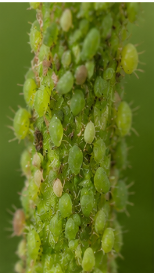
Piercing-sucking insects are insects that feed by inserting specialized, needle-like mouthparts into plants or animals to remove fluids. In pest control and agriculture, the term is most often used for plant-feeding insects that suck sap from leaves, stems, flowers, fruit, roots, or developing shoots. This group includes many of the most damaging pests in gardens, farms, greenhouses, orchards, turf, and landscapes.
The name describes how these insects feed rather than one single scientific group. Their mouthparts act like tiny syringes. They pierce the surface of a host and withdraw sap, plant juices, or blood, depending on the species. In plants, this feeding can cause yellowing, wilting, curled leaves, stunted growth, fruit deformities, sticky honeydew, sooty mold, and disease transmission.
Overview
Piercing-sucking insects are especially important because they often cause damage without chewing visible holes in leaves. A plant may look weak, yellow, curled, sticky, or distorted even when no obvious chewing injury is present. These pests can be difficult to notice early because many are tiny, soft-bodied, or hidden on the undersides of leaves.
Major examples include aphids, whiteflies, scale insects, mealybugs, leafhoppers, psyllids, stink bugs, plant bugs, cicadas, and thrips. Many belong to the order Hemiptera, commonly known as true bugs. Thrips belong to the order Thysanoptera, but they are often discussed with piercing-sucking pests because of their rasping and sucking feeding style.
Taxonomy and Classification
Piercing-sucking insects are a functional group rather than a formal taxonomic category. Most important species belong to the order Hemiptera, family groups within that order, or related pest groups with similar feeding habits.
- Aphids: Small, soft-bodied insects in the family Aphididae. They reproduce rapidly and are major vectors of plant viruses.
- Whiteflies: Tiny, moth-like insects in the family Aleyrodidae. They gather on leaf undersides and can transmit serious plant diseases.
- Scale Insects and Mealybugs: Sap-feeding insects often covered in wax, cottony material, or hard protective shells.
- Leafhoppers, Planthoppers, Cicadas, and Psyllids: Mobile sap-feeders that may transmit bacteria, phytoplasmas, or viruses.
- Stink Bugs and Plant Bugs: Larger true bugs that pierce fruit, seeds, stems, and developing plant tissue.
- Thrips: Slender insects that scrape and suck plant cells, often causing silvery scarring and flower distortion.
Physical Description
The shared feature of this group is the presence of specialized feeding mouthparts. In true bugs, the mouthpart is usually called a proboscis or rostrum. Inside this structure are thin stylets that pierce the host tissue.
These stylets allow the insect to inject saliva and withdraw fluids. Some species feed from the phloem, the sugary sap-moving tissue of plants. Others feed from the xylem, which carries water and minerals. Some pierce individual plant cells, seeds, flowers, fruit, or animal tissue.
- Phloem feeders: Aphids, whiteflies, soft scales, and mealybugs often cause yellowing, curling, sticky honeydew, and sooty mold.
- Xylem feeders: Leafhoppers, sharpshooters, and cicadas may cause scorch, dieback, and disease spread.
- Tissue feeders: Stink bugs, plant bugs, and thrips may cause spotting, scarring, catfacing, fruit dimpling, or flower distortion.
Distribution and Habitat
Piercing-sucking insects are found worldwide. They occur in home gardens, vegetable fields, orchards, greenhouses, turfgrass, forests, ornamental landscapes, wetlands, and indoor plant collections. Because plant sap is available in nearly every terrestrial habitat, these insects have adapted to many different host plants and climates.
Some species feed on a wide range of plants, while others are highly host-specific. Aphids may attack vegetables, herbs, fruit trees, ornamentals, weeds, and greenhouse crops. Whiteflies are common on tomatoes, peppers, cucurbits, poinsettias, hibiscus, and many ornamentals. Scale insects and mealybugs are frequent pests of citrus, houseplants, palms, shrubs, and landscape trees.
Behavior and Life Cycle
Many piercing-sucking insects develop quickly when temperatures are warm and food is available. Aphids can reproduce without mating for much of the season, allowing populations to explode in a short time. Whiteflies lay eggs on leaf undersides, where immature stages remain attached and feed. Scale insects may spend much of their lives fixed in one place, protected by wax or armor.
Most true bugs undergo incomplete metamorphosis. Their young, called nymphs, resemble smaller versions of adults and become more mature through a series of molts. Thrips also develop through egg, larval, pupal-like, and adult stages, though their life cycle differs from true bugs.
Damage and Problems
The damage caused by piercing-sucking insects depends on the species, host plant, feeding location, and population size. Even small numbers can matter when the pest is a disease vector.
- Yellowing and Stunting: Sap removal weakens plants and can slow growth.
- Leaf Curling: Feeding on tender new growth may cause leaves to twist, curl, cup, or deform.
- Honeydew and Sooty Mold: Aphids, whiteflies, scales, and mealybugs excrete sticky honeydew that supports black sooty mold growth.
- Fruit and Seed Damage: Stink bugs and plant bugs can cause sunken spots, corky areas, dimpling, and catfacing on fruit.
- Flower Damage: Thrips can scar petals, deform buds, and reduce ornamental value.
- Disease Transmission: Many species spread viruses, bacteria, and phytoplasmas from plant to plant.
Disease Transmission
The most serious impact of piercing-sucking insects is their ability to spread plant pathogens. When an insect probes or feeds on an infected plant, pathogens may attach to the mouthparts, enter the insect’s body, or multiply inside the insect. The pest can then move to a healthy plant and transmit the disease while feeding.
Examples include citrus greening spread by psyllids, tomato yellow leaf curl virus spread by whiteflies, and many mosaic and wilt diseases spread by aphids, leafhoppers, or thrips. Once a plant is infected with many of these diseases, curing it is often impossible. Prevention and early pest management are therefore critical.
Management and Control
Managing piercing-sucking insects requires regular inspection and a balanced integrated pest management approach. Because many species reproduce quickly, early detection is much easier than trying to control a heavy infestation.
Monitoring
- Inspect the undersides of leaves, new shoots, buds, and stems.
- Use yellow sticky traps to monitor whiteflies, aphids, fungus gnats, and leafhoppers.
- Use blue sticky traps where thrips are a concern.
- Look for honeydew, sooty mold, cast skins, curled leaves, and ants tending aphids or scales.
Cultural Control
- Remove heavily infested leaves or plant tips when practical.
- Control weeds that may serve as alternate hosts.
- Avoid over-fertilizing with nitrogen, which can encourage tender growth attractive to aphids and whiteflies.
- Keep plants healthy with proper watering, spacing, and airflow.
Biological Control
Natural enemies are extremely important for keeping piercing-sucking pests under control. Lady beetles, lacewings, hover fly larvae, minute pirate bugs, predatory mites, and parasitic wasps attack many soft-bodied pests. Broad-spectrum insecticides can disrupt these beneficial insects and sometimes lead to pest outbreaks.
Exclusion
Row covers, insect netting, greenhouse screens, and reflective mulches can reduce pest entry and feeding. These methods are especially helpful for high-value crops, young vegetable plants, and disease-sensitive crops.
Chemical Control
Insecticidal soaps and horticultural oils can help suppress aphids, whiteflies, mites, scales, and mealybugs when coverage is thorough. Systemic insecticides may be used in some situations because they move within plant tissues and target sap-feeding pests. However, systemic products must be used carefully, especially around flowering plants, pollinators, edible crops, and waterways.
Prevention
Prevention begins with plant inspection. Check new transplants, houseplants, nursery stock, and greenhouse plants before placing them near healthy plants. Remove weeds, reduce plant stress, encourage beneficial insects, and avoid repeated use of broad-spectrum sprays. In gardens, rotate crops and separate vulnerable plants from known pest hot spots when possible.
Conclusion
Piercing-sucking insects are one of the most important pest groups in agriculture, gardening, greenhouse production, and landscape care. Their damage may appear as yellowing, curling, sticky residue, fruit deformity, or plant decline rather than chewing holes. Because many species also spread serious plant diseases, early detection and integrated management are essential. Monitoring, sanitation, biological control, exclusion, and careful pesticide use provide the best long-term protection.